

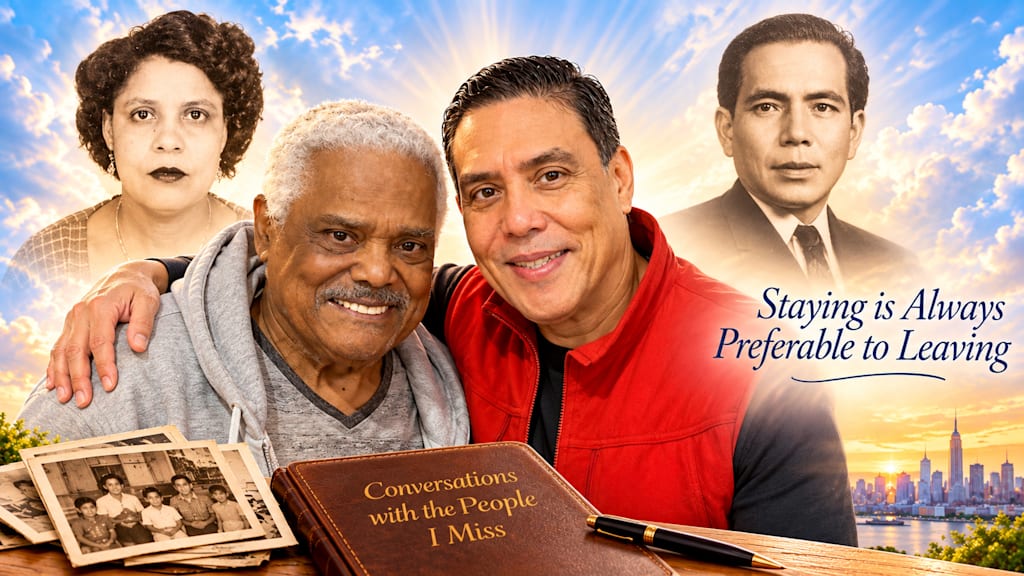
At 69, Anthony had begun to measure time differently.
When he was young, time had seemed almost unlimited. There would always be another birthday, another holiday dinner, another chance to call his brother, another chance to ask his mother a question, and another day to tell his father something he had never had the chance to say.
But time had a way of changing its appearance as a person grew older. At 20, a year seemed an eternity. At 40, it passed quickly. By 69, I sometimes wondered how so many years could have slipped by while I was busy living them.
He hadn't forgotten the conversation with his father that happened in a dream when he was ten. His father, who had died of a brain aneurysm, had appeared to him one night and explained that people did not always get to choose when their time on earth ended. Before leaving, his father gave Anthony a message he would carry for the rest of his life.
“Staying is always preferable to leaving.”
For decades, Anthony had understood those words as a declaration of life's value. He had read them as a reminder to persevere through disappointment, overcome adversity, and appreciate the privilege of waking each morning.
He had become a man who valued life deeply. But now, at 69, the words had acquired a second meaning.
Staying was preferable, yes, but nobody stayed forever.
His father had not stayed, and neither had his mother, who had lived into her nineties. His older brother, who had reached the remarkable age of 89, had also passed away. Aunts, uncles, cousins, and other relatives who had once filled his world with voices, laughter, advice, and occasional disagreements had gradually faded from his daily life.
Anthony was not eager to join them. He had no intention of surrendering the years he had left. He still had people to love, stories to write, places to visit, and experiences he hoped to enjoy. Yet he had begun asking himself a question he had avoided for much of his adult life.
What would happen when his own time came?
He did not expect a precise answer. He had spent enough years studying economics to understand the difference between a forecast and certainty. Death was one of those subjects for which no living person could provide a verified timetable, and Anthony was not about to pretend otherwise.
What he could do, however, was reconsider his relationship with those who had already left. He began to realize that his deceased relatives were not as distant from him as he had imagined.
They appeared in his thoughts as he walked, in his dreams as he slept, and in recollections that surfaced unexpectedly when he faced a difficult decision. He could not prove that he was communicating with them in any literal sense. Perhaps these conversations were his mind's way of keeping the people he loved close.
But their impact was real. And that was enough for him. His brother was the first to return regularly.
Anthony had always regarded his older brother as more than a sibling. The man he lovingly called “Tata” had been a companion, a source of reassurance, and someone he could share the ordinary details of a day with, without having to explain why they mattered.
They had developed routines that seemed unremarkable as they unfolded. They spoke on the telephone every single day! They walked together when he was a young boy. They discussed family matters, exchanged observations about the world, and sometimes talked about nothing at all.
Only after his brother died at 89 did Anthony realize how precious those ordinary encounters had been.
One evening, several years after the funeral, Anthony was struggling with a decision about a family matter. He spent hours reviewing the alternatives, weighing the consequences, and trying to decide which course of action would cause the least disappointment.
The more he thought, the less certain he grew. He finally sat in his favorite chair and closed his eyes.
Almost immediately, he remembered his brother's familiar expression whenever Anthony made a problem more complicated than it needed to be. In his mind, his brother sat across from him, wearing the same look of amused patience he had worn so often in their conversations.
“You're doing it again,” Anthony imagined him saying.
“Doing what?” Anthony asked silently.
“Trying to solve tomorrow's problems before you've finished dealing with today's.”
Anthony smiled.
It sounded exactly like something his brother would have said.
He remembered how his brother had approached difficult situations throughout his life. He wasn't necessarily the one who gave the most elaborate explanation. He was often the one who reminded everyone what truly mattered.
Family first. Be fair. Don't confuse being right with doing the right thing. When a decision must be made, make it with the information you have, not the information you wish you had.
Anthony had heard variations of that advice many times, though he had not always followed it. Now, sitting alone, he reconsidered the problem. He separated what he knew from what he feared, distinguished genuine obligations from imagined expectations, and reached a decision that seemed both reasonable and compassionate.
His brother had not delivered a new message from beyond the grave. Anthony knew that. But the wisdom his brother had accumulated over 89 years remained available to him.
The conversation had never really ended. His mother returned to him differently.
Anthony remembered her hands, always busy with something. She had worked hard throughout her life, often taking jobs that demanded more physical effort than they deserved recognition. She had not enjoyed the luxury of solving every problem through careful deliberation. Many days, the problem was getting through the day and making sure the family had what it needed.
She had received little formal education, but she understood things no classroom could teach.
Sitting by the window, he remembered his mother telling him that a disappointing day need not be a disappointing life. He could almost hear her voice.
“You think too much about what didn't happen,” she seemed to say. “What about all that did?”
The recollection brought him back to the years when money had been scarce and uncertainty had been a constant companion. His mother hadn't spent her days comparing her circumstances with those of people who had more. She had focused on what she could do with what she had.
Anthony looked around his apartment. He thought about the education he had received, the career he had built, the people who had trusted him, and the family members who had shared their lives with him.
For decades, he had chased one accomplishment after another, sometimes forgetting to appreciate what he had already achieved. His mother had never needed a lecture about gratitude.
She had practiced it.
He could almost hear his mother approving. Not because he had won, but because he had continued.
His father was more difficult to approach.
Anthony had known him for only a brief part of his childhood. His father had worked hard, including long hours as a waiter, and had left behind a boy far too young to understand why a parent could disappear so suddenly.
For years, Anthony carried questions without satisfactory answers. As a child, he had wondered whether he had somehow contributed to his father's death. Over time, he had come to understand that a child's behavior could not have caused the catastrophe that took his father's life.
But the emotional residue of losing a parent so young had never fully disappeared. At 69, Anthony sometimes wondered what his father would think of the man he had become.
Would he be proud? Would he recognize the boy who had once asked him so many questions? Would he understand why his son had spent a lifetime trying to make complex subjects understandable to ordinary people?
One night, Anthony dreamed that his father stood beside a printing press, as he had appeared in the original dream from Anthony's childhood.
The machines were quiet. Newspapers were stacked nearby.
His father looked older than Anthony remembered, though Anthony knew that memory could not determine what his father might have looked like if he had lived longer.
“Dad,” Anthony asked, “do you remember telling me that staying is always preferable to leaving?” His father smiled.
“I remember what I wanted you to understand.” “What was that?”
“That your life was worth living. I didn't want you to spend your days wishing you had been somewhere else, living someone else's life, or waiting for some future moment before you allowed yourself to be happy.”
Anthony considered those words. “Then why am I thinking so much about leaving now?”
His father looked at him with the tenderness Anthony had searched for during the years after his death.
“Because you are older and understand that life has an ending. But knowing that something ends doesn't mean you must spend the time before it ends afraid.”
Anthony wanted to ask what happened after death. He wanted to know whether his father had found peace, whether their family was somehow reunited, and whether there would be another conversation after Anthony's life ended.
But his father did not provide answers that the living could verify.
Instead, he asked a question.
“What do you want to do with the time you have left?”
Anthony woke before he could respond.
For several minutes, he remained still, listening to the familiar sounds of the city outside his window.
Then he understood that the question mattered more than the answer he had hoped to receive.
He could spend his remaining years trying to solve the mystery of death, or he could use them to live more thoughtfully.
He chose the latter.
In the months that followed, Anthony began to realize that many of his relatives had left him something more lasting than photographs and family stories.
His favorite aunt had taught him that kindness often mattered more than status. An uncle had shown him that a person could endure disappointment without becoming bitter. A cousin had shown him that humor could restore perspective when circumstances seemed unbearable.
Each memory became a small piece of a much larger inheritance.
Anthony began keeping a notebook, which he called Conversations with the People I Miss.
Whenever he faced a difficult decision, he wrote down the problem and asked himself what he remembered about the relatives who might have helped him think it through.
He did not pretend the answers were supernatural revelations. He understood that memory was selective and that people sometimes remembered their loved ones more generously after death than they had during life.
Still, the exercise helped him distinguish the qualities he wanted to carry forward. His brother reminded him to simplify while his mother reminded him to be grateful.
His father reminded him to value the life he had been given.
Other relatives reminded him to forgive, laugh, persevere, and recognize that the people around him often carried burdens he could not see.
Gradually, Anthony discovered that the prospect of his eventual death had become less frightening.
It had not become appealing. He was not eager to leave, nor did he want to rush the process. He intended to protect his health, enjoy his relationships, pursue his interests, and make the most of every ordinary day that remained.
But he no longer regarded death solely as a dark doorway beyond which every meaningful connection vanished into uncertainty.
He began to see his life as part of a chain of human experiences. His relatives had shaped him through their sacrifices, mistakes, generosity, and advice. In turn, his words and actions could influence people who would continue living long after he was gone.
Perhaps that was one of the most important ways people remained connected.
Not through a promise to meet again, but through the consequences of having loved one another.
On his seventieth birthday, Anthony planned to gather with family and friends. He knew there would be laughter, photographs, and stories, and at least one relative would remind everyone that Anthony was now officially old enough to complain about young people.
He looked forward to it.
The evening before the celebration, he took out his notebook and reread several pages. He thought about his brother, who had lived to 89. He thought about his mother, who had reached her nineties. He thought about his father, whose life had ended when Anthony was still a child.
For the first time, he did not ask why they had left him. Instead, he asked himself what he could do to honor the time they had spent with him.
He could continue writing. He could tell their stories accurately and lovingly. He could offer advice when younger relatives needed it, listen when they needed to be heard, and spend less time postponing the conversations that mattered.
He could also allow himself to enjoy life without feeling guilty that it was temporary. Anthony switched off the light and settled into bed.
As sleep approached, he imagined his brother sitting beside him, his mother preparing something in the kitchen, and his father standing by that old printing press. He pictured them not as proof of an afterlife but as the people whose love and wisdom had become inseparable from his identity.
“Good night,” he whispered.
There was no audible response. No response was needed.
Anthony was 69 years old, and he understood that the day would eventually come when he would have to leave the people he loved. He could not negotiate the terms of that departure, just as his father could not negotiate his own departure.
But he could choose how he lived until then.
He could be present. He could be grateful. He could keep learning from those who had gone before him. And he could leave behind memories that might one day help someone else navigate life's uncertainties.
His father's words still mattered.
Staying was always preferable to leaving.
But Anthony now understood something the frightened ten-year-old boy could not.
The purpose of remembering those who have left is not to prepare us to leave sooner. It is to learn how to stay more meaningfully while we can.
And when his final transition eventually arrived, whenever that might be, Anthony hoped he would face it with the same quiet gratitude that had begun to guide his remaining years.
He would not know exactly what waited beyond the end of his life.
But he would know whom he had loved, what they had taught him, and how their memories had helped him find his way.
For now, that was enough. He closed his eyes, grateful for another night on earth.
About the Creator
Anthony Chan
Chan Economics LLC, Public Speaker
Chief Global Economist & Public Speaker JPM Chase ('94-'19).
Senior Economist Barclays ('91-'94)
Economist, NY Federal Reserve ('89-'91)
Econ. Prof. (Univ. of Dayton, '86-'89)
Ph.D. Economics
Enjoyed the story? Support the Creator.
Subscribe for free to receive all their stories in your feed. You could also become a paid subscriber, letting them know you appreciate their work.
Comments
There are no comments for this story
Be the first to respond and start the conversation.