
The Complete Cost Breakdown of Web Application Development in 2026
From MVPs to enterprise platforms, explore what it really takes to build a successful web application in 2026.

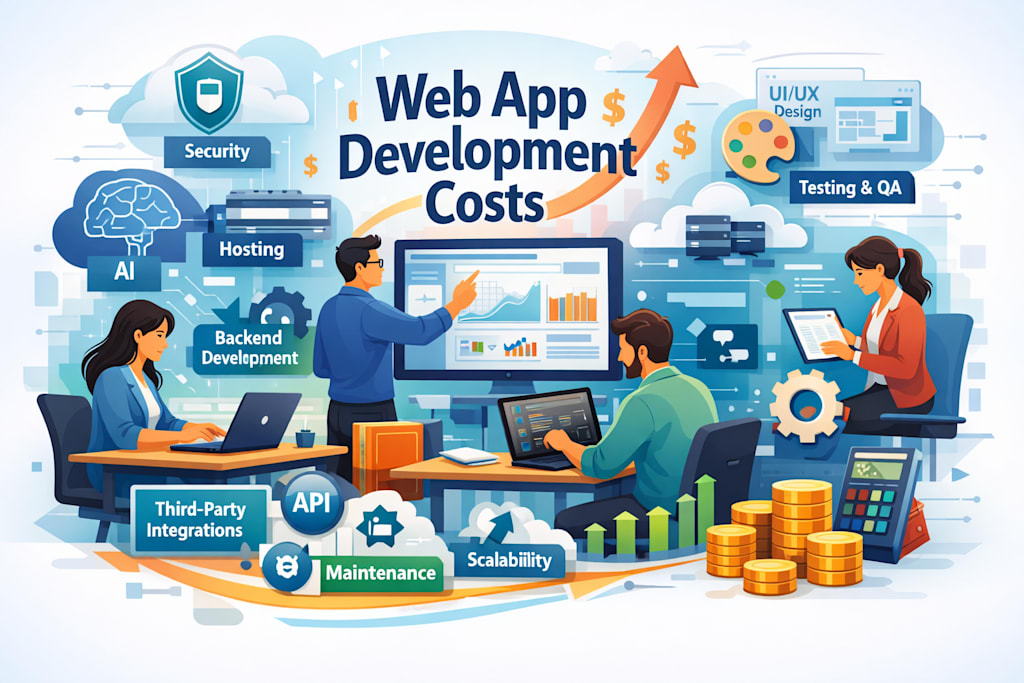
Understanding What It Really Takes to Build a Modern Web Application
Every year, thousands of entrepreneurs, startups, and established businesses invest in web applications to streamline operations, improve customer experiences, and create new revenue opportunities.
Yet one question continues to dominate the planning stage:
How much does it actually cost to build a web application in 2026?
Unfortunately, there is no universal answer.
The cost of web application development can range from a few thousand dollars for a basic platform to hundreds of thousands for a feature-rich enterprise solution. The difference comes down to complexity, technology requirements, scalability goals, security considerations, and ongoing maintenance needs.
Many organizations focus solely on development costs and overlook the expenses that emerge throughout the product's lifecycle. As a result, budgets become strained, timelines extend, and projects encounter unexpected challenges.
This guide explores every major cost component involved in web application development in 2026, helping business owners, founders, and decision-makers plan more effectively.
Why Web Application Costs Vary So Dramatically
Not all web applications are created equally.
Consider the difference between:
- An online booking platform
- A social networking application
- A SaaS project management tool
- A healthcare portal
- An AI-powered analytics platform
While all of these are web applications, the technical requirements behind them differ significantly.
A simple booking platform may require user registration, scheduling features, and payment processing. An AI-driven platform, on the other hand, may require advanced algorithms, cloud computing resources, machine learning infrastructure, and extensive data processing capabilities.
The more functionality a web application requires, the greater the development investment becomes.
The Major Cost Components of Web Application Development
To understand the true cost of development, it is important to break the process into individual categories.
1. Product Discovery and Planning
Every successful application begins with a strategy.
Before development starts, teams must answer critical questions:
- Who are the target users?
- What problem does the application solve?
- Which features are essential?
- What technologies should be used?
- How will the product scale in the future?
The discovery phase typically includes:
- Market research
- Competitor analysis
- User journey mapping
- Technical planning
- Feature prioritization
While some businesses skip this stage to reduce costs, inadequate planning often leads to expensive revisions later.
Estimated Cost
$2,000 – $15,000+
Depending on project complexity and consulting requirements.
2. User Experience and Interface Design
In today's digital landscape, users expect intuitive and visually appealing experiences.
A well-designed interface can influence:
- Customer satisfaction
- Conversion rates
- User retention
- Brand credibility
Professional UI/UX design typically includes:
- Wireframes
- Interactive prototypes
- User flow design
- Mobile responsiveness
- Accessibility considerations
Design is no longer simply about aesthetics—it directly impacts business performance.
Estimated Cost
$3,000 – $25,000+
3. Front-End Development
The front end represents everything users interact with directly.
This includes:
- Navigation systems
- Dashboards
- Forms
- Interactive elements
- Responsive layouts
Modern applications are expected to function seamlessly across smartphones, tablets, laptops, and desktop devices.
As user expectations continue to rise, front-end development has become increasingly sophisticated.
Estimated Cost
$5,000 – $60,000+
4. Back-End Development
The back end serves as the application's operational core.
It manages:
- Business logic
- Databases
- User authentication
- API communication
- Data processing
Complex applications often require advanced backend systems capable of supporting thousands—or even millions—of users simultaneously.
Features such as real-time notifications, payment processing, analytics dashboards, and AI integrations significantly increase backend complexity.
Estimated Cost
$8,000 – $120,000+
5. Database Development
Every web application depends on data.
Whether managing customer accounts, transactions, content, or analytics, a reliable database infrastructure is essential.
Database costs are influenced by:
- Data volume
- Security requirements
- Scalability needs
- Backup systems
- Performance optimization
Poor database architecture can create long-term performance issues that become increasingly expensive to resolve.
Estimated Cost
Usually included within backend development budgets but may require additional investment for large-scale applications.
6. Third-Party Integrations
Most modern applications rely on external services.
Common integrations include:
- Payment gateways
- Email marketing platforms
- Customer relationship management systems
- Analytics tools
- Social login providers
- AI APIs
- Customer support software
These integrations accelerate development but often introduce recurring subscription costs.
A product that appears affordable during development may become considerably more expensive to operate after launch.
Estimated Cost
$500 – $20,000+
Depending on integration complexity.
7. Security and Compliance
Cybersecurity is one of the fastest-growing areas of technology investment.
Users expect organizations to protect sensitive information, while governments continue introducing stricter privacy regulations.
Security investments may include:
- Data encryption
- Secure authentication systems
- Vulnerability testing
- Security monitoring
- Compliance assessments
Businesses operating in healthcare, finance, legal services, and e-commerce often require additional protection measures.
Estimated Cost
$2,000 – $50,000+
8. Quality Assurance and Testing
A web application is only as reliable as its testing process.
Quality assurance helps identify issues before users encounter them.
Testing typically includes:
- Functional testing
- Cross-browser testing
- Mobile testing
- Performance testing
- Security testing
- Regression testing
Although testing is sometimes viewed as a secondary expense, it often prevents costly failures after launch.
Estimated Cost
10%–25% of the overall development budget
9. Cloud Infrastructure and Hosting
Once development is complete, the application requires a hosting environment.
Modern cloud infrastructure commonly includes:
- Servers
- Databases
- Storage systems
- Load balancers
- Content delivery networks
- Monitoring tools
Infrastructure costs are generally low during the early stages but increase as user adoption grows.
Estimated Monthly Cost
$50 – $10,000+
Depending on traffic and system requirements.
10. AI and Automation Features
Artificial intelligence has become one of the most requested additions to modern web applications.
Businesses are increasingly implementing:
- AI chat assistants
- Predictive analytics
- Recommendation engines
- Automated content generation
- Intelligent search capabilities
Unlike traditional software features, AI functionality often introduces continuous usage-based expenses.
The more users interact with AI systems, the higher operational costs become.
Estimated Cost
$1,000 – $100,000+
Depending on implementation scale.
Hidden Costs Many Businesses Overlook
Development costs represent only part of the investment.
Several ongoing expenses frequently surprise business owners after launch.
Maintenance and Updates
Software requires continuous improvement to remain secure and competitive.
Performance Optimization
As traffic grows, applications require optimization to maintain speed and reliability.
Customer Support
Users need assistance, documentation, and issue resolution.
Feature Expansion
Market demands evolve, requiring continuous enhancements.
Technical Debt
Shortcuts taken during development often require future remediation.
These costs should be considered part of the long-term product strategy rather than unexpected expenses.
Typical Cost Ranges by Project Type
To provide a broader perspective, here are common development ranges for different application categories in 2026.
Application Type Estimated Cost
Basic MVP $10,000 – $30,000
Startup SaaS Platform $30,000 – $100,000
E-Commerce Platform $25,000 – $150,000
Marketplace Application $50,000 – $200,000
Enterprise Web Application $100,000 – $500,000+
AI-Powered Platform $50,000 – $300,000+
These estimates vary based on geographic location, team expertise, technology stack, and business requirements.
How to Reduce Development Costs Without Compromising Quality
Many organizations focus on reducing expenses, but the goal should be maximizing value.
Here are several proven strategies:
Start With an MVP
Launch a simplified version of the product to validate demand before investing heavily.
Prioritize Essential Features
Avoid feature overload during the initial development phase.
Choose Scalable Technologies
Future-proofing the application can prevent costly migrations later.
Invest in Planning
Clear requirements reduce expensive revisions and delays.
Focus on Long-Term Value
Building sustainable software is often more cost-effective than choosing the cheapest solution.
Final Thoughts
The cost of building a web application in 2026 extends far beyond writing code.
Successful applications require careful planning, thoughtful design, robust development, strong security, reliable infrastructure, and ongoing maintenance.
While development budgets vary significantly, understanding the complete cost breakdown helps businesses make informed decisions and avoid unpleasant surprises.
The most successful organizations don't simply ask how much a web application costs.
They ask how much value that application can create over time.
When viewed as a long-term investment rather than a short-term expense, web application development becomes one of the most powerful tools for business growth in the digital economy.
About the Creator
DZ Insights
Best Guest Blogging for Authors to share their stories and ideas.
Enjoyed the story? Support the Creator.
Subscribe for free to receive all their stories in your feed.
Comments
There are no comments for this story
Be the first to respond and start the conversation.