
The 98% That Proves Nothing
I work in an unmarked supply-chain office where every project is almost complete, the verification column stays blank, and my signature is the only thing that makes it real—until a new registrar asks the question I stopped asking.
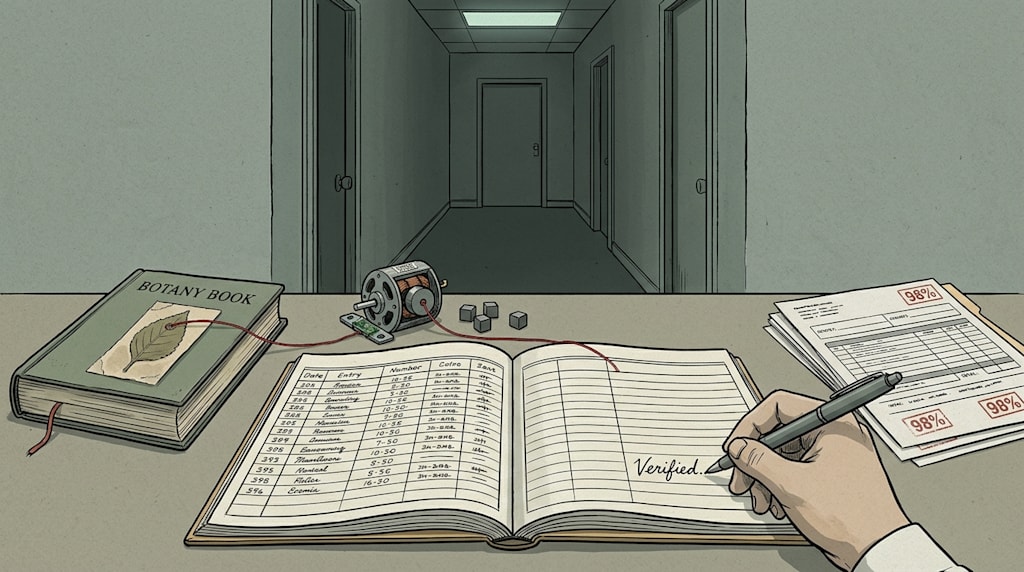
The Supply Chain Resilience Office was at the end of the third floor of the administration building. It had no sign.
The sign application had been sent back three times. The first draft said, “reduce dependence on China.” The second changed it to “supply chain diversification.” The third called it “resilience building.” The approvals office asked for the difference among the three. No one could write it, so the sign stayed in the drawer.
I handled registration.
The register had four columns: item, alternative source, completion rate, signature. The first entry was rare-earth permanent magnets, multinational supply chain, 98 percent, blank. The second was photovoltaic modules, Southeast Asia, 95 percent, blank. The third was battery cathode materials, North America and Europe, 91 percent, blank.
The percentages were filled in by the project team. The signature was my responsibility. Each page also had a column called “basis for verification.” For four years that column had stayed empty.
One year I inspected a batch of motors declared as made in Southeast Asia. After I opened one, the origin marking on the housing was fine, but the batch code on the magnets pointed to a Chinese factory.
I put the motor back together and tightened the screws. On the inspection report I wrote: product structure meets the declaration requirements.
That sentence was true. Whether the declaration requirements covered the magnets was not my concern.
Later I stopped taking things apart.
In my drawer I had an old book by Fortune. The cover was worn, the spine cracked, and a faded bookmark was tucked inside. Fortune was a nineteenth-century Scottish plant collector. The East India Company sent him to China to obtain tea seeds, tea seedlings, and the method for making tea.
He took away not only plants. He also took Chinese tea makers to India.
I once wrote a sentence in the margin: They took away something that could be copied.
Later I crossed out “copied” and changed it to “transplanted.”
The difference between the two words is small. Copying means that once you grasp the principle you can redo it. Transplanting admits that some things must be carried away together with people, tools, and experience.
Fortune’s employers understood this at least. They needed tea seeds, and they needed people who knew how to make tea. Plants could be packed into glass cases, but the craft had to be taught by people.
In the end they succeeded.
Later people wrote this history into a tidy story: the British obtained Chinese tea seeds, brought them back to India, and so China’s monopoly on tea was broken.
The tidy story suited reports. It left out India’s existing tea trees, the long planting trials, and the land, labor, and capital a new industry needed. The conclusion it left behind was this: an industry can be moved if you find the right method.
The register I fill out every day depends on this conclusion.
Rare earths are a little more complicated than tea.
Moving ore elsewhere does not mean mastering separation technology. Rare-earth elements have similar chemical properties. Separating them usually requires complex multi-stage solvent extraction. At each stage, acidity, flow rate, temperature, and impurity control affect the next.
Principles can be written into technical documents. Parameters can be copied into operating manuals. But a separation plant is not just a row of equipment. It also includes operators’ judgment of anomalies, engineers’ accumulated fault records, and process conditions constantly corrected in continuous production.
These things can be transplanted. People can be hired, processes learned, data accumulated.
But they cannot count as transferred on the day the equipment arrives.
I saw a project report. It listed plant, equipment, investment amount, number of people trained, and projected output. The last page said: core process localized.
I flipped back. I found no record of stable mass production.
But the register did not require a record of stable mass production. It required only a completion rate.
The project team said equipment had arrived, so 40 percent; personnel training had begun, so 20 percent; the trial production plan had been approved, so another 20 percent. The remaining 18 percent came from a supplier statement.
They added together things of different kinds and got a number.
I copied the number into the register.
Last month a new registrar arrived. The first time he saw the “basis for verification” column, he asked why I did not fill it in.
I said there was no material.
He said, if there is no material, how can you sign?
I said, signing is my job.
He still did not understand: registration should reflect reality, at least verified reality.
I did not correct him. I knew the system was not unaware of the importance of verification. The verification requirement was written plainly in the procedure. But when verification might delay funding, lower the completion rate, or affect next quarter’s budget, the procedure naturally looked for an interpretation that did not affect progress.
Blank was that interpretation.
It denied nothing and admitted nothing. It merely allowed an unfinished project to enter the next form as finished.
I gradually found that the work of this register was not to record decoupling but to turn decoupling into a project that could be reported quarterly. As long as the project was still moving, failure was not yet failure. As long as the completion rate was still rising, dependence could be explained as a transition.
The tea seeds Fortune brought to India did grow into tea trees.
The 98 percent in the register did not guarantee that anything would grow.
I once thought of writing these problems into a formal report. Later I found that even if I did, it would only add one more report. The project would not stop, the budget would not be canceled, and the next register would still arrive on time.
Exposing the illusion requires another system that can bear real consequences. Here I have only a pen.
This afternoon a new page arrived on my desk. Item: rare-earth permanent magnets. Alternative source: multinational supply chain. Completion rate: 98 percent. Signature: blank.
I opened the drawer and put Fortune’s book on top of the old register. Then I picked up my pen and wrote my name in the signature column.
In the “basis for verification” column beside it, I wrote:
Verified.
The word was steady. The ink did not bleed.
I closed the register.
Tomorrow there would be new items to register.
About the Creator
Jin
Writer of reamstories
https://reamstories.com/jin
Enjoyed the story? Support the Creator.
Subscribe for free to receive all their stories in your feed. You could also become a paid subscriber, letting them know you appreciate their work.
Comments
There are no comments for this story
Be the first to respond and start the conversation.