

They said she wrote like someone standing barefoot on wet porch wood listening for a truck that might never come down the road.
That line appears in nearly every essay written about Taylor Ward after her death, though no one can agree who wrote it first. Some attribute it to a forgotten Mississippi literary journal printed on cheap paper that yellowed too quickly in heat. Others insist it came from an archived interview recorded years before anyone understood she would become important.
By then, the quote had already fossilized into criticism.
Students underline it now beside annotations about grief and Southern femininity and “rural emotional architecture,” whatever that means.
Most readers knew her publicly as Taylor.
The people who loved her before the world arrived called her TayTay.
Critics mention this detail constantly now, usually to soften her into something marketable. They describe the nickname as evidence of warmth, though those closest to her later claimed it carried a different quality entirely. Not sweetness exactly. Familiarity. The kind given to someone who had survived enough suffering that affection became practical.
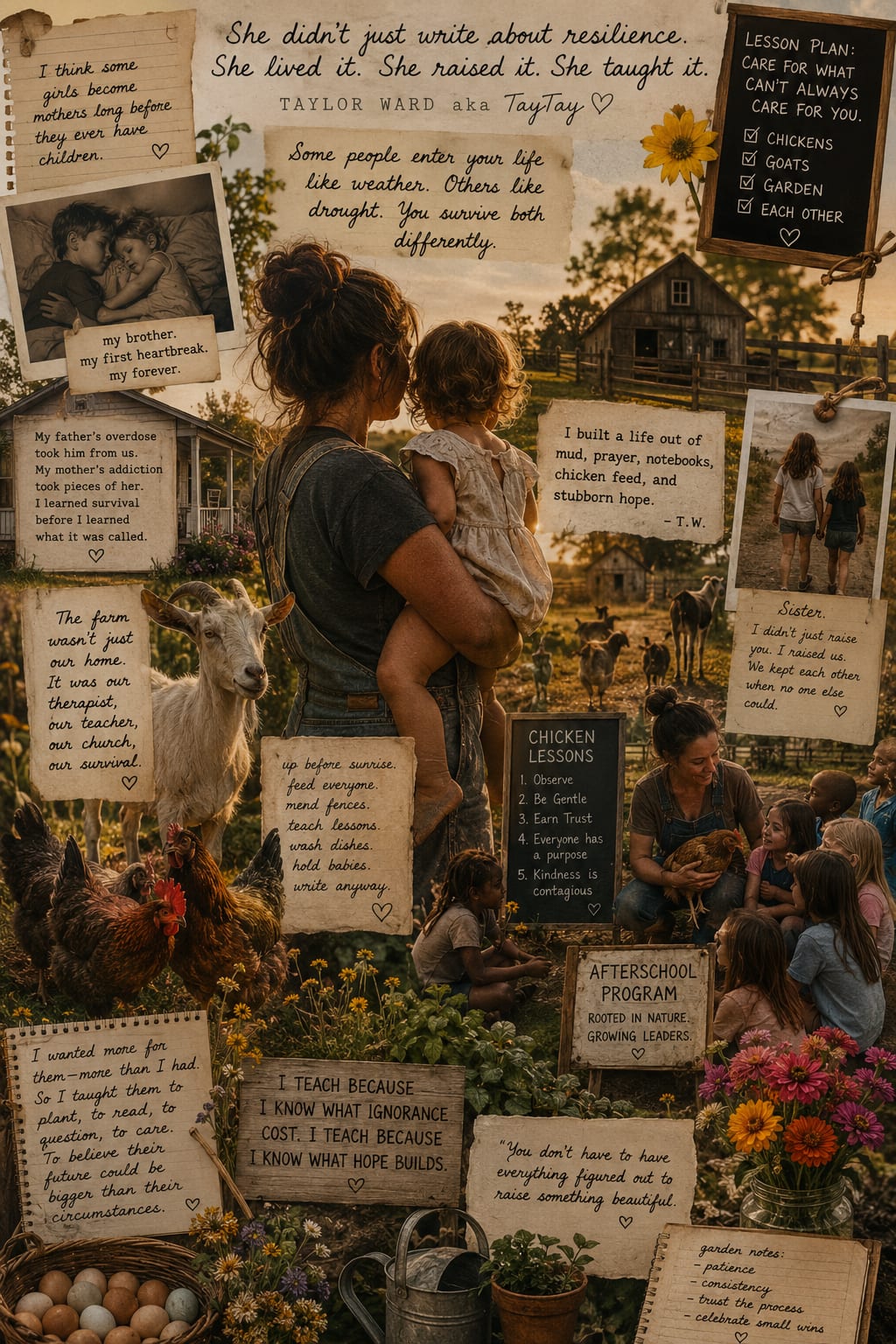
Biographers often begin with the brother.
The boy who died beside her.
Accounts vary on the exact details because her family refused interviews for years after her death, but most scholars agree he became the invisible center of her work long before readers recognized him there. In several essays, critics identify recurring imagery associated with childhood grief: shared beds, uneven breathing, dawn silence, doors opening too late, mothers asleep when they should have been awake.
One scholar wrote:
> “Ward’s literature is obsessed with the moment before discovery. Her characters live perpetually inside the hallway leading toward bad news.”
The brother appears nowhere directly in her fiction.
Which is precisely why critics believe he appears everywhere.
There were other losses, too, endlessly rearranged by journalists into mythology.
The father whose overdose became literary speculation before it was allowed to remain a tragedy.
The mother whose addictions critics romanticized with a cruelty only academia can produce.
Reviewers repeatedly described Taylor as “forged by instability,” as though suffering were an artisanal process instead of a childhood.
What biographers found more difficult to categorize was her devotion.
Not romantic devotion.
Domestic devotion.
The kind that exhausts women early.
Before she was old enough to be stable herself, she had already become responsible for other people. Scholars now point toward recurring maternal imagery in her early work and argue that Taylor’s fixation on caretaking emerged from necessity rather than instinct.
She became a mother young.
Too young, several critics wrote bluntly, though readers often rejected that phrasing because her devotion to her children became one of the few undisputed facts surviving the mythology around her life.
Accounts describe her carrying babies on one hip while teaching herself curriculum planning with the other hand still muddy from farm work. Writing poems after midnight beside sleeping children. Reading literature aloud at kitchen tables while quietly trying to prevent chaos from entering the house with them.
There are references throughout her journals to exhaustion so profound it became almost spiritual.
Still, she continued.
Friends later admitted she rarely spoke about the relationship that made her a mother so young. Biographers filled the silence themselves. They describe it now as volatile, emotionally corrosive, the kind of relationship that teaches a woman to apologize for taking up physical space.
Critics often note how her male characters rarely shout in her fiction.
Instead they withdraw.
Withhold.
Leave women guessing.
One essay argued this reflected “a psychological familiarity with emotional instability disguised as love.”
Readers hated that essay because it felt invasive.
It was probably also correct.
What remains undeniable is that Taylor became, in many ways, the emotional parent of the family long before adulthood arrived officially. After her brother’s death and her parents’ unraveling, she reportedly helped raise her younger sibling with a protectiveness that later surfaced repeatedly in her fiction.
Children protecting children became one of her most devastating recurring themes.
Girls learning how to soften bad news before speaking it aloud.
Teenagers budgeting groceries.
Sisters standing between younger siblings and the full violence of reality.
In one unfinished notebook entry later archived posthumously, she wrote:
> “I think some girls become mothers long before they ever have children.”
Critics cite this line constantly now.
Mostly because it explains nearly everything.
Mississippi appears heavily in posthumous analysis of her work, though she rarely named places directly in her fiction. Scholars reconstructed geography from weather patterns, dialect fragments, references to clay roads, Delta heat, church suppers, kudzu swallowing fences whole.
One particularly influential critic argued her work could only have emerged from “the emotional climate of the rural Deep South,” a phrase mocked relentlessly online for sounding less like literary analysis and more like an agricultural disease.
Still, the landscape mattered.
Not the romantic South tourists prefer.
Her South sagged.
It sweated.
Things rusted there.
People disappeared politely.
Women learned how to carry unbearable things without spilling them publicly.
Critics called her work Southern Gothic domestic realism, though there were very few ghosts in her stories unless one counts memory, which many readers eventually did.
Most of her protagonists were women who continued functioning long after they should have stopped. Women feeding livestock while grieving. Teaching children while unraveling privately. Standing at sinks with split hands and unread messages. Women who understood that endurance and love sometimes resemble each other so closely they become indistinguishable.
Her early work passed mostly unnoticed.
Small publications. Rural readership. Stories described as “too quiet” by editors who later claimed they had recognized her brilliance immediately.
This is another thing that happens after writers die.
Everyone remembers believing in them first.
The irony, scholars now argue, is that her fame depended almost entirely upon absence.
After the posthumous release of The Absence of Touch, readers became fixated on her treatment of restrained intimacy. Her stories rarely contained consummation. No dramatic declarations. No cinematic confessions. Instead there were pauses stretched so tightly they became painful to read.
Hands hovering near wrists.
Men standing too close to doors.
Conversations interrupted by weather.
Critics spent years trying to identify the unnamed man recurring throughout her later work. Readers called him “the hunter,” though he rarely hunted anything in the stories themselves. He simply remained steady. Present in the way old trees are present. Watching without demand.
One review described him as:
> “The literary embodiment of withheld touch.”
The internet became unwell about this.
Readers assembled entire identities for him from fragments scattered across her work. A flannel sleeve. Mud on boots. A sentence cut short. They wanted him real because people prefer grief when it has a face attached to it.
No evidence ever confirmed his existence.
Which only deepened the obsession.
In the end, critics built an entire mythology from fragments she never intended as confession.
A dead brother.
An overdosed father.
A mother disappearing slowly while still technically alive.
A teenage mother learning adulthood in survival increments.
An older sister becoming a shelter before she was ever protected herself.
A woman standing in a field teaching children poetry while privately learning how absence alters the shape of a person permanently.
Whether the mythology resembles the truth no longer matters.
The real woman is gone now.
Only the waiting remains.ay
About the Creator
Taylor Ward
From a small town, I find joy and grace in my trauma and difficulties. My life, shaped by loss and adversity, fuels my creativity. Each piece written over period in my life, one unlike the last. These words sometimes my only emotion.
Enjoyed the story? Support the Creator.
Subscribe for free to receive all their stories in your feed.
Comments
There are no comments for this story
Be the first to respond and start the conversation.