Stream of Consciousness
My Favorite Teachers
Natalie Goldberg's Writing Down the Bones Deck prompts - Tell me about a favorite teacher. My favorite teacher, who was in my life for about fifteen years, was a fourth-grade nun. She was constantly moving her fingers on the larger rosary she had hanging at her side. She shared stories of her marriage to Jesus. She gave me bookmarks with stories of the saints.
By Denise E Lindquistabout a year ago in Writers
Poe Vices
Introducing Poe ‘Vices: Life Advice You Definitely Didn’t Ask For or Need. From chaos gremlin to cosmic counsellor, Poe (The infinite, scream-Beam) is now solving your deepest problems with her signature style: shouting, biting things, and chicken, obvs. Fools.
By River and Celia in Underlandabout a year ago in Writers
My Three Friends And The Foods My Mother Cooked
Natalie Goldberg’s Writing Down the Bones Deck prompts — “I had three friends. I still keep up with two of them.” (The Round House, Louise Erdrich) Erdrich was in deep concentration writing this wonderful book. Why not start by using her line as a topic? See where it goes. Ten minutes. You might want to read the book too. It’s good.
By Denise E Lindquistabout a year ago in Writers
The Golden Age of Islam
The Scientific and Philosophical Contributions of Muslims in the Golden Age of Islam: How Did Europe Benefit? The period of history known as the Golden Age of Islamic Civilization—the period from the 8th to the 13th centuries—was a unique period of scientific and intellectual awakening not only for the Muslim world but for all of humanity. Although this period is commonly referred to in the West as the “Middle Ages” or “Dark Ages,” the Muslim world was at the dawn of a knowledge-based, research-based, and human-welfare-oriented civilization. The Muslim thinkers, physicians, mathematicians, philosophers, astronomers, and engineers of this Golden Age sowed the seeds of discoveries and ideas that later laid the foundation for the Renaissance, Enlightenment, and Scientific Revolution in Europe. Sadly, these contributions have been largely forgotten or misrepresented in historical scholarship today.
By Abdul Barik2 years ago in Writers
The Things She Carried. First Place in I Wrote This Challenge.
“This is Bisan from Gaza. I’m still alive.” You say it to prove survival. But it is not a triumph. It is a reckoning. You are twenty-five years old. You have documented life under siege. But you have not seen war—
By River and Celia in Underland2 years ago in Writers
I Remember. Content Warning.
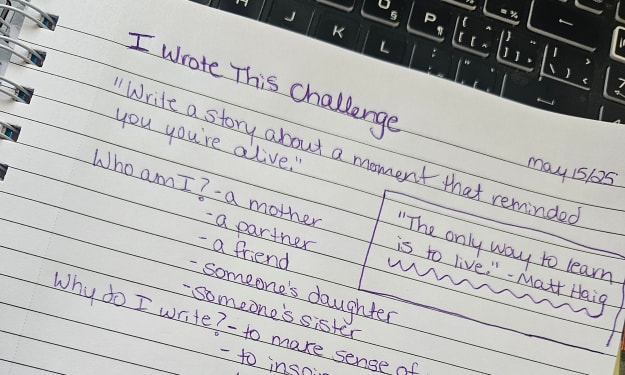
"The only way to learn is to live." -Matt Haig I knew I was meant to write something for this challenge on Vocal. I just didn’t know what to write or where to start. So I took out some paper, and I compiled a list of things about myself and went from there.
By Chloe Unfiltered2 years ago in Writers
From the perspective of Orientalism
The Western World’s Strategy of Lies and Distortion in Islamic History: From an Orientalist Perspective The study of history is not just about knowing the past—it is a struggle for power, perspective, and control. Who is writing history, how is it being written, and why are these questions important, as is whose perspective is being written. The Western world has practiced a systematic distortion and falsification of the history of Islam and Muslims for centuries, the main background of which was created through an academic and political framework called so-called ‘Orientalism.’ This framework was not just a practice of knowledge, but a strategy for establishing cultural dominance. In this discussion, we will see how Orientalists have distorted Islam and Muslims, what their intentions were, and what their impact is on the world today.
By Abdul Barik2 years ago in Writers