Stream of Consciousness
Can You Please Pass the Salt
I am a pilgrim, willingly wandering into writing this piece, along with some other pilgrims who seek to create a postmodern narrative that destroys meaningless metafictions of wishful thinking and preconceived principles of realism.
By Katherine D. Grahamabout a year ago in Writers
My Therapist Says I'm Depressed. Runner-Up in I Wrote This Challenge. Content Warning.
I have an unwavering feeling that I'm watching myself die. Everyday, everything and everyone I love are taking a step away from me at 12 p.m. (the time the sun rises for me). These fragments of my being are deserting me like a Polaroid photo losing faces.
By Jada Fergusonabout a year ago in Writers
The power of an empty wallet
Ali had always lived by one principle: earn more, live more. His wallet was always full, his clothes always branded, and his phone always the latest model. From the outside, he looked successful. But the truth was—he lived paycheck to paycheck, with a credit card drowning in red. One rainy Friday, everything collapsed. His company announced massive layoffs, and Ali’s name was on the list. “You’ll get your final paycheck next week,” HR told him with a weak smile. Suddenly, his world turned gray. He had no savings. Rent was due. He had debts piling up and no one to lean on. For the first time, Ali’s wallet was empty. He avoided friends, too ashamed to admit he was broke. With no money, no job, and no motivation, he wandered the streets for hours each day, hoping something would change. On the third day, while sitting on a park bench, he noticed an old man handing out sandwiches to the homeless. Out of curiosity, Ali approached him. “You hungry?” the man asked kindly. Ali hesitated. “I’m not homeless,” he said quickly. The man smiled. “Neither was I. Until I lost everything in 2008.” Ali sat beside him. They spoke for hours. The man, once a CEO, had learned humility after the crash. “Losing money was painful. But losing pride was freeing,” he said. “That’s when I started living.” Inspired, Ali decided to change. He reached out to a charity and began volunteering. At first, just for food. But slowly, he found something else: purpose. He taught English to underprivileged children. Helped the elderly. And somewhere in the process, he discovered skills he never knew he had—teaching, organizing, public speaking. Three months later, a non-profit organization offered him a full-time job. He was still earning less than he did in the corporate world, but for the first time, he slept peacefully at night. Years later, Ali became the director of that same organization. His story inspired hundreds of others. Moral: True wealth is found in character, not coins.
By Shehzad khanabout a year ago in Writers
Translation - Experimento
The following text is a text I wrote more than 10 years ago. I was finishing my studies as a literary translator and at some point we translated Samuel Beckett's Waiting For Godot. After I contrasted the French version with the English one, I came up with the idea that perhaps Beckett had merely translated himself into English and so I tried to do the same with one of my texts, originally written in Spanish.
By Laura Rodbenabout a year ago in Writers
Have You Enjoyed Your Life
Natalie Goldberg’s Writing Down the Bones Deck prompts — "Have you enjoyed your life?" one of Edwidge Danticat's brothers asks his father after the father tells his children he has a fatal disease (Brother, I'm Dying).Let me ask this of you: Have you enjoyed your life? No matter what your age, look back in this moment and respond.
By Denise E Lindquistabout a year ago in Writers
What You Need To Know
Natalie Goldberg’s Writing Down the Bones Deck prompts — You need to know this. “Tell me. What? Go, ten minutes There are millions of things that a person needs to know. Will someone tell you? Why? Or why not? Throughout my chosen work life, I have learned many valuable lessons over the years. Most of it has to do with the population I worked with.
By Denise E Lindquistabout a year ago in Writers
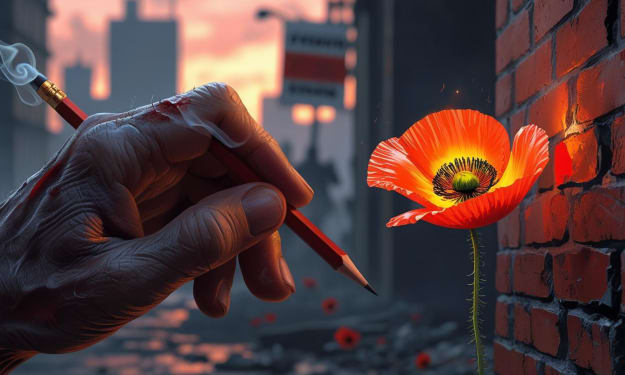
Art in the Rubble
Creating Amidst Collapse In a blackout in Gaza City, Amina sits cross-legged on the floor, her phone’s dying flashlight casting a frail glow. She scribbles a poem on a torn napkin, her pen shaking as drones hum overhead. The words are jagged, about olive trees and blood-soaked earth, but they’re hers—proof she’s still here. Across the world, in a shelled-out building in Kharkiv, Dmytro paints a mural with scavenged house paint, a defiant sunflower blooming across cracked concrete. In Port-au-Prince, Jean records a song on a cracked phone, his voice raw, weaving Creole proverbs into a melody of rage and hope. These aren’t polished works destined for galleries or Spotify. They’re acts of survival, art born in the rubble of crisis zones, where creation is as vital as breath.
By Shohel Ranaabout a year ago in Writers