Life
Can You Please Pass the Salt
I am a pilgrim, willingly wandering into writing this piece, along with some other pilgrims who seek to create a postmodern narrative that destroys meaningless metafictions of wishful thinking and preconceived principles of realism.
By Katherine D. Grahamabout a year ago in Writers
Stepping Stones
When I was in early elementary school I wanted to be two things: a teacher and a writer. My love for writing definitely blossomed from a love for reading. I developed an appreciation for books and experienced the power of stories at a pretty young age. My dad would read me a Little Golden Book at night before I could read independently. And once I started reading, my mom would take my sister and I to the huge public library near where we lived in the suburbs of Denver every week.
By D.K. Shepardabout a year ago in Writers
The Great Banana Peel Plan. Content Warning. AI-Generated.
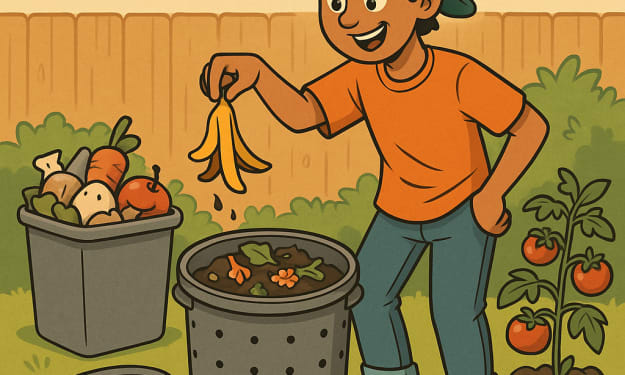
Ravi hated mornings. Not because he was a night owl or loved sleep more than pizza (though both were true), but because mornings meant one thing—chores. And at the top of the dreaded list was taking out the trash. Every day, his mom would yell, “Ravi! Take the garbage out before it takes root in the kitchen!” And every day, Ravi would reply, “In five minutes, Amma!” Which, of course, meant never. Until one morning, things changed. It started with a banana peel. Ravi, trying to balance his phone, breakfast, and leftover laziness, tossed the banana peel into the trash. Missed. It landed with a wet splop on the floor. His dog, Toffee, sniffed it and gave him a judgmental stare before walking away. Even Toffee was disappointed. Feeling unusually guilty (probably because he was out of excuses), Ravi picked up the peel. As he stood there, looking at the mess inside the trash bin, something clicked. “Why do we throw all this stuff away? Can’t we do something cool with it?” His mom, now peering from behind her glasses, said, “Like what? Build a spaceship out of potato skins?” That night, Ravi Googled "what to do with kitchen waste." After several cat videos and an accidental search for "how to train a hamster," he stumbled on the word: composting. It was perfect—take food waste, turn it into soil, grow stuff. Simple, smart, and best of all, it meant less trash to take out. He was hooked. Ravi built a compost bin using an old plastic bucket, some holes for air, and a lid he stole from the cookie jar (don't tell his mom). He began tossing banana peels, veggie scraps, and even paper bits into it. At first, it stank. Like a combination of gym socks and boiled cabbage. But after a few weeks, the smell faded and the magic began. The mushy waste turned into dark, rich soil. He used it in the garden behind his building, planting tomatoes and chillies. Toffee tried to eat them once. Regretted it immediately. Ravi started telling his neighbors about it. They laughed at first. “You? Growing food? The same kid who couldn’t grow a mustache?” But when they saw his plants—tall, green, and proud—they changed their tune. Soon, Mrs. D’Souza from next door gave him her tea leaves and eggshells. Uncle Mani gave him dry leaves and twigs. Even grumpy old Mr. Ramesh, who once shouted at Ravi for breathing too loudly, dropped off orange peels with a grunt. Before long, the whole apartment block was composting. The trash bins were half-empty, the garden was full, and people actually started talking to each other instead of arguing about parking spaces. Then came the school science fair. Ravi, who once used to write essays titled "My Pet Rock," now walked in with his compost bin, a tomato plant, and a giant smile. His project, “Trash to Treasure,” won first prize. The principal even called him “a green hero,” which made Ravi’s ears turn red. Local news picked it up. A journalist called it “The Great Banana Peel Plan.” Ravi’s mom laminated the article and stuck it on the fridge. Right above his old math test with a big red 32. But the best part? One morning, months later, Ravi woke up to find no trash in the kitchen. Confused, he ran to his mom. “Amma, where’s the garbage?” She sipped her coffee and smiled. “We don’t make garbage anymore, remember? Everything’s composted or recycled.” Ravi stood there, stunned. He had done it. The boy who hated taking out the trash had made it disappear. --- Moral of the Story: Sometimes, the smallest, laziest action—like not taking out the trash—can lead to the biggest, greenest change. You don’t need superpowers to save the world. Just a banana peel and a little curiosity.
By fazilat bibiabout a year ago in Writers
The Prom
Note: here is a story that I have avoided discussing even here, but this particular Challenge seems to demand that I dig deep and look at a very unpleasant memory. Some of you may think less of me, or the other person involved, but that is just the way things work out.
By Kendall Defoe about a year ago in Writers
My Therapist Says I'm Depressed. Runner-Up in I Wrote This Challenge. Content Warning.
I have an unwavering feeling that I'm watching myself die. Everyday, everything and everyone I love are taking a step away from me at 12 p.m. (the time the sun rises for me). These fragments of my being are deserting me like a Polaroid photo losing faces.
By Jada Fergusonabout a year ago in Writers
Next Right (Video Proof Missing)
Peering into the rearview mirror, Ryan Kelly continued monitoring, an uncomfortable developing situation, taunting the travelling free bird, concerned with what was behind him, past events challenging his independent lifestyle.
By Marc OBrienabout a year ago in Writers
Making A House A Home. Second Place in I Wrote This Challenge.
‘It looks like a model house’ my mother would joke with more than a tinge of jealousy when we visited friends who kept their place so clean and clutter-free it seemed unlived in. “It’s almost eerie.”
By Raistlin Allenabout a year ago in Writers