Advice
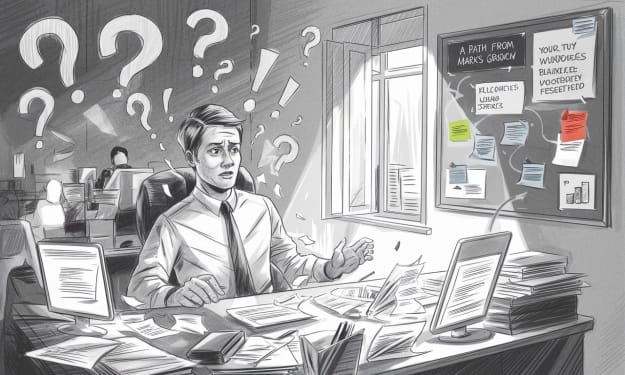
Stuck in Your Job? Talk to Ambika Jyotish
Feeling stuck in your job can be a frustrating experience, but seeking guidance from an astrologer like Ambika Jyotish might offer new perspectives. Astrological insights can help identify the underlying causes of career stagnation and provide remedies to improve your professional life. Here's how Ambika Jyotish can assist:
By ambikajyotish2 years ago in Writers
How AI Changes the Way We Write
AI has changed everything. From the way we get inspiration for photos to taking selfies that make you look like a queen or a badass superhero. It’s even changed the way we write. These days, there's really no excuse for bad grammar—or for saying, “I don’t have anything to write about.” Any good writer will tell you that writer’s block isn’t real. They’ll tell you to sit in a park, observe the world around you, and just write. Eventually, an idea will come. But let’s be honest—sometimes it’s hard to come up with a good idea, one that makes people want to keep reading. So, I turn to ChatGPT to help me brainstorm. That idea might not be entirely my own, but it brings some inspiration to the table.
By Adrianna M. Braun2 years ago in Writers
It is about finding the joy in little things
You know those moments that light you up like a forestfire, the circumstances, people, entities, stories, words or notions that trigger something in you. That makes you act differently, to approach your life differently, to stride a different walk or embrace a new mindset. These are often quite moments that we think are insignificant, but are in reality monumental transgressions of metamorphosis, where everything changes, but also nothing changes.
By Hridya Sharma2 years ago in Writers
Echoes for the Departed
Detective Rehan Shah stood in the candlelit room, staring at the lifeless body of Professor Adil Murtaza. A respected academic, known for his work on memory and trauma. And now, the third victim in a series of killings that had the entire city gripped with fear. As with the others, there was no sign of forced entry. No defensive wounds. Just a body laid out with unsettling care — and a handwritten note. Rehan read it aloud: “You said some memories should stay buried. I guess this one didn’t.” Zara, his partner, stood beside him, arms crossed. “It’s like the killer isn’t talking to us. He’s talking to them. After they’re dead.” Rehan nodded. “He wants them to hear him... even if it’s too late.” Each of the three victims had one thing in common: they were influential in their own fields — a judge, a journalist, and now a professor. But beyond their careers, no connection was immediately clear. Each murder scene, however, included a note that hinted at a shared past. The judge’s said: “You ruled over truth, but silence was your verdict.” The journalist’s: “You printed lies, but forgot who bled for them.” Rehan pinned the notes to a corkboard in his office, staring at the words until the lines blurred. They weren’t just messages. They were accusations. Emotional, bitter, personal. It was as if the killer wasn’t seeking justice — he was seeking to be remembered. Zara dug deeper. She found a long-forgotten case from twelve years ago involving a young boy named Sameer Raza, who had accused a group of respected adults of abuse and manipulation at an elite boarding school. The case had been dismissed. The records were sealed. The boy had vanished. Forgotten. Rehan whispered the name aloud. “Sameer...” Could it be? Could Sameer be back? Before he could say more, a fourth murder rocked the city. This time, it was a defense attorney — one who had worked on the dismissed case. The note beside his body was longer: “You told them I was confused. You said I imagined it. But you knew. You all knew.” The pieces began to fit. The killer was Sameer — or someone close to him — targeting the people who had betrayed him, silenced him, discredited him. And each message was written as if speaking directly to the victims, reminding them of what they did. A final reckoning they couldn’t escape, even in death. Rehan and Zara went public with their theory, appealing to Sameer — if he was watching — to come forward. To talk. Instead, Rehan received a note. This time, not left at a crime scene, but hand-delivered to his desk. “You were at the academy once. You heard me. But you walked away.” His hands trembled. A memory, long buried, surfaced. He had met Sameer once, during a school visit. The boy had tried to speak to him. But Rehan, young and unsure, had brushed him off — assuming it was a student prank. He hadn’t remembered… until now. The next morning, Zara was gone. Her apartment door was unlocked. No signs of struggle. A note sat on her kitchen table: “She tried to help you forget. That’s enough betrayal for one life.” Rehan’s heart shattered. Not just from grief — but guilt. This wasn’t just a case anymore. It was a mirror. And he was part of the reflection. He returned to the academy — now abandoned. In the old library, he found Sameer waiting. Older now. Pale. Eyes heavy with years of pain. “You came,” Sameer said. “I should have come years ago,” Rehan replied quietly. Sameer held out one last note. Rehan took it with shaking fingers. “Forgiveness isn’t for the dead. It’s for the ones who failed to listen.” “I’m sorry,” Rehan whispered. Sameer nodded. “I believe you.” And then he was gone. He turned himself in that night. At the trial, Rehan testified. About the case. The silence. His own cowardice. He lost his badge but found something far more important — truth. Sameer was sentenced, but the world finally heard his story. The notes had done what they were meant to: not to taunt, not to terrify — but to speak for the child who had been ignored, abandoned, forgotten. And in the end, that voice — however late — was finally heard.
By Muhammad Ali 2 years ago in Writers
The Village Without Yesterday
Deep in the folds of misty mountains, where roads turned to dirt and time seemed to slow, there lay a village called Nimara. The village was a curious place — not for its landscape, which was green and beautiful, nor for its people, who were kind and simple — but for something far stranger: no one in Nimara remembered yesterday. Every dawn, when the sun rose over the hills and its light kissed the rooftops, the villagers awoke with no memory of who they were, what they did, or where they had come from. All they knew was the present — their names written on stones outside their homes, their roles carved on wooden boards, and a strange inner calm that convinced them this was normal. Every day was a new life. Old Jaanu, the village blacksmith, would awaken each morning, read his name on the metal plate nailed to his door, glance at the hammer in his hands, and nod. “Ah yes,” he’d murmur to himself, “I am Jaanu. I make things.” And off he’d go to his forge. Mira, the baker, would wake with the smell of dough clinging to her fingers. “I must love bread,” she’d say, looking at the loaves lined up in her oven. She’d smile and begin anew, selling warm buns to people who didn’t remember buying them the day before. Each evening, as the sun dipped behind the mountains, a fog would roll in, thick and silent. The villagers would feel sleep calling them. Some tried to stay awake, frightened by the feeling of their memories slipping, but it was no use. The fog took everything. Then morning came, and the cycle repeated. Children did not grow up remembering their childhood. Lovers forgot their love. Parents didn’t know their own children. And yet, the village thrived. Until one day, a traveler arrived. He was a dusty man with a notebook and a confused expression. His name was Aarav, and he had heard rumors of Nimara during his long, aimless wanderings. People in nearby towns spoke of it in hushed tones — “The village of forgetfulness,” they called it, “where time stands still.” Curious and lost in his own search for meaning, Aarav came to Nimara. He was greeted with warm smiles and confusion. “You’re new,” said Mira, handing him a loaf of bread. “At least, I think you are. Maybe I’ve met you before?” “No, I’ve never been here,” Aarav said. “You’ll forget that by tomorrow,” she replied with a shrug. Aarav stayed the night in an empty hut. But he didn’t sleep. He wrote furiously in his notebook, trying to record what he saw, what people told him, and what he felt. When the fog rolled in, his eyes grew heavy, but he forced himself to stay awake, repeating his name, his past, his purpose. He awoke to sunlight and silence. Rushing to his notebook, he sighed in relief — it was still there. His memories were intact. The villagers, however, greeted him like a stranger once more. For days, Aarav observed. He tried to ask questions: “Do you know why this happens? Have you tried to stop it?” But no one had answers. They lived in the now, content, unaware of the tragedy of forgetting. One morning, he found a small girl, no older than seven, sitting beneath a tree and crying. “What’s wrong?” Aarav asked gently. “I don’t know,” she sniffled. “I just… I feel sad. Like I lost something. Someone.” Aarav looked at her and realized that somewhere, beneath the surface, memory left behind traces — feelings, instincts, longing. The village wasn’t free. It was trapped. That night, Aarav climbed to the top of a hill that overlooked Nimara. He lit a fire, opened his notebook, and began to read aloud every memory he had recorded — names, stories, laughter, tears. As the fog crept up the hill, he yelled into the night, “Remember who you are! Remember something! Fight it!” Then the fog took him, too. Morning came. The fire had burned out. The notebook lay beside the ashes. Down in the village, something felt different. Mira paused as she kneaded dough. “Aarav,” she whispered. “Where did I hear that name?” Jaanu looked at a hammer and felt a surge of emotion he couldn’t place. The little girl ran to the tree and found the notebook. She opened it and saw her name — Lina — with a drawing of her beneath it. Something warm bloomed in her chest. And so, bit by bit, day by day, the village began to change. Memories crept back like the sun after a long winter. Names were no longer just letters on a stone. Faces carried meaning. Love grew roots. No one knew how it began — only that once, a traveler came, refused to forget, and left behind the gift of remembrance. Nimara, the village without yesterday, slowly found its way back to tomorrow.
By Muhammad Ali 2 years ago in Writers
When Doubt Creeps In: How to Reclaim Your Confidence as a Spiritual Writer
As spiritual writers, there is a lot of pressure on us, we’re not just putting words on a page—we’re opening portals, sharing transmissions, and channeling experiences that can change lives. But even with the deepest calling, there are moments when doubt sneaks in. Suddenly, the story feels too big, too vulnerable, or too risky to share. You begin to wonder… Who am I to write this? What if I get it wrong? What if no one understands me?
By Ameera May2 years ago in Writers
How to Know When the Universe Is Nudging You to Write Your Book
First off, If you are looking for signs that you should write your book, this is that sign. But seriously, have you felt the quiet whisper in your heart urging you to share your story? Maybe it shows up as a persistent thoughts, a dream, a phrase someone casually says, or a repeated sign you can’t ignore. These nudges aren’t coincidences—they’re divine invitations. If you've had a near-death experience (NDE), a spiritually transformative experience (STE), or a deep spiritual awakening, the Universe may be calling you to write your book.
By Ameera May2 years ago in Writers