
Sure, the money is nice, but . . .
that’s not why I’m here

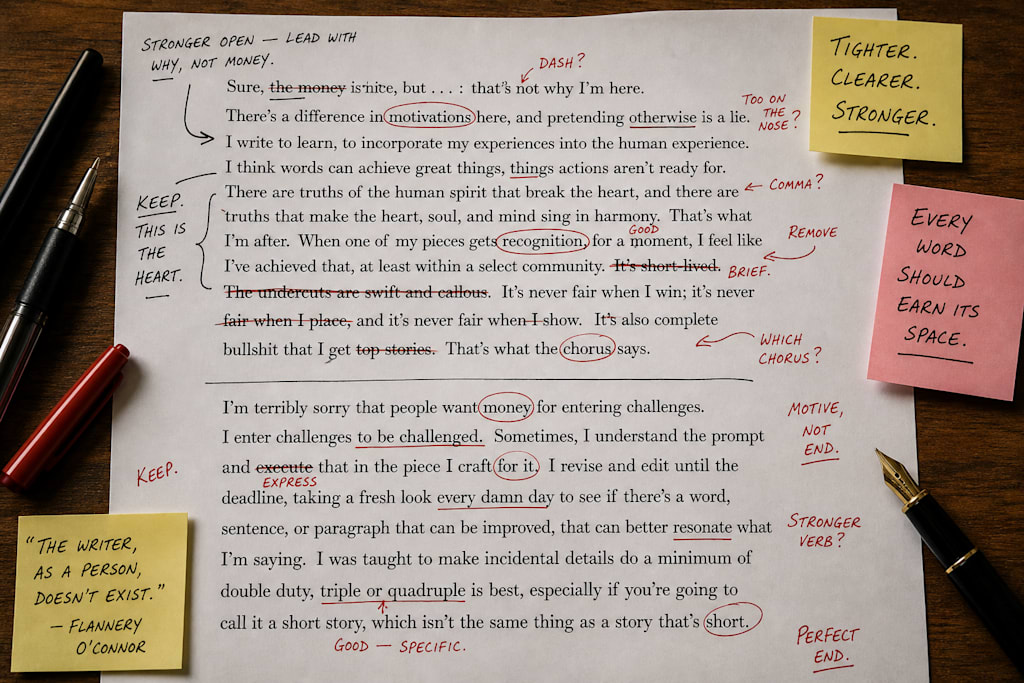
There’s a difference in motivations here, and pretending otherwise is a lie. I write to learn, to incorporate my experiences into the human experience. I think words can achieve great things, things actions aren’t ready for. There are truths of the human spirit at war with itself that break the heart, and there are truths that make the heart, soul, and mind sing in harmony. That’s what I’m after. When one of my pieces gets recognition, for a moment, I feel like I’ve achieved that, at least within a select community.
It’s short-lived. The undercuts are swift and callous. It’s never fair when I win; it’s never fair when I place, and it’s never fair when I show. It’s also complete bullshit that I get top stories. That’s what the chorus says.
I’m terribly sorry that people want money for entering challenges. I enter challenges to be challenged. Sometimes, I understand the prompt and execute that in the piece I craft for it. I revise and edit until the deadline, taking a fresh look every damn day to see if there’s a word, sentence, or paragraph that can be improved, that can better resonate what I’m saying. I was taught to make incidental details do a minimum of double duty, triple or quadruple is best, especially if you’re going to call it a short story, which isn’t the same thing as a story that’s short.
I write what I know in language I know. I don’t pretend insider information I didn’t come by honestly. I write about Augusta with authority because that is the world I was born into. I know it like my blood. I know southern trees and flowers, and I know mountains, rivers, islands, and oceans. I don’t assume settings I’m unfamiliar with. Memory will always be more precise and more powerful than imagination, and the sensory details our memories store carry weight, so much more weight than we’re aware of.
I read a disproportionate volume of front-loaded work from creators braying about how unfair it is that they aren’t winning any money. It’s almost like there’s a correlation between front-loading work and not winning. Hmmmm, how strange.
Serious readers don’t want writers telling us how to read or interpret a text. As Flannery said, the writer, as a person, doesn’t exist. When I read someone’s work, I am not signing up to babysit their feelings about literary merit. Feelings about merit don’t matter. Merit does matter. Don’t tell me the woman was sad. Tell me she draped the threadbare dishrag over the now-empty sink like a shroud, a remembrance of a former life. If you aren’t taking the time to do that, you’re not doing the work. On that note, my nature poetry isn’t actually about nature, and my history poems are actually love poems. The surface is merely the contact point.
When I write in exposition, I come back to it, revise it into a narrative present. I didn’t do that in my unhappy ending piece because I couldn’t. Narrative present would have pushed the piece into a 6-10K word range, and there was too much to tell to approach it that way, and I still had to leave out more than I included.
Writing that piece ripped my heart, still beating, out of my chest and put it on display for the entire world. I’ll be pleased if it’s recognized. I’ll still be pleased if it’s not; I achieved something by having the courage to sit down and write it. I achieved something else when I told it true, without romanticizing it or embroidering it with my feelings. And my greatest achievement was finishing it when I got to the hard part. Yes, it has typos. It also has blood, sweat, and tears. I almost hope it’s not recognized—at least then I won’t be subjected to assertions that it shouldn’t have been recognized because someone else hasn’t had a turn winning yet.
It’s considered acceptable for some to attack the results of every challenge, completely disregarding what the winners put into their pieces, dismissing them as fluff that should have taken a backseat to some other fluff. I’ve even seen attacks that brazenly admit they didn’t bother reading the winning entries but know it wasn’t fair. Empirical knowledge matters. Attacking something you don’t know the contents of as an unfair win is the most disrespectful, anti-supportive action one can take when results are posted. The arrogance can be overwhelming.
Maybe, for once, when challenge results are posted, the money-grubbers can have some respect for the people being recognized for doing the hard work well. It’s disrespectful to criticize the judging simply because you don’t see your name on the winners’ page, and it actively hurts those whose names are there. If you truly want to win, stop entering first-draft, front-loaded work that condescends to the reader. We don’t want or need you to tell us what the story is about if you’ve done the work. If you haven’t done the work, a preface won’t close the gap between your piece and the pieces fron the same old names that do the work. Read the full prompt. Let it resonate. Read it again. Let it resonate some more. Think about how you can fully adhere to the prompt (not the prompt blurb). And, for fuck’s sake, stop whining. It’s gotten so bad that I’m bitching about whining.
About the Creator
Harper Lewis
Intrusive rhyme bothers me, except as a weapon.
Intertextuality is my passion.
Formalist/ New Critical are my guiding theories.
My words are mine, not a robot’s.
MA English literature, CofC
Enjoyed the story? Support the Creator.
Subscribe for free to receive all their stories in your feed. You could also become a paid subscriber, letting them know you appreciate their work.
Comments
There are no comments for this story
Be the first to respond and start the conversation.