
Stinky Wuz Here
A Meditation on Innocence


Mainstream critics generally shy away from offering critiques of works in the realm of the children’s comic. Although the graphic novel has gained broader acceptance over time, there still exist the more “puerile” forms of the art which remain a guilty and uncommented on form of pleasure for so-called “serious” readers.
I have long enjoyed and collected such “lesser” art forms myself and a few years ago discovered the delightful Stinky, Stabby and Stumpy series. My inner 10-year-old loves every snot and vomit joke, every mishap suffered by the ill-fated hero, Stinky McFarland, and especially the endless repetition of his disastrous weekly marriages to his girlfriend Stinkyella. Stumpy finds new ways to eat the whole of the three tiered wedding cake prior to the wedding reception in every single issue.
These are comics written in the just for fun category that no critic would consider reviewing outside of the narrow world of comic’s publishing. But then the unthinkable happened. In May, Strange World Press published Stinky Origins and Compendium, a new graphic novel, and turned Stinky’s adorable adventures into something much darker.
Its first chapter opens with a previously unpublished origin story and reframes the series as a tragedy rather than innocent fun. We learn a mad scientist created Stabby, the human knife, and Stumpy, a cross between a human and a tree, and in a Frankensteinian operation turned a skunk into Stinky, the smelliest boy who ever lived.
The puerile jokes that endeared so many readers to the series in the first place continue to land but their power is tempered by pity once we recognize what Stinky has endured in his torturous transformation from skunk to boy. Somehow, he becomes more human once we learn that he is not human at all.
For those of you who are already fans of the long running Stinky, Stabby and Stumpy comic series, you have likely noted the irony. The whole point of the original comic is for the readers to laugh at the super powered antics of the three adopted brothers in their war against the normy world.
Both the original series and the graphic novel were penned and illustrated by the late John Cox, who did not live to see either published. His estate, mostly through the efforts of his grandsons, Campbell Cox and Hunter Casel, was solely responsible for finding publishers for his work.
The critic Northrup Frye wrote in his landmark work, Anatomy of Criticism, that tragedy is concerned with the separation of the hero from society. Even if we accept that there are many definitions of tragedy and Frye’s is only one of them, comic superheroes by definition dwell on the liminal edges of society, outcasts in any other manifestation. It is their powers that make them both revered and relevant.
The question, does the addition of the origin story elevate a silly series to art is, in my mind, the wrong question. What intrigues me more is the question Why am I so disturbed by the story after learning Stinky’s true beginnings? Now that I have reread the complete compendium several times, I think I have learned the reason why.
I have written in this space before about writers who are adept at depicting life as a game without rules where the stakes are everything. Often supernatural in setting and events, these stories lend themselves to existential themes and creating unnerving atmospheres.
By opening the compendium with Stinky’s origin story everything his existing readers think they know about him is reframed in the Weird Fiction tradition. What happens when a silly story suddenly turns into an alternate and deeply disturbing world and what demands does that make on the unsuspecting reader?
This cannot help but transform Stinky from a comic figure we thought we knew into a pitiable one. He’s yanked away from the life he understood and thrust into one he can never learn to adapt, in essence forced to play a game with rules that are alien to his conception of survival.
A skunk has a single defense mechanism, a human boy several. Stinky reacts to every crisis and perceived threat by releasing a plume of stench equal to a megatonnage of skunk spray. In the original series it’s hilarious. But in Origins it is what alienates him from the human, normy world.
The image below is the first time we meet the tragic reconception of Stinky in his native wilds on Rock Island as recorded by Professor McFarland, then a noted *anthropologist.
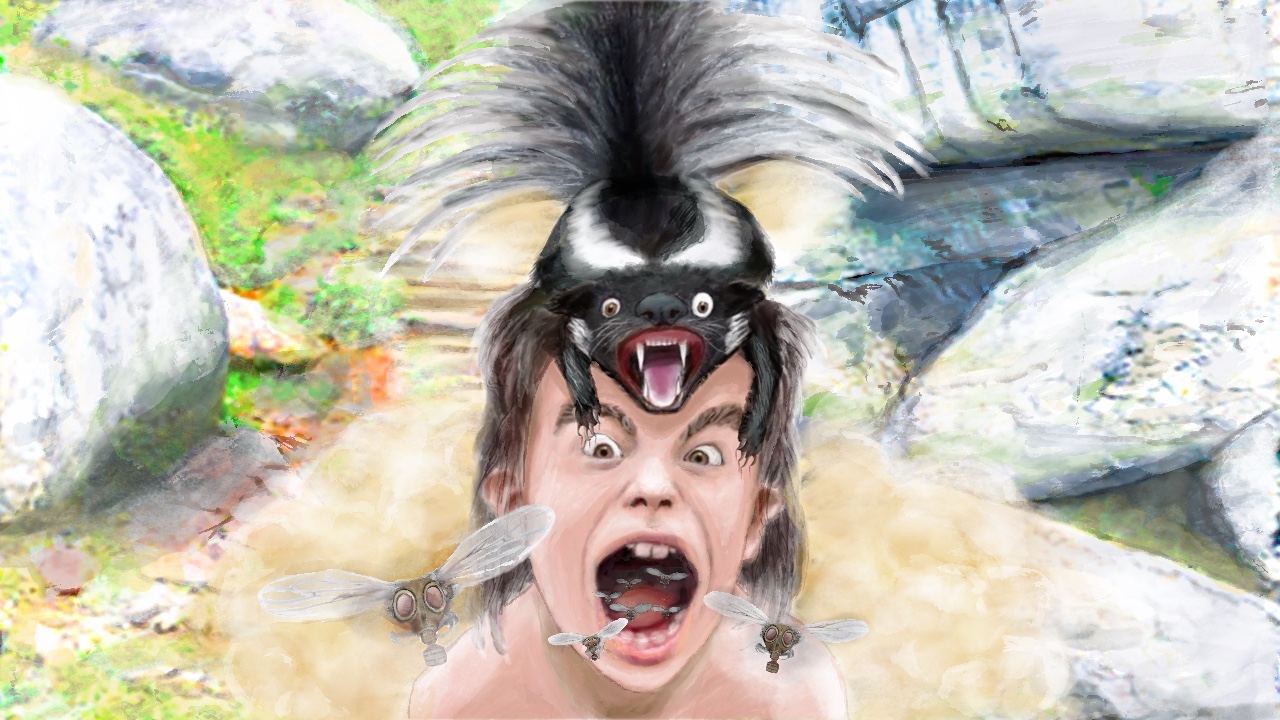
We smelled him coming long before spotting him. That terrible acrid stench common to mephitis mephitis assaulted our nostrils and made our eyes red and watery. Soon we saw what we thought was a naked boy crawling down a series of stone steps on all fours with something on his head that we could not immediately identify. He did not see us at first, we later learned he suffered from weak eyesight. But once we began to move slowly toward him, he stood suddenly up on two legs with his hands hanging limply like a bear and raised his nose to sniff the air.
Gadzooks, I whispered to my partner, he knows we are here!
That’s when I recognized that the creature on his head was a striped skunk and the likely source of smell that had so irritated our olfactory organs. Returning to all fours he continued to move slowly toward us before standing in terror and recognition. Both he and the skunk on his brow sprayed in the same moment. We were fortunate that they faced away from us, for I fear otherwise the effect may have been far worse. Our noses began to discharge snot uncontrollably and the burning in our eyes caused them to swell almost to blindness.
I still wish that I had not witnessed what followed. The boy opened his mouth so widely that it seemed his jaws unhinged and a sulfurous cloud of corpse flies flew out of his gullet, the two of us running in terror away from the horror we had had the great misfortune to witness.
Compare the former image to the seeming innocence in the one below of Stumpy showing his mama his tattoo;
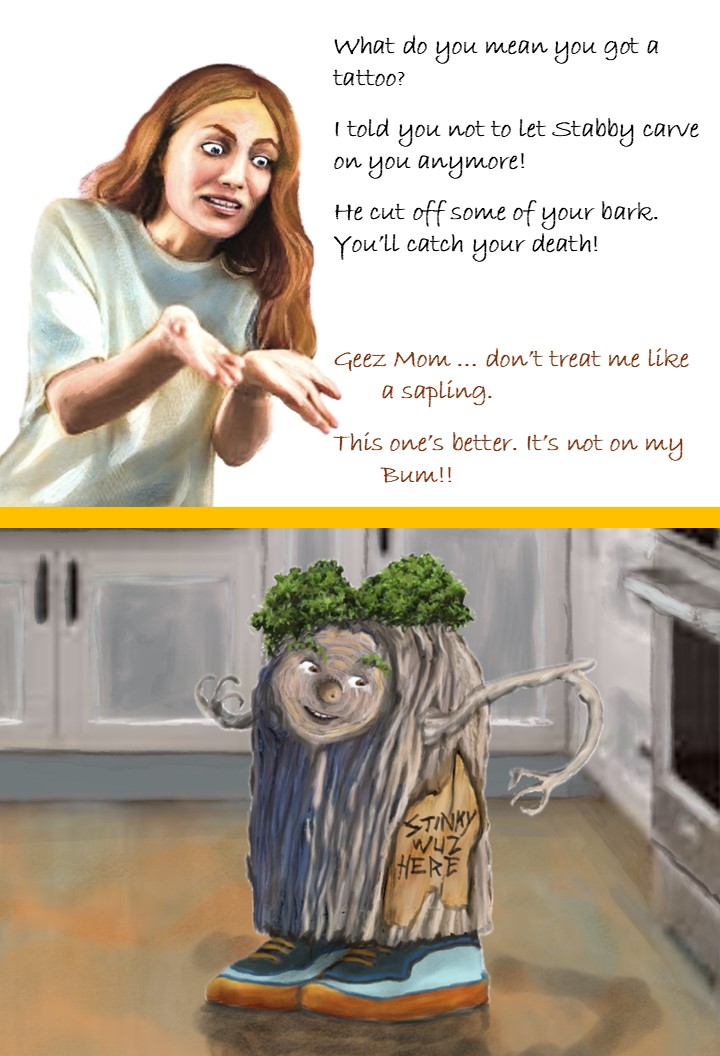
Once Stinky’s loyal fans purchase Origins they may be surprised to discover that what seemed as harmless fun before has become a form of voyeuristic bullying, like those who laugh at the kid who is clumsy or uncoordinated or God forbid, the smelliest person on the face of the earth.
Dark comedies often find humor in tragedy, but I do not believe that is what Cox intended. He ensures that every laugh comes with a little dose of shame. I understand now why Origins was not published with the original series. I do not understand, however, why it was published at all. It was clearly intended to provoke rather than entertain.
There is a lesson here. But it is not an easy one to unpack and every reader will draw their own meaning from the tale or perhaps find no meaning at all. I imagine Cox knew what he intended with Origins, but dead men tell no tales.
Here in lies the problem when an artist dies. His estate controls his collected works. And like all estates, there are always behind the scenes efforts to bring every “lost” story or unfinished work to the reading public. And if the work is as popular as the Stinky series the fans will clamor for it with all the attendant merchandise.
Without giving the game away, Stinky Origins and Compendium takes place on a deserted island, essentially Cox’s satirical version of HG Wells classic Sci Fi tale The Island of Dr Moreau. Cox works Well’s repeated house of pain quote and the beast’s law for all of their horrid comic potential. The relentless repetition of the same gags, over and over again, drives the point of the true tragedy home. Eventually, the reader begins to helplessly laugh at the sheer horror of Stinky’s hopeless circumstances.
This is the sort of laughter that people who have experienced true despair understand well. The time stamp on the Stinky Origin illustrations date back to 2025, when Donald Trump was president and Immigration & Customs Enforcement (ICE) began using lethal force on protesters and immigrants. I’m tempted to wonder if the conception of Stinky as a tormented and alien figure was birthed during that dark era.
Although I see the value in calling attention to the misfortune of the alien to encourage ‘the better angels of our nature’ I’m also disappointed in the loss of innocence for the original comic series once it’s fully subsumed by the dark message of Origins.
But what bothers me the most is that I waited too late to share the world of Stinky, Stabby and Stumpy as Cox originally intended it, a story he made up while pushing his eldest grandson Campbell on a swing when the three year old tyke asked for a story.
Perhaps I am a naïf, but I prefer to remember the series as a tall tale made up to entertain a little boy and for no other reason moral or otherwise. Who knows, perhaps the laughter of a child might someday make the world a better place.
Thanks for Reading - Bob Block on Books - 07/19/2051
Notes & Photos:
*Once he published what he learned on Rock Island Professor McFarland was hounded from his profession as a raving lunatic.
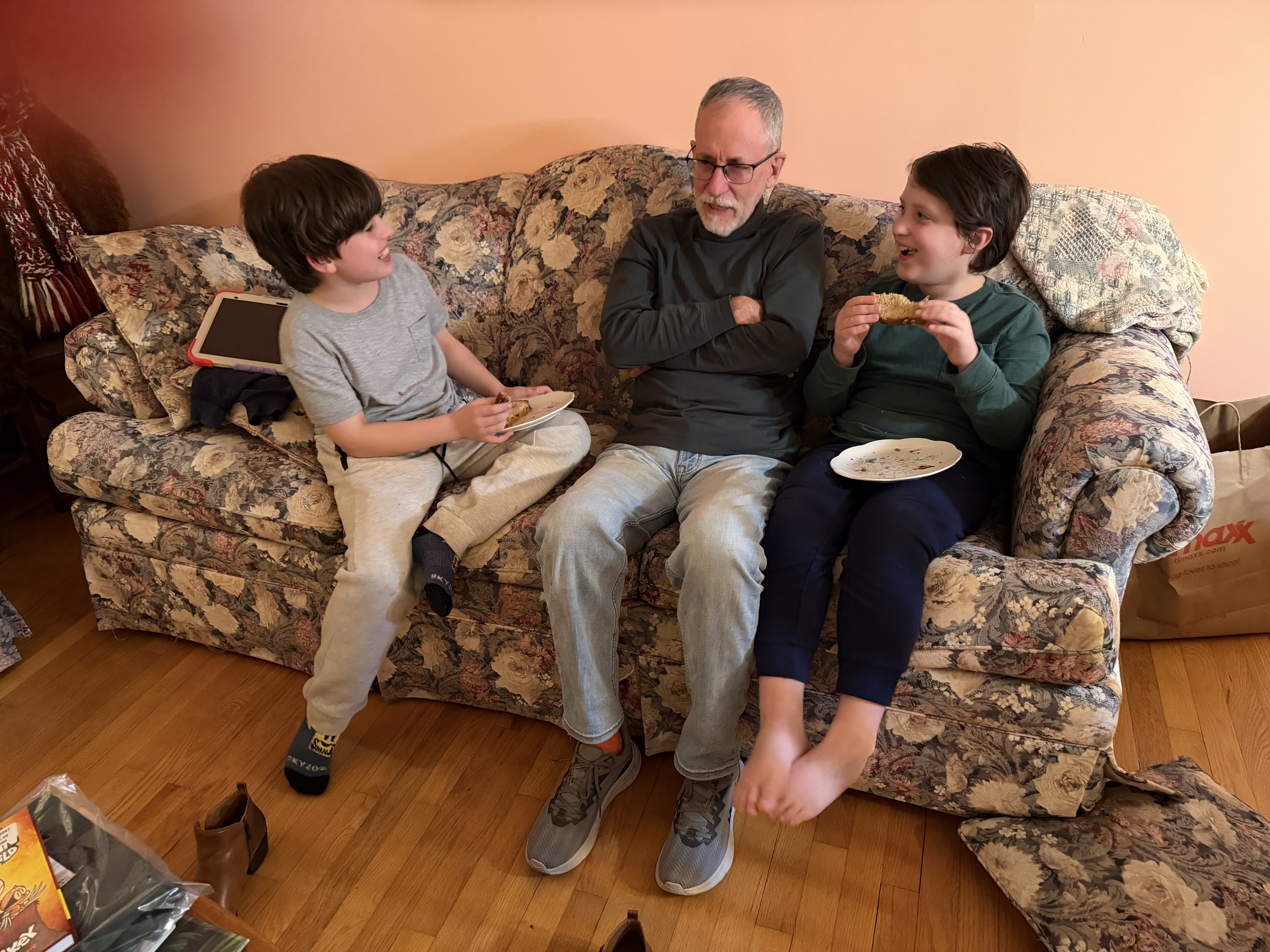
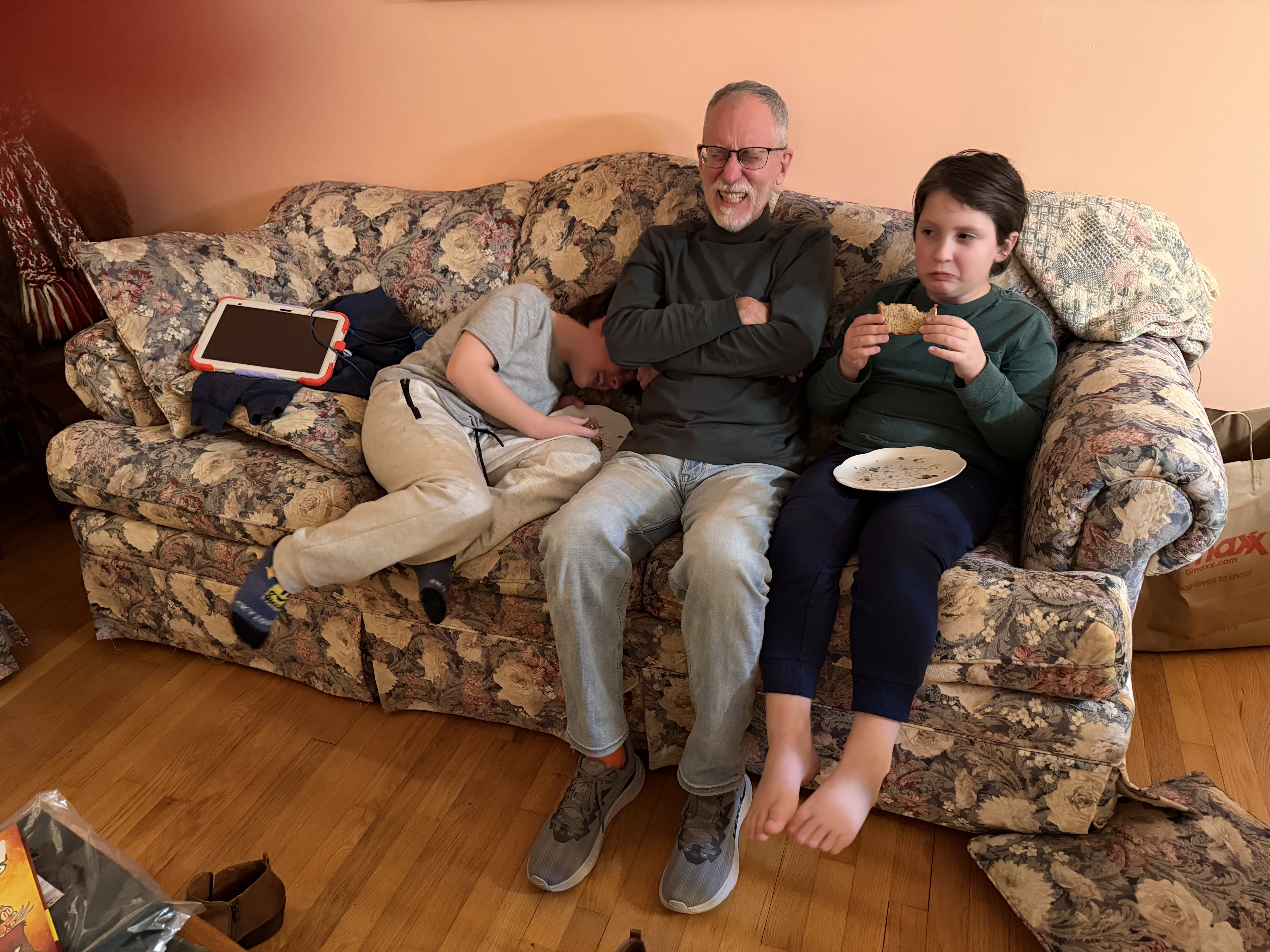
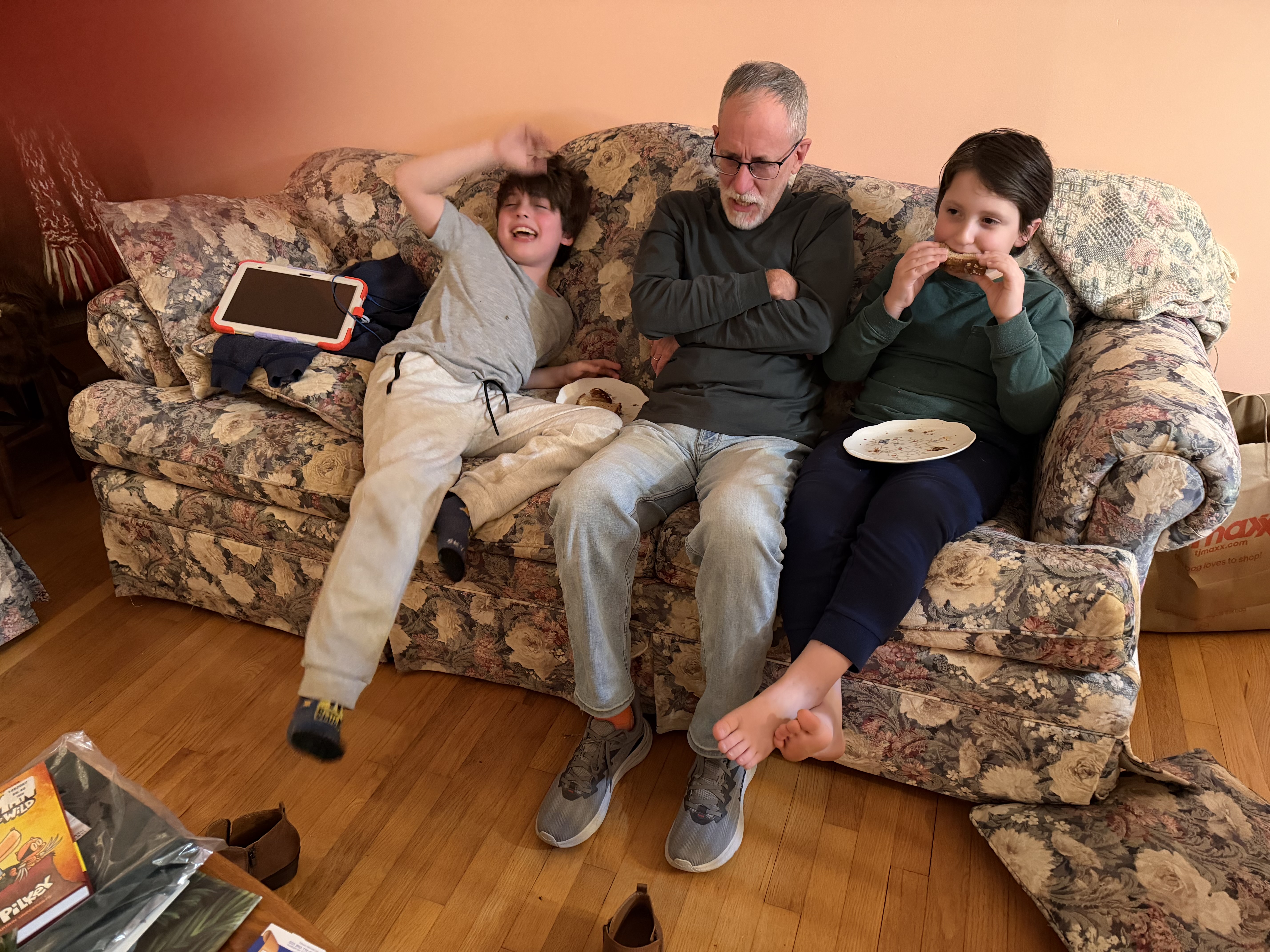
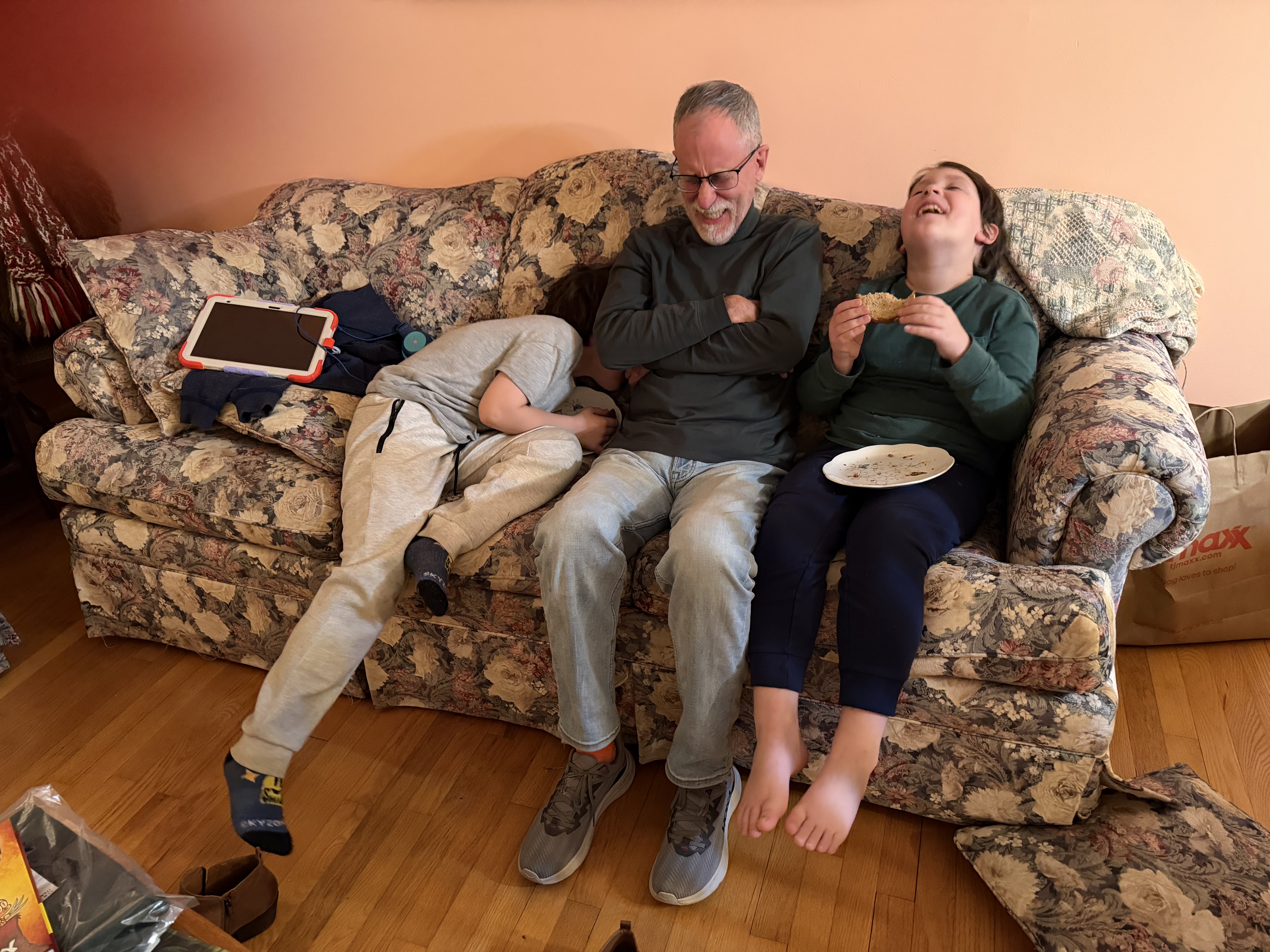
For those few of you who have not seen them already on the Stinky and Friends website, I have attached a few photos of Cox telling his grandsons the story Stinky Wuz Here. Campbell is on Cox’s left and Hunter on his right. Is it just me or does it look like grandpa is laughing harder than his grandsons?
About the Creator
John Cox
Where would you like to travel? Who would you like to meet? No ticket required, a surprise at every destination guaranteed. Strap on your time travel goggles and bring a compass. It's sometimes bumpy in my imagination, so hold on tight!
Enjoyed the story? Support the Creator.
Subscribe for free to receive all their stories in your feed. You could also become a paid subscriber, letting them know you appreciate their work.
Comments
There are no comments for this story
Be the first to respond and start the conversation.