
My Interview with The End of Everything Booker Prize Winner
M. John Harrison has a lot to say

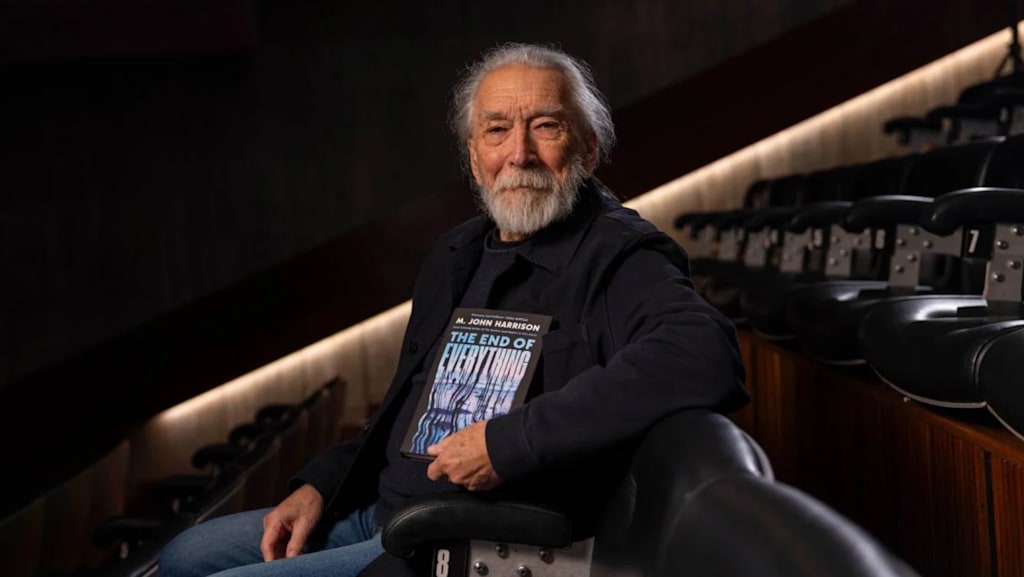
It is 9:00 AM on the day after the Booker Prize, and M. John Harrison does not have a hangover.
Instead, he is radiant, vibrating with opinions, and sitting across from me in a cramped London café, expecting me to nod along like his most devoted disciple.
“Writing or reading, my overall relationship with a book is always romantic,” he says, leaning forward over a cold americano. He expects a profound look of agreement. I give him the same blank stare my Shiba Inu, Yoshi, gives me when I tell him to stop chewing the baseboards in our Hoboken apartment.
But Harrison is unstoppable. He’s spent decades being the best-kept secret in British literature, and now that he has £50,000 and a trophy, he is going to make me suffer through every single thought he’s ever had.
He immediately launches into a diatribe about tech billionaires. “I find Musk’s love of sci-fi frightening,” he barks, expecting me to join the anti-Silicon Valley chorus.
After spending the full week in London interviewing almost prize-winning novelists, who all have a lot to say, I just want to be home drinking chilled Pinot Grigio out of a plastic cup on my balcony overlooking the Hudson, but instead, I have to pretend I’m deeply invested in the geopolitical ramifications of The End of Everything.
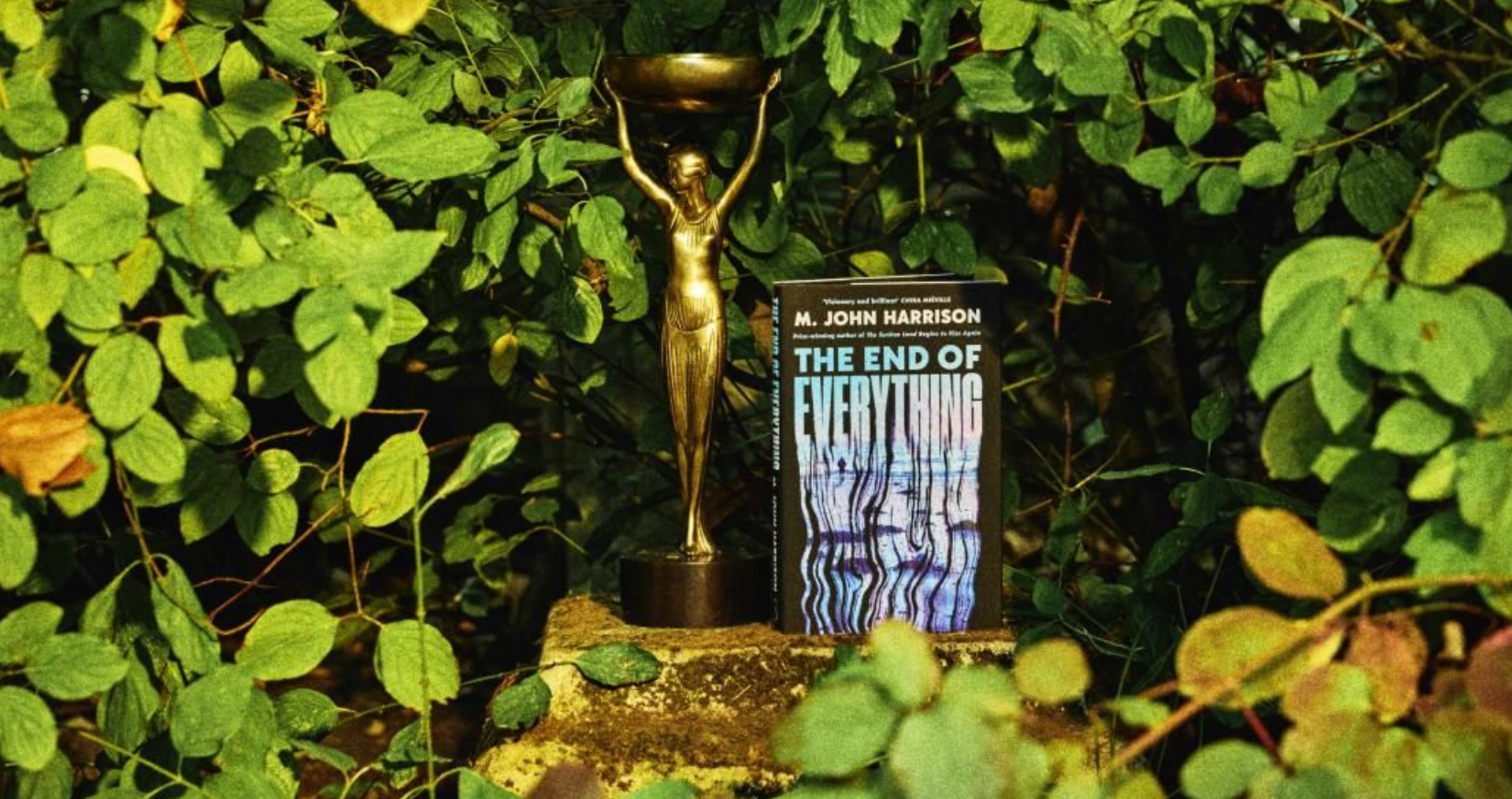
Harrison shifts effortlessly from Elon Musk to the limits of human cognition, recalling his chat with Chris Power: “If we met a real alien we’d have no clue what they thought.”
I nod weakly, my thumb secretly scrolling through pictures of my dog on my phone. Personally, if I met an alien, I’d ask if they knew how to make a Shiba sit on command, because twenty hours of training has yielded zero results.
Harrison starts rambling about British history, then stops mid-sentence. His eyes narrow behind his glasses. “You’re not doing it, are you?”
“Doing what?” I ask, blinking.
“Paying attention,” he says, his voice dropping into a sharp, schoolmasterly tone. “I am breaking down the distinctively British ‘keep calm and carry on’ attitude during a societal collapse — concepts heavily influenced by John Wyndham, J.G. Ballard, and Robert Aickman — and you are staring at your lap. What is on your phone that is more compelling than the failure of explanation in modern society?”
“I was just… checking the time,” I stammer. “To ensure we get through the part about the 2008 financial crisis from Tom’s podcast.”
Harrison not being hungover is a personal tragedy. I was praying for a man defeated by champagne, a man who would give me monosyllabic grunts so I could wrap this up and catch the early flight back to Newark.
“I haven’t even gotten to the 2008 crisis!” Harrison snaps, slamming a hand on the table. A nearby barista shoots us a look. “I was about to explain why massive, 1,200-page doorstop novels are an exhausting, self-indulgent blight on the literary landscape! But clearly, you’d rather read a tweet.”
“Look, Mike,” I say, the lack of sleep and the desperate craving for chilled wine finally breaking my professional filter. “It’s a 13th novel. You’ve had too much to say about it since yesterday. The whole world has heard your opinions on romance in reading. I just need three usable quotes so I can go home to New Jersey.”
“New Jersey?” Harrison scoffs, his voice rising. “I am offering you a structural breakdown of the apocalypse, and you are worrying about a flight to Newark? This is exactly the kind of intellectual laziness that caused the financial crash!”
“The financial crash did not happen because I want to go home and see my dog!” I yell back, standing up.
“Excuse me, gentlemen,” the café manager appears, hovering over our table with absolute firmness. “You’re making the other guests uncomfortable. I must ask you both to leave. Right now.”
We glare at each other, pack our bags in furious silence, and storm out onto the rainy London pavement. The door clicks shut behind us.
Harrison stands under the awning, adjusting his scarf, looking suddenly stranded. He turns to me, his anger instantly dissolving into an awkward, calculating squint.
“Look here,” Harrison says, clearing his throat. “Are you hailing a black cab to the airport?”
“Yes,” I say flatly, raising my arm to a passing taxi.
“The thing is,” Harrison says, stepping closer and tapping his coat pocket, “I haven’t actually cashed the Booker Prize yet. The banks are closed for the morning. Mind if we share?”
I stare at the literary giant of the century. I stare at the taxi pulling up to the curb. I think of Yoshi. I think of the Pinot.
“Fine,” I growl, opening the door.
Harrison slid in next to me and the door of the black cab slammed shut, sealing us inside a damp, leather-scented microcosm of tension. Outside, the London rain streaked the windows; inside, the meter was already ticking on my personal credit card.
I leaned my head against the glass, closing my eyes. I was exactly three hours away from escaping this country.
“It’s a long-short ‘i’, you know,” Harrison said suddenly.
I didn’t open my eyes. “What?”
“The way you said it back there. Ee-ghetti. The alien in my novel. You said it entirely wrong,” Harrison lectured, turning in his seat to face me fully. “It’s a glottal stop followed by a hard, greedy vowel. I-Ghetti. Like I get it. You’re completely missing the cadence.”
“My article will be in print,” I groaned, keeping my eyes closed.
“This is exactly the failure of explanation I was talking about on Tom’s podcast!” Harrison insisted, his voice rising over the hum of the taxi. “If the press cannot even pronounce the name of the entities occupying the rubble of the Kent coastline, how can we expect the public to grasp the slow-collapse of the post-2008 fiscal landscape?” Harrison takes a deep breath. “It is I-Ghetti. Say it.”
“No.”
“Say it correctly or this interview is over.”
“The interview is over, we got kicked out of the café!” I yelled.
Harrison sat back, sniffing disdainfully. “Fine.”
About the Creator
Scott Christenson🌴
Born and raised in Milwaukee WI, living in Hong Kong. Hoping to share some of my experiences w short story & non-fiction writing.
Enjoyed the story? Support the Creator.
Subscribe for free to receive all their stories in your feed. You could also become a paid subscriber, letting them know you appreciate their work.
Comments
There are no comments for this story
Be the first to respond and start the conversation.