

“It’s the robins taking the little pots, then?”
“Blackbirds,” Thomas said. “The robins have opinions about the blackbirds taking the little pots.”
Nia smiled into her tea.
Beyond the open kitchen wall, a pair of blackbirds were pulling the lining from a seed basket. The garden’s watering system worked quietly beneath the soil. Above the roofs, a passenger carriage slipped between two towers, its pale underside briefly catching the sun.
“Shall I move the basket?” Tomas asked.
“Give them the lining. We’ve more in the cupboard.”
A robin appeared on the low wall beside him.
He glanced at it. “There’s your supervisor.”
Nia was about to answer when the bird tipped its head.
One foot rested on the moss. The other was tucked beneath its breast. It watched her with the unhurried attention of something that had arrived for a reason.
She lowered her cup.
In the hall behind her hung three birds made from pebbles.
Two large, one small. Faded red paint. A crooked twig. The smallest bird had slipped sideways at some point in the family’s history, and nobody had ever quite had the heart to straighten it.
“Nia?”
“Leave some of the coir loose,” she said. “They’ll come back for it.”
She did not tell him what she was remembering.
Elin had come home from the meeting with a headache and a leaflet folded so tightly that the paper had split.
The road needed widening. The hedge would go. The strip of ground behind it, where the children looked for beetles and the older neighbours sat in summer, had been coloured grey on a plan.
She had asked about the nests.
A man had smiled before answering her.
That was the part she kept returning to while she put the kettle on. The smile. As though she had brought a child’s concern into a room where serious things were being decided.
Her phone lit up.
You did your best. Try not to get upset.
She turned it over.
“Mam?”
Lisabeth stood in the doorway holding a broken pencil.
“Just a minute.”
“Can you—”
“Lisa. Please.”
The child stopped.
Elin heard herself then: the sharpness she had carried out of that room and brought into this one.
She set down the spoon.
“I’m sorry. Come here.”
Lisa came slowly. Elin crouched, took the pencil, and kissed the place where her daughter’s hair parted.
“Let’s find the sharpener.”
At the window, a robin landed on the rim of the empty water dish.
Lisa noticed it first.
“He’s waiting.”
“Probably wants a drink.”
“Then we should give him one.”
Such a small correction to the afternoon.
Elin filled a jug. They went outside together.
The robin moved to the fence while Lisa poured, then returned before they had reached the door. Elin watched the quick dip of its beak, the tiny movement in its throat.
Her grandmother would have said someone had sent him.
Angels in disguise, she used to call them. The birds, the old dog who knew which chair to rest his head against, the creatures that seemed to find you when you could no longer explain yourself to another person.
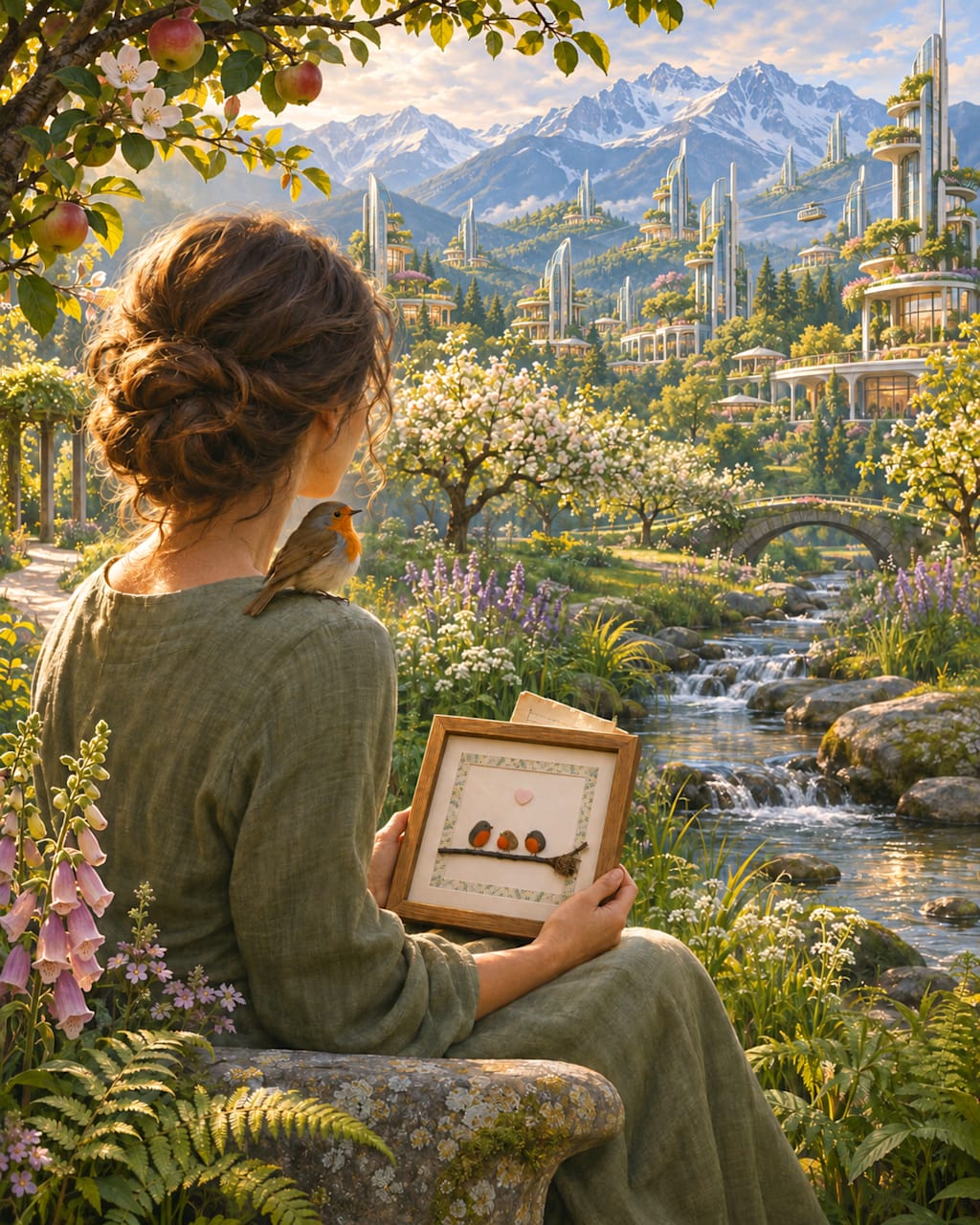
On the kitchen windowsill stood the pebble robins her grandmother had given her.
There was a note behind their backing. Elin had found it when the frame first came to her.
If one comes close, be still a while. There may be something you have forgotten to hear.
She had kept the note, though she had never quite known what to make of it.
Now Lisa leaned against her.
“Will they leave his hedge?”
“I don’t know.”
“Can you ask again?”
Elin looked down at the small hand resting on her sleeve.
“Yes,” she said. “I can.”
Nia had first read Elin’s addition to the note at twelve, sitting on the floor while her mother repaired the frame.
She remembered being surprised by the handwriting. There were crossings-out. One sentence climbed towards the edge of the page. Until then, ancestors had mostly been names spoken at gatherings, or faces restored from old photographs. Here was a woman who had run out of room.
Later, Nia learned that Elin had written poems.
One line had stayed with her.
Why the robin lands just close enough and stays longer than it should.
As a child, Nia had thought the last part strange. How long should a robin stay?
She understood the question differently now.
In the garden, the bird hopped down from the wall.
A maintenance device emerged beneath the fruit trees, paused beside a fallen branch, and folded its cutting arm away. Something was nesting in the hollow end. It marked the branch for a gardener and moved on.
Thomas carried the breakfast things inside.
Nia watched the robin search among the leaves.
Then she went to fetch the frame.
That evening, Elin knocked on the door of the woman who lived three houses down.
She had seen her at the meeting, sitting near the back with both hands resting on a walking stick.
“I’m going to write to them again,” Elin said. “Would you like me to include anything?”
The woman looked past her towards the hedge.
“My husband planted some of that.”
Elin took her phone from her pocket, then hesitated.
“Can I finally take that cup of tea you always offer?”
By the time she left, there were two cups in the sink and a photograph waiting to be copied.
She went to another door the next day.
Some people were too busy. One disagreed with her. A young father said he needed the safer crossing the road plan promised, and Elin went home and read the proposal again.
She began a new page.
There had to be room to ask for both.
At night, after Lisa had gone to sleep, she wrote something else.
She put her grandmother’s note on the table beside her own.
For whoever has these birds after me,
I used to think my grandmother meant they came to comfort us.
Perhaps they do. But today a robin waited beside an empty dish, and my daughter understood what to do before I did.
I have been wondering how often we ask for a sign, then carry on exactly as we were.
If you are anything like me, someone will tell you that you feel too much. Find the others who feel it too. You will need one another. Listen to what they are trying to save.
She stopped. Upstairs, a floorboard creaked beneath Lisa’s turning feet.
Elin waited until the house settled.
I dream of a garden where a child can be safe without everything wild being cleared away. Somewhere people have enough, and no one has to make themselves hard to be heard.
I would like to know that place.
If you reach it, will you show me?
She signed her name.
While the ink dried, she rested her head on her arms.
For a few moments she was somewhere else.
There was water moving over stone. She could smell something growing that she did not know the name of. Beyond it rose the dark shoulders of mountains, and between them—
“Look.”
She lifted her head.
The kitchen was quiet.
Outside the window, the robin sat on the fence in the last of the light.
She stayed there until it left.
Then she folded her page around her grandmother’s and placed them both behind the birds.
By midmorning, Nia had reached the garden.
She carried the frame wrapped in a cloth, although she knew its old wood was stronger than it looked.
There were other things her family had kept: a silver button without its coat; a list of names in three different hands; a key nobody could place. The frame had a darkened corner that no amount of careful cleaning had lifted. Beneath its newer backing, the older papers bore the marks of other homes.
Nia had grown up among these things. Sometimes she had held them without thinking.
Today she was careful.
The garden lay where the city opened towards the mountains. A stream passed through it on its way to the lower growing terraces. Children could follow the water almost to the river, crossing the same paths used by the people who tended the fruit trees.
Along the eastern beds, small instruments measured what the soil needed. A gardener knelt beside them with a handful of earth, checking for herself.
Nia greeted her and followed the path uphill.
She had been asked to bring something for the children visiting the next morning. Something from the time before their grandparents’ grandparents.
Until breakfast, she had been planning to bring a photograph.
At the sheltered bench, she unwrapped the birds.
There would be time to show the children the old frame, to let them puzzle over the uneven pebbles. She could read them the note. Then they could walk the garden with the people who worked there and ask what needed doing.
She rested the frame beside her.
A robin landed on the back of the bench.
Nia smiled.
“Did you follow me?”
It moved closer.
She held still as it stepped onto her shoulder.
The feet were warm through the thin fabric of her shirt. She could feel each tiny adjustment as the bird found its balance.
Then, beneath the sound of running water, a kettle began to boil.
Nia caught the scent of a kitchen she had never entered.
There was a child moving upstairs.
And near her, so near that Nia felt the breath catch, a woman was trying to see.
For all those years, the little bird had been carrying the way between them.
Nia turned slowly towards the view.
Beyond the garden, skyscrapers rose among the mountain slopes. Trees spread from their terraces; green passages joined their lower floors. Small birds gathered beneath the planted eaves. Higher still, the mountains held the last white traces of winter.
There was room to see them both.
Nia felt the woman beside her grow very still.
“Here,” she whispered. “Look.”
The robin settled against her neck.
And stayed.
About the Creator
Enjoyed the story? Support the Creator.
Subscribe for free to receive all their stories in your feed. You could also become a paid subscriber, letting them know you appreciate their work.
Comments
There are no comments for this story
Be the first to respond and start the conversation.