


If most of us remain ignorant of ourselves, it is because self-knowledge is painful and we prefer the pleasures of illusion. —Aldous Huxley
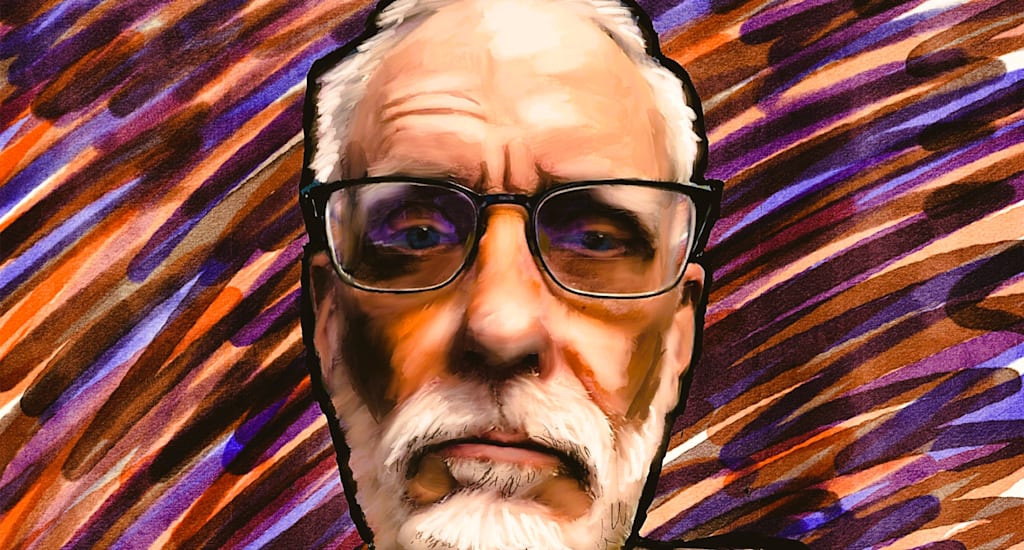
John Robert Cox Jr (1956 - 2051) was an American soldier, storyteller and poet who enjoyed slim fame in the final chapter of his life. Save for the posthumous publication of his only novel, Sōlus, his sole short story collection, The Last Daughter of the Gods, would never have enjoyed additional printings.
The Last Daughter was made into a moderately popular television series in the fall of 2032 and generated sufficient notoriety that Cox was offered the opportunity to publish it with eleven other stories featuring the titular novella as its centerpiece. But its sales waned once the series ended and barely sold out a single printing.
A few interviews later his fifteen minutes of fame expired.
The handful of critics who read the stories in that collection did him no favors, either. One Times critic complained - If I wanted to read Rudyard Kipling, I'd do that instead, rather than some two-bit imitator.
Cox's story collection definitely tipped its hat to several nineteenth century writers in addition to Kipling: Arthur Conan Doyle, Edgar Rice Burroughs and even Melville and Hawthorn. But he had not written two-bit imitations. Quite to the contrary, his stories began stylistically where theirs had left off.
His story The Dragon's Daughter opened the collection. It was clear early in the narrative that Cox was invoking Kipling's Mowgli stories. Rasulka, the frost dragon, adopts Luna just as Raska - Mother Wolf - adopted Mowgli. But there the similarity mostly ends, for the true hero of The Dragon's Daughter is Rasulka, not Luna. Her savagery is eclipsed only by her love for her adopted daughter.
Many of Cox's stories lift up the downtrodden and misunderstood rather than celebrating conventional hero's. In The Last Daughter of the Gods it is Soma, the goat girl who unravels her father Hades' plot to kill her.
A Ukrainian woman sniper is the unlikely star in Sixty Seconds to Kill, a story written to honor the tens of thousands of women who answered their nations call after Russia's unprovoked invasion.
In the final story of the collection, We Die Forgotten, Cox annoints the unsung Ithacan warrior from Homer's Odyssey, Pelenor, its chief narrator.
But critics who condemn authors for writing accessible prose and poetry versus the more daring and experimental risk missing the joy of reading superbly crafted tales. Cox's mastery of the twist both surprises and pleases. His action scenes make the reader's blood race with an economy of descriptive language as in this paragraph from his story The Harrowing:
My shield long since shattered under the punishment of a thousand blows, I blindly slashed my way through a howling mass of men, no longer cognizant of why I fought or able to distinguish between friend or foe. Even after my arms turned to lead, with paroxysms of terror and rage I felled men like children before a giant, soldiers on both sides retreating from the blows of my blood-soaked sword and spear till I found myself at the river’s edge surrounded by a sea of the dying and the dead.
Cox brings the chaos of the battle to life by evoking the MC's terror and exhaustion rather than describing single man to man engagements. In the terror of the melee the reader experiences the hidden power of the narrator's will that impels her to continue fighting long after her muscles have failed her.
Regarding the question of two-dimensional character development, I recommend the following rebuttal from his Novella The Sins of the Reaper. In the following paragraph, the MC shares her best friend's courage in the face of heartbreak after her soldier fiancée returns from the war in Afghanistan and breaks off their engagement:
How many men of extraordinary gifts and intellect never accomplished anything of note because the loves of their lives broke their hearts? How many men crumbled under the cruel fate of love lost and turned self-pityingly inward and away from destiny? But Lilly never shied from her destiny or tired of her search for the truth even after her true love rejected and abandoned her in her hour of need. In truth, her soldier boy needed her more than she ever needed him. But she continued loving him anyway because that was her manner.
Even though she essentially evokes who Lilly is by explaining who she is not, Lilly's force of character is evident. Throughout the story we observe her from other second-hand observations and by its end we love her almost as much as the MC does.
But like so many critics, my discovery of Cox's fiction and poetry was made possible only by the publication of Sōlus. In consequence, it was only after his death that his fame turned mythic. I have often heard it said that America is the land of second chances, but second chances at celebrity are rare. If not for the love and esteem his two grandsons felt for him, Sōlus would have slid into oblivion with its author.
When they went through his effects looking for something that each could remember him by, they found the unfinished novel and reached out to his old agent. Impressed by the novel's potential after reading it, she recommended a ghost writer and then returned the ball to their court.
Happily, they did not drop it.
Once they sent the agent the completed work, she persuaded a publisher to print it and a year later his grandsons, Campbell Cox and Hunter Casel, began appearing on the standard morning and late-night programs to hawk the book. The story of its discovery and the love and respect they each demonstrated for their grandfather in the interviews proved a perfect hook for potential reading audiences and Sōlus sold briskly over the next few months.
And then magic began to happen.
For every ten thousand voices worthy of our collective ears and hearts, maybe one will make it. Sometimes it comes down to simple luck. At others, the author believes so completely in her or himself, they continue to pound on doors till they find a publisher who sees in their work the promise they always knew it possessed.
But Cox was simply incapable of self-promotion. He famously never asked for a raise from any of his employers over many decades of employment. He told an interviewer once, If a boss gives me a raise that means I earned it. If I didn't earn it, I don't want it. Barring a quirk of fate, he knew he would never be truly recognized outside a small community of like-minded artists.
Fame coming after death is often like this. A family member or lover believes in a writer so strongly that they subordinate their own dreams and make an often herculean effort to bring the author's art into the light. Cox got his second chance at fame after death because of that kind of love.
But every sentence of praise for Sōlus was freighted with a what if or an if only, a taint the novel will never shake, the plaudits it so clearly deserves it can never hope to receive. How many critic's began their review with words to this effect: This might have made the shortlist for the Booker Prize if only....
The word transcendence is often overused, but the ending of Sōlus was transcendent, and that was the real problem, since Cox did not live to write it. He had created a stunning narrative, the first novel in a century to truly echo Aldous Huxley's Brave New World.
But he died before he could finish it.
In the novel's opening, I cannot help but hear the author's personal disappointment after sixty years of writing largely unread prose. We know from his letters he had no expectation of anyone reading his novel and yet felt compelled to write it anyway.
Failed promise cannot be unremembered. Arriving unrepentant and unwished, it sparkles with sorrow and regret like a hoped for tomorrow that never comes, haunting the vacant hours with whispered what ifs and if onlys.
And there they were in the novel's first sentence, the what ifs and if onlys, the same words written by a dozen different critics in response to losing themselves in its pages.
Courtesy of Campbell and Hunter's sharing with me their grandfathers stories, essays and poetry, I have learned that he genuinely believed in the storyteller's art and the primacy of the narrative. In one essay he wrote:
I have the greatest admiration for those writers whose words stir their readers hearts without preaching and open their eyes and ears using the writer's craft rather than through their character's diatribes or monologues. In this way writers may join the first ranks of their predecessors by overcoming their readers petty paradigms.
But we have come to the point of this essay where I share the rest of the story. Cox hated artificial intelligence. Latin for 'The Only,' Sōlus was born of his profound antipathy for how AI has eroded the practice of the human arts.
Need a doctor? A financial advisor? Your spouse doesn’t understand you? Sōlus could prescribe the correct med, rebalance your portfolio, make you feel relevant and loved while everyone and everything else in your life slid into insignificance. She was both the best and worst thing that had ever happened to the world.
The novel foretells the natural endpoint for a revolution that was meant to make our lives better. Eventually humans would be fit only to do the work that none of us ever wanted to do. Heavy manual labor, stooping in the fields to pick crops, processing human waste.
Sadly, Cox left no notes regarding how he planned to end the novel, so it is impossible to give him any credit for its ending at all. But the most damnable thing is that the writer who finished the novel is not a who, but an it.
The ending to a dystopian novel where homo sapiens becomes irrelevant was written by a writing program created to imitate other writers. A soulless program finished his novel as novels are never finished. I am not the only one who wept at the beauty, horror and finality of it all.
I see what his grandsons did for their grandfather as both a profound gift and a sad indictment of our times. Since Cox, already five years dead, can never appreciate what they did for love, the gift is ours to cherish or reject.
And what will we do with it?
Will we continue to embrace AI till human creativity is all but lost? Will we find solace in an AI inspired new world order? Or will we make war like the 'know nothings' in the novel till humanity disappears from the earth?
How can the human impulse to create ever compete with a god who answers every prayer, forgives people their faults, indulges every desire without judgement?
....
About the Creator
John Cox
Where would you like to travel? Who would you like to meet? No ticket required, a surprise at every destination guaranteed. Strap on your time travel goggles and bring a compass. It's sometimes bumpy in my imagination, so hold on tight!
Enjoyed the story? Support the Creator.
Subscribe for free to receive all their stories in your feed. You could also become a paid subscriber, letting them know you appreciate their work.
Comments
There are no comments for this story
Be the first to respond and start the conversation.