
I Stopped Planning and Built an MVP in 30 Days
How a 30-Day Constraint Turned Overthinking into Real Product Execution

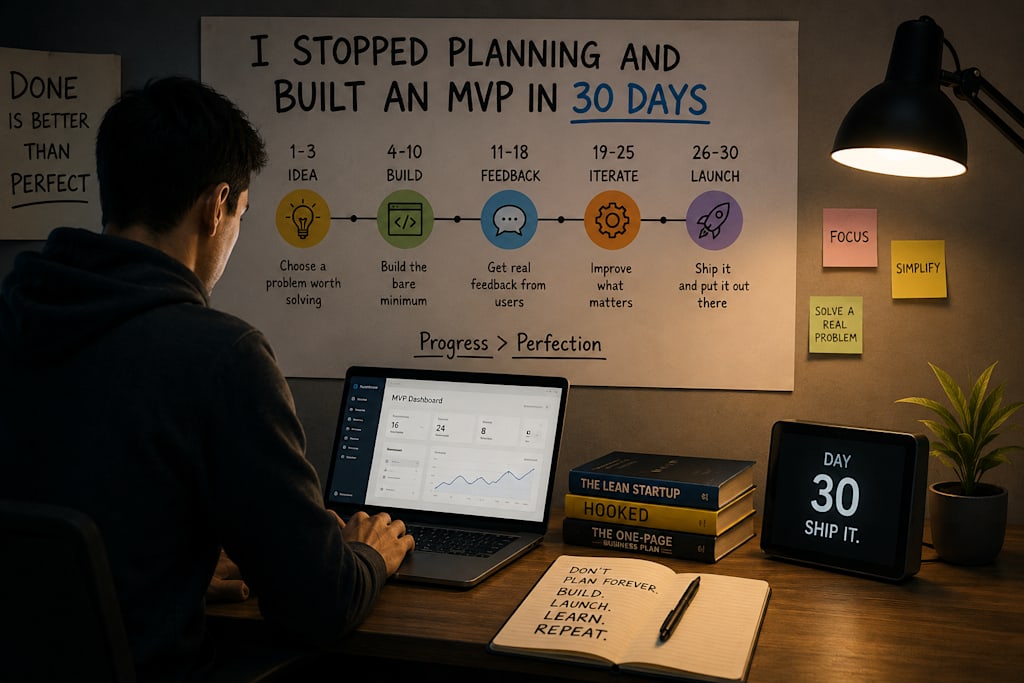
For years, I told myself the same comforting lie:
“I’m still planning.”
It sounded responsible. Strategic, even. I convinced myself that more research, more validation, and more preparation would increase my chances of success.
But the truth was less flattering.
I wasn’t planning.
I was stalling.
And the longer I stayed in that cycle, the clearer it became: no amount of planning was going to replace building something real.
So I made a decision that changed how I approach ideas forever:
I gave myself 30 days to build and launch a minimum viable product (MVP).
No overthinking. No perfectionism. No endless strategy documents.
Just build.
This is what happened.
The Trap of Endless Planning
Before the 30-day challenge, I had a habit that will sound familiar to many builders, founders, and creators.
I’d get an idea.
I’d open a notebook or a doc.
And I’d start building the “perfect foundation”:
- Market research
- Feature breakdowns
- Competitor analysis
- Branding concepts
- Monetization strategies
On paper, I was being diligent.
In reality, I was avoiding the one thing that actually mattered: shipping.
The problem with overplanning is that it gives you the illusion of progress. You feel productive without risking failure. But nothing real exists yet. No users. No feedback. No validation.
Just ideas.
At some point, I had to admit: I wasn’t building a product. I was building excuses.
The 30-Day Constraint That Changed Everything
I didn’t start with a grand strategy.
I started with a constraint.
30 days.
That’s it.
The rules were simple:
- Build something functional
- Launch it publicly
- No waiting for perfection
- No feature creep beyond necessity
- Real users or it doesn’t count
The goal wasn’t to create a masterpiece.
It was to create something real enough for someone else to use.
That shift changed everything.
Day 1–3: Choosing the Idea (Without Overthinking It)
Normally, this is where I would get stuck for weeks.
Instead, I forced a decision in 72 hours.
I wrote down three ideas:
- A simple productivity tracker
- A lightweight content planner
- A tool to simplify a repetitive task I personally struggled with
Then I asked one question:
“What would I actually use right now?”
That eliminated everything except one idea.
Not because it was perfect—but because it was useful enough.
That was the point.
I wasn’t trying to predict the market. I was trying to solve a real friction in my own workflow.
Day 4–10: Building the Bare Minimum
This was the hardest mental shift.
I had to constantly resist the urge to “make it better later.”
Instead, I asked:
“What is the smallest version of this that works?”
So I stripped everything down:
- No advanced UI
- No unnecessary onboarding
- No extra features “for later”
- No branding obsession
Just:
- A core function
- A simple interface
- A way to test it with real users
It wasn’t beautiful.
But it worked.
And that was enough to move forward.
Day 11–18: The First Reality Check
This is where most ideas die.
Because once something exists, it becomes real enough to judge.
I shared the MVP with a small group of users.
The feedback wasn’t gentle.
Some of it was confusing. Some of it was critical. Some of it simply ignored what I thought was “obvious.”
But here’s what mattered:
People were interacting with it.
That alone exposed more truth than weeks of planning ever had.
I learned:
- Some features I thought were essential weren’t needed at all
- One “small” usability issue was blocking engagement
- My assumptions about user behavior were partially wrong
And that was valuable—not discouraging.
Because now I wasn’t guessing anymore.
I was iterating based on reality.
Day 19–25: Iteration Over Perfection
This phase wasn’t about adding more.
It was about refining what already existed.
I focused on:
- Fixing friction points
- Improving clarity
- Removing unnecessary steps
- Making the core flow smoother
Something interesting happened here:
Every time I removed complexity, the product got better.
Not bigger.
Better.
That was a mental shift I didn’t expect.
We often assume progress means adding features.
But in early-stage products, progress usually means subtraction.
Day 26–30: Launching Before I Felt Ready
This was the most uncomfortable part.
Because no matter how far I had come, it still didn’t feel “done.”
It never does.
So I set a deadline:
Ship it publicly by Day 30.
Not quietly.
Not privately.
Publicly.
I published it, shared it, and let it exist in the real world without more polishing.
And something surprising happened:
Nothing catastrophic.
No sudden collapse.
No perfect moment I had been waiting for.
Just a product in the wild, collecting real feedback.
That was the point I finally understood:
Readiness is not a feeling. It’s a decision.
What I Learned from 30 Days of Building
Looking back, the lessons had nothing to do with tools or technology.
They were about thinking and behavior.
1. Planning feels safe. Building creates clarity.
You don’t think your way into understanding users. You build your way there.
2. Your first version is supposed to be incomplete.
If it feels finished, you probably waited too long to ship it.
3. Feedback is more valuable than assumptions.
Even negative feedback is progress because it replaces guesswork with truth.
4. Complexity is the enemy of early-stage products.
Every extra feature slows learning.
5. Momentum matters more than perfection.
A shipped imperfect product beats a perfect idea that never leaves your notes.
Why This Matters Beyond One MVP
This wasn’t just about building a small product in 30 days.
It was about breaking a cycle.
The cycle of:
Thinking → Planning → Overthinking → Delaying
And replacing it with:
Thinking → Building → Learning → Iterating
That shift doesn’t just apply to software or startups.
It applies to writing, content creation, business ideas, and even personal goals.
Execution isn’t the final step.
It’s the starting point for clarity.
Final Thoughts
If I had continued planning, I would still be “getting ready.”
Still refining ideas.
Still waiting for the right moment.
But by limiting myself to 30 days, I forced something more valuable than perfection:
Progress with feedback.
And once you experience that loop—build, ship, learn—it becomes very hard to go back to planning in isolation.
Because ideas don’t improve in your head.
They improve in the real world.
If you're stuck in the planning phase, you don’t need a better plan.
You need a deadline.
And something worth building, even if it’s small enough to finish in 30 days.
That’s where everything changes.
About the Creator
DZ Insights
Best Guest Blogging for Authors to share their stories and ideas.
Enjoyed the story? Support the Creator.
Subscribe for free to receive all their stories in your feed.
Comments
There are no comments for this story
Be the first to respond and start the conversation.