
I, Paul
for Paul's The Critique The Work of Paul Stewart Unofficial Challenge

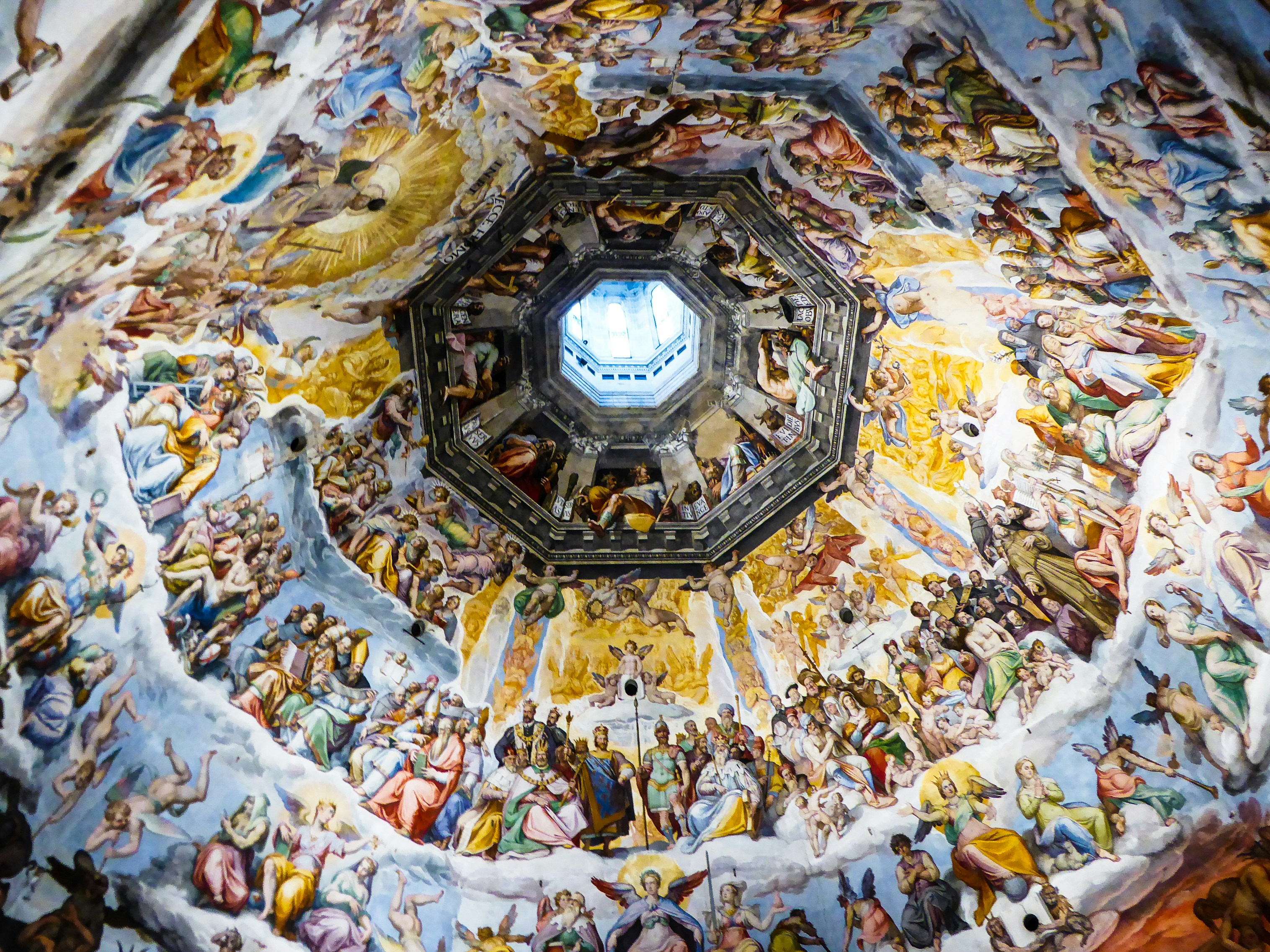
I wish my hyperbolic musings on stonework etchings on a wall behind the Mona Lisa, under the toilets in the Duomo, or shadowing The Creation of Adam
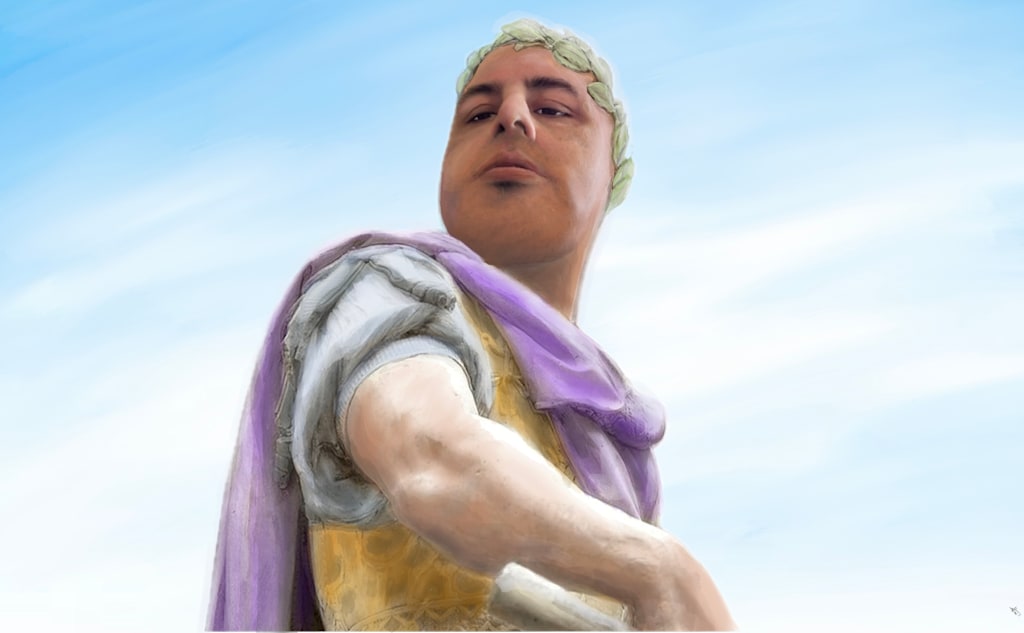
Venit Vidit Vicit, Paul Stewart
Read Venit Vidit Vici for context or not. I'm not the boss of any of you.
Why, man, he doth bestride the narrow world
Cassius, Act 1, Scene 2, Julius Caesar by William Shakespeare
Like a Colossus; and we petty men
Walk under his huge legs, and peep about
To find ourselves dishonourable graves.
Venit, Vidit, Vicit is Latin for he came, he saw, he conquered. Paul breaks the poem up in three parts:
Part One - Venit
Veni, vidi, vici - I came, I saw, I conquered, reputedly uttered by Julius Caesar might be the greatest, most succinct boast in human history. The question, why did Paul reference it in his title in the third person rather than the first?
Let’s look at the text for clues:
He opens the poem with And so I face the final curtain…
Paul imagines his death with a dying wish to be remembered and memorialized. But not in a small way. Does he really want the public to associate his work with two of the greatest paintings in history, the first by Leonardo da Vinci and second by Michelangelo, as well as the largest domed cathedral before the modern era and one of the most beautiful, the Duomo in Florence? Or is this simply a grand artistic flourish suggesting his work should be remembered with the grandest of the illuminati?
Then he asks Why is it too much to hope for such greatness? Why are we taught to think so little? Why indeed?
But Paul is not alone in his wish that his works survive him, such desires are common to the human condition. What sets him apart is the framing of his dreams in his art, and we are inclined to admire him for wishing aloud rather than in secret even if we also think he might be a little crazy.
What separates us from those who actually achieve renown? Is it solely talent? Or is it something more primal, a passion to excel, to reach the pinnacle of our art form, a determination to succeed driving the artist to actually work tirelessly toward it rather than only daydream. But read on. Paul has more to say on the matter. He writes:
Teach my ways, my Practices, and the way in which I deftly infect traditional form and syntax
Every revolutionary advancement, no matter the form, attract imitators in the beginning. But what is Paul asking us to imitate, really? Is it the infection of traditional form and syntax? or something else unstated? Perhaps he merely wants us to challenge the form and make it our own rather than live in subservience to it, something Paul has consistently aspired to during the three years I have read him.
Paul then spends several lines on Vincent Van Gogh's frustration with lack of recognition of his contribution to the art world and his fear that his work was the result of madness rather than genius.
Van Gogh is the posterchild for greatness unrecognized till after he had died. History has treated his experience as a great tragedy rather than a triumph, however. Is this what Paul truly wants? Fame after death versus adulation while he can yet enjoy it? But Paul has only begun his assault on conventional sensibilities when he trumpets:
I am your master, your savior, and your hero, the one you desire-
Rather than writing this off as excessive artistic hyperbole, which is our natural reaction to a seeming declaration of Messianic pretensions, let’s explore the impulse that drives artists to challenge cultural norms, values and beliefs.
Consider these lines from the song Vincent:
Now I understand
What you tried to say to me
And how you suffered for your sanity
And how you tried to set them free
They would not listen, they did not know how….
Don Mclean
The impressionist movement in the pictorial arts challenged the conventional attitudes about the artist's role in championing reason and order and visualizing civic virtue and morality by trying to present the world as it truly is rather than a sanitized version of it. But if Manet and Monet were impressionism's rational deity's, Van Gogh was its mad prophet. I believe it is significant that Paul addressed him in the Venit section of his poem.
I would suggest that Paul has cast himself in many roles on the Vocal stage: cultural and artistic raconteur, experimentalist, gonzo iconoclast, and to use his favored term - king maker. He certainly is tireless in his efforts, often publishing multiple pieces daily while simultaneously somehow finding time to promote new voices on the platform. But is he also a master seeking acolytes? That question is harder to answer.
He ends Venit with an uncredited quote from a sixteen-year-old Salvidor Dali: I'll be a genius, and the world will admire me. Perhaps I'll be despised and misunderstood, but I'll be a genius, I'm certain of it.
Part Two - Vidit
In the beginning of Vidit he sharpens his request, not merely to be remembered among the greats but to Ponder over the many-layered meanings of (his) hyperbole and create streaming platform sensationalized dramas about (his) life....
His unofficial challenges have already begun this work, and we bemused but dutiful acolytes' are participating in his memorialization as (he) dive(s) into the thick of the densest shitstorm of (his) creation and even as I attempt to plum the meaning I find myself the willing (unwilling?) participant in it all.
I wonder if he is redesigning participatory art in the social media age, looking for volunteers to spread his gonzo gospel of a world gone so wrong that only art as a tsunami of excrement can hope to return it to sanity.
Binge it, binge my life in 45-minute episodic form, and debate fervently over the half-truths and outright lies the producers create to sell my story as the next great Succession to the throne....
My apologies, dear readers, but in a 45-minute episodic form? If I write the suggested 15,000 words on this topic, not even Paul will read it!
At this point in the poem, Paul begins to name drop and mash genres like an Orwellian nightmare in which Cthulhu stalks (him) from high. Then he suggests that those mourning his memory create a three-hour, overblown, big-named approach to the biopic of (his) existence in the manner of Martin Scorsese.
In quick succession Paul imagines himself perversely turning down honours and knighthood - I want people to say they loved me through gritted teeth as they fawn over my subsequent dark periods as much as they have a distinct distaste for my very own cubism, my boundary-pushing backward novel or poem within a novel within a graphic eulogy for some unsane propagandist. Call me Judas when I plug my brain into the Matrix and go fully neuroelectric.
Personally, I think the sentence above is off the chart sensational even though I resist parsing it for meaning beyond pointing out how bombastic it is. Perhaps I fear what I might learn if I look any closer. Maybe Paul never intended us to understand any of it but only to viscerally tremble with horror.
Dozens of pop cultural references (influences?) follow with rhetorical questions that nobody would care to answer ie:
How does one acquire a legacy? Can it be bought with Bitcoin? Or hard graft in the dog-eat-dog world of the low-level combative online poetry community? Is he talking about Vocal or are there roving poet gangs in Glasgow rapping Rabbie and Dylan on opposing street corners?
Part Three - Vicit
He rolls up his sleeves for battle in part three with a list of some of literature’s glitterati like Chaucer, Shakespeare, and Austen, sharing a pigeonhole with Doyle (Scottish), Doyle, Thomas, Frost, King, Stoker, Christie, Carrol, Lewis (Carl Lewis was an athlete, incidentally), Stevenson, Burns (Scottish), Welsh (Scottish), Tolkien, Dickenson (oh Dickenson dancing with Poe) and Dahl before trashing living authors like Dan bloody boring as truck Brown, Anne definitely-a-wrong-un Rice, and E.L. James and her chamber of dirty leather-clad, whip-smart secrets....
He rages against the darkness of insipid pop culture by anointing himself the anti-Pop(e) even while asking us to remember (him) as someone who cared.... who carelessly but carefully fashioned his literary incisions with the expertise of a madman with a BSc....
He ends his poetic musings with this quote as his epitaph:
Good friend for Jesus’ sake forbear, To dig the dust enclosed here. Blessed be the man that spares these stones, and cursed be he that moves my bones.
Shakespeare's Epitaph on his grave in Holy Trinity Church, Stratford-upon-Avon
And what should we take away from this ingenious and infuriating ode to his artistic legacy? Is he really serious or joking? The primary purpose of hyperbole is to amplify and draw the audience's attention to the message. But when everything is hyperbolic one tends to focus on the messenger rather than on the message. And perhaps, dear friends, that was the point from the beginning.
To thoroughly misuse Marshall McLuhan’s quote the medium is the message, Paul intends that we are the medium and he is the message. We are given a sacred and profane obligation to remember and love both the man and the mythos that he birthed by telling the world -
Venit (he came), Vidit (he saw) Vicit (he conquered).
About the Creator
John Cox
Where would you like to travel? Who would you like to meet? No ticket required, a surprise at every destination guaranteed. Strap on your time travel goggles and bring a compass. It's sometimes bumpy in my imagination, so hold on tight!
Enjoyed the story? Support the Creator.
Subscribe for free to receive all their stories in your feed. You could also become a paid subscriber, letting them know you appreciate their work.
Comments
There are no comments for this story
Be the first to respond and start the conversation.