
How to Scale a SaaS Product: From Startup Success to Sustainable Growth
Scaling a SaaS product requires more than great software. Learn how to build the technology, processes, and customer-focused strategies needed for sustainable growth in a competitive market.

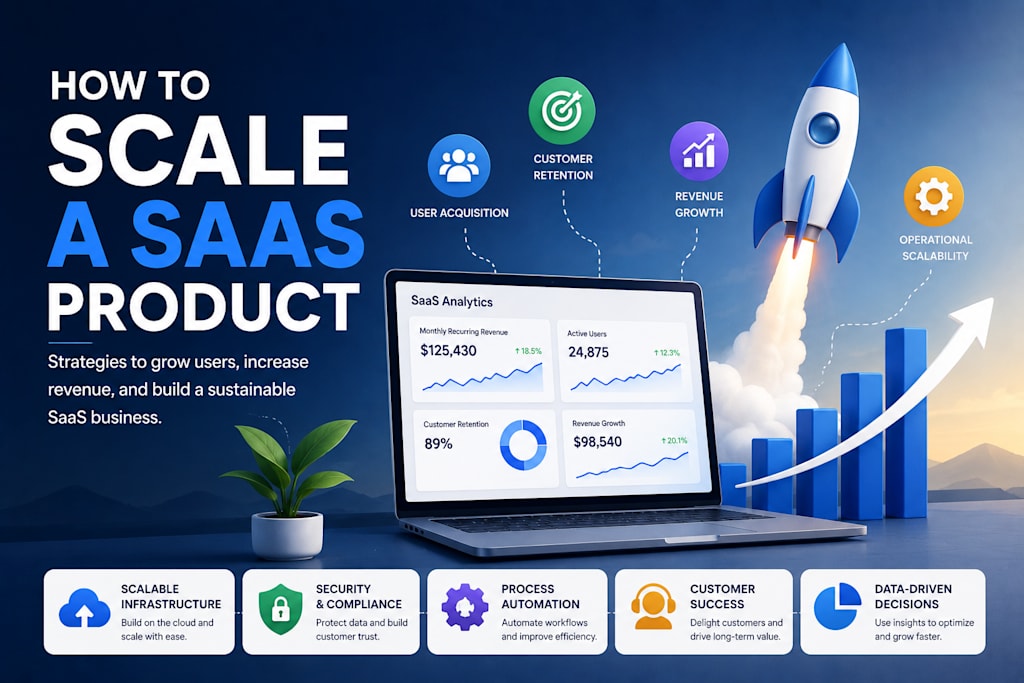
The Software-as-a-Service (SaaS) industry has transformed how businesses operate, collaborate, and innovate. However, launching a SaaS product is only the beginning of the journey. The real challenge lies in scaling it effectively.
Many startups achieve early traction but struggle when demand increases. Servers become overloaded, customer support falls behind, acquisition costs rise, and growth begins to stall. Scaling a SaaS product is not simply about gaining more users—it's about building systems, processes, and teams capable of supporting long-term expansion without sacrificing quality.
This article explores the key strategies SaaS companies can use to scale successfully while maintaining performance, customer satisfaction, and profitability.
Understanding SaaS Scaling
Scaling a SaaS product means increasing revenue, users, and operational capacity without a proportional increase in costs. A scalable business can handle significant growth while maintaining efficiency and customer experience.
True scalability involves three critical areas:
- Technical scalability
- Operational scalability
- Business scalability
When these components work together, SaaS companies can grow rapidly while remaining stable and competitive.
Build a Scalable Product Architecture
Technology forms the foundation of every SaaS business. If the product architecture is not designed for growth, scaling becomes expensive and risky.
Embrace Cloud Infrastructure
Modern SaaS platforms benefit from cloud-based environments that allow resources to scale automatically as demand increases. Flexible infrastructure helps businesses avoid downtime during traffic spikes and ensures consistent performance.
Optimize Performance Early
Many startups postpone performance optimization until problems arise. However, slow applications can damage customer retention and brand reputation.
Key areas to monitor include:
- Database performance
- API response times
- Application load speeds
- Server resource usage
Continuous monitoring allows teams to identify bottlenecks before they impact customers.
Prioritize Security
As user numbers grow, so do security risks. Customers trust SaaS providers with sensitive information, making cybersecurity a business necessity rather than a technical feature.
Strong security practices include:
- Multi-factor authentication
- Data encryption
- Regular security audits
- Compliance with industry regulations
- Access control management
A secure platform creates trust and reduces future risks.
Focus on Product-Market Fit Before Aggressive Growth
One of the biggest mistakes SaaS companies make is attempting to scale before validating product-market fit.
Before investing heavily in marketing and sales, ensure that customers genuinely value the solution. Indicators of strong product-market fit include:
- High customer retention
- Positive user feedback
- Consistent referrals
- Growing organic demand
- Strong engagement metrics
Scaling a product that customers love is far easier than trying to force growth on a product that still requires significant improvements.
Create a Customer-Centric Growth Strategy
Successful SaaS businesses understand that customer retention is often more valuable than customer acquisition.
Improve Customer Onboarding
The first experience a user has with a product often determines long-term success.
Effective onboarding should:
- Demonstrate value quickly
- Simplify setup processes
- Provide clear guidance
- Reduce friction
When users achieve their first success early, they are more likely to remain customers.
Invest in Customer Success
Customer success teams help users maximize value from the platform. Their role extends beyond support and focuses on ensuring customers achieve their desired outcomes.
Benefits include:
- Reduced churn
- Increased retention
- Higher customer satisfaction
- More upsell opportunities
Customer success becomes increasingly important as SaaS businesses grow.
Build a Predictable Revenue Engine
Scaling requires financial stability. SaaS companies should focus on creating predictable recurring revenue streams.
Optimize Pricing
Pricing should evolve as the product matures.
Consider:
- Tiered pricing models
- Usage-based pricing
- Enterprise plans
- Annual subscription discounts
A well-designed pricing strategy supports growth while improving profitability.
Track Essential Metrics
Data-driven decisions are critical for scaling.
Important SaaS metrics include:
- Monthly Recurring Revenue (MRR)
- Annual Recurring Revenue (ARR)
- Customer Acquisition Cost (CAC)
- Customer Lifetime Value (LTV)
- Churn Rate
- Net Revenue Retention (NRR)
These metrics reveal whether growth is sustainable and profitable.
Automate Operations Wherever Possible
Manual processes become major obstacles as a SaaS business expands.
Automation helps companies scale efficiently by reducing repetitive work and minimizing errors.
Common areas for automation include:
- Customer onboarding
- Billing and invoicing
- Marketing campaigns
- Customer support workflows
- User notifications
- Performance monitoring
Automation allows teams to focus on innovation and strategic growth rather than administrative tasks.
Scale Your Team Strategically
Growth often creates pressure to hire quickly. However, rapid hiring without a clear strategy can create inefficiencies.
Hire for Future Growth
Focus on individuals who can adapt to changing business needs and contribute beyond their immediate roles.
Look for team members who demonstrate:
- Problem-solving abilities
- Strong communication skills
- Ownership mentality
- Continuous learning mindset
- Build Strong Processes
As organizations grow, documented processes become essential.
Standardized workflows improve:
- Collaboration
- Productivity
- Consistency
- Employee onboarding
Strong internal systems allow teams to operate efficiently at scale.
Expand Through Product-Led Growth
Many of today's fastest-growing SaaS companies rely on product-led growth (PLG).
Instead of depending solely on sales teams, the product itself becomes the primary driver of acquisition and retention.
Examples include:
- Free trials
- Freemium plans
- In-product referrals
- Self-service onboarding
When users can experience value before making a purchase decision, conversion rates often improve significantly.
Leverage Data for Smarter Decisions
Scaling without data is like driving without a map.
Analytics help SaaS companies understand:
- User behavior
- Feature adoption
- Conversion funnels
- Customer retention patterns
- Revenue opportunities
Organizations that make decisions based on evidence rather than assumptions often outperform competitors over the long term.
Prepare for International Growth
Once a SaaS company establishes a strong domestic presence, global expansion can unlock significant opportunities.
Key considerations include:
- Localization
- Multi-currency support
- Regional compliance requirements
- Language preferences
- Global customer support
A thoughtful international strategy can dramatically increase market reach.
Common Scaling Mistakes to Avoid
Many SaaS businesses encounter similar obstacles during growth.
Avoid these common mistakes:
- Scaling before achieving product-market fit
- Ignoring customer retention
- Underestimating infrastructure needs
- Hiring too quickly
- Failing to monitor key metrics
- Neglecting customer feedback
- Delaying automation
Recognizing these risks early can save time, money, and resources.
Final Thoughts
Scaling a SaaS product is one of the most challenging yet rewarding stages of business growth. Success requires more than acquiring new customers—it demands scalable technology, efficient operations, customer-focused strategies, and data-driven decision-making.
The companies that scale successfully are not necessarily those with the biggest budgets. They are the ones that consistently deliver value, adapt to changing market conditions, and build systems capable of supporting long-term growth.
In the competitive SaaS landscape, sustainable scaling is not about growing fast at all costs. It is about growing intelligently, efficiently, and strategically. Businesses that master this balance position themselves for lasting success in an increasingly digital world.
About the Creator
DZ Insights
Best Guest Blogging for Authors to share their stories and ideas.
Enjoyed the story? Support the Creator.
Subscribe for free to receive all their stories in your feed.
Comments
There are no comments for this story
Be the first to respond and start the conversation.