
Frankly, Dead
A Posthumous Profile

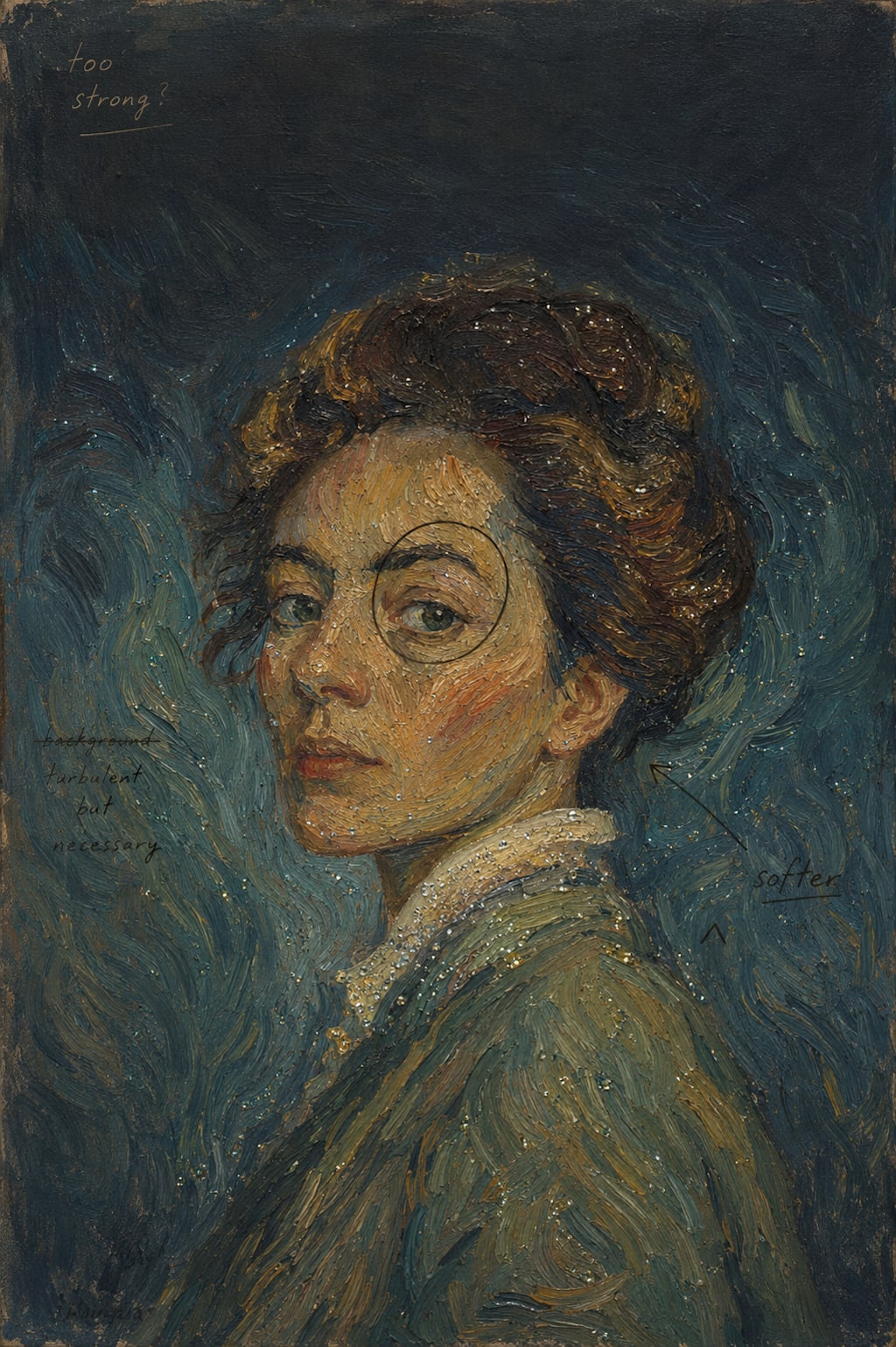
A dead writer is a text with no author to defend it. Nicky Frankly should be judged the way she feared being judged: competent until proven creative. That charge was planted by a professor of philosophy during her second (of four) stints in graduate school. "Your writing is good," they said, "but not creative." Every appraisal of her work since has been, whether it knows it or not, a verdict on that sentence. From her early Start Here quarry, where she hewed the unflattering years, to her later Machine Gospel cathedral, where she enshrined the ordinary inside a myth, Nicky dressed her words with rhinestones.
I met her on a fact-checking assignment during my first year with The New Yorker. I was sent to check a piece that quoted her, which meant I had to call her and read her own words back to her, and ask if she had really said them. It was a phone call. I Googled her mid-conversation to put a face to her laugh. She hurled it at me when I asked, "What did you mean by, 'It was the first story that ever demanded to be written'?”
It is worth remembering that Nicky spent a decade at a theme-park boutique turning other people's children into princesses and knights. She never pretended the work was serious.
"You go, you make six ponytails, you eat lunch with your friends."
After the success of Machine Gospel, her boutique years were read as Nicky's immersive research, as irony, as anthropology of manufactured enchantment. There is a simpler explanation that appears nowhere: that she went there because it was a place to be perfect. There was a right way to do things, and she could do things the right way. She went there for discipline, and to mother-hen a hundred and fifty girls she never felt connected to, and who treated her, without exception, with love and respect.
Underneath the mythology veneer, in her presence, one felt that person her colleagues described: someone you want on your team. When she opened two dance studios during the pandemic, the owner told her, “I’m pretty sure you can fly.” The critics have never known what to do with that sentence or that brand of magic. Neither, one suspects, did she.
Serious readers were kept away from her early stuff of pixie dust and enchantment for hire. Too obvious. Self-help. Come on. Even her clients, who reported real healing from the work, conceded it only in private, and cynically, as if embarrassed by the results.
For years the parks and studios and labs and institutions claimed her as an asset, preferred her to whatever the next generation was offering, and found her at once convenient and terrifying: any minute now, she could leave. But no one, and this is the unnerving part, could say for what.
No one who worked beside her ever doubted the discipline. Whatever else was in question, the woman could be handed an impossible standard and meet it, every time, without visible strain: a dozen flawless ponytails, a clean manuscript, a show's worth of choreography delivered on schedule and enchanted. That much cannot be faked, and no one has tried to deny it.
Her circle of reluctant admirers, those who spoke of her with amusement and disapproval, yet genuinely liked and admired her, showed up for her, even if only to roll their eyes. Deans. Parents. Editors. They did not keep away from her work. They ate her up, and never suspected her of anything worse than enthusiasm. Nobody accused her of coasting, of trading on charm, of resenting the talented. She grayed naturally, never suffered vanity, with sloth and malice absent from her CV.
We instinctively hold such a person to high standards of excellence, so her virtues slip by unseen. We assume her greatness and seek its provenance. She was owed a grudge, and if her nonfiction is to be believed, she had grounds for several. She carried none of it. No envy, no visible sense of inferiority, nothing that curdled. Casual cruelty astonished her, the professor's sentence included, but it never embittered her the way it would have embittered most. A bitter woman would have written the professor into something. The professor appears in none of it. She approached that person the same way she approached her abuser: as someone who had happened, rather than someone who had happened to her.
The second time we met, she was grading in her car between shifts, forty essays on the passenger seat, engine running for the air conditioning. But again, I had to check facts about her. This time it was the jobs. The piece called her a writer, and I had been asked to confirm that this was, in the ordinary sense, true. And I had to ask about a title. The piece referred to a book of hers I could not locate in any catalogue, and she had to explain, patiently, that the index was the book. For one of the challenge pieces she kept publishing on that site, she had built an index to a book she had chosen not to write. She left the explanatory entry redacted, so that a reader could search the whole apparatus and arrive, correctly, at nothing. I have thought about that structure more than I have admitted in print. It was the first object of hers my methods could not open. It was not the last. I told her I could not confirm the existence of the work. She said, "That was the work."
She wore scuffed Goodwill flats, a discount blouse, and a blazer with inside pockets. She would have told you she chose teaching for the wardrobe, just another costumed role. She groomed her fingernails while we spoke, pulled loose hairs from her ponytail, and openly massaged her knuckles.
Her entry into public life was through a fiction challenge, dressing her words in whatever material the prompt handed her. But she could fly. Her extraordinary mixture of diction, discipline, and nerve assured that even her enemies would concede the world was better with her in it. Whether she was also creative is a separate question. It is the one I have returned to for thirty years, and the one I have never been able to settle.
From the work, a doctrine has been assembled: that her subject was post-traumatic growth, slow integration of what happened into who one becomes. Fair enough, as far as it goes. Where the readings fail is the abuser material. Critics of one school insist Nicky did not know what she was revealing, that a line like "I hope you die first" escaped her in a memoir meant to say goodbye, that she held on to him for years without noticing the grip. This would have been the misreading she minded most. The holding on was not a mistake. It was her method. You do not integrate what you refuse to keep.
She wrote stories the right way, every time: the structure, the restraint, the refusal to let a sentence do more than it could prove. What matters is the rule she broke: she kept, on purpose, her one exclusive love, and never released him.
I was listening to the last chapter of Machine Gospel when the news came. I had heard it before, the author reading. I was listening again. It was the Becoming Day part where the technicians are there working in the operational register, the family is speaking in the liturgical one, and no one in the room is asking the person on the table anything at all. I had heard it a dozen times as a set piece about institutions. That afternoon it sounded like a portrait, which is what it had always been. The prose does it so gently that no one asks. He is on that page. She put him there and left him there, and I had heard it a dozen times without seeing him.
Our last encounter came twenty years after the first, by which time I was a staff writer and no longer had to check anyone's facts. I called her anyway. Without question, her reason for holding on rang true. "He became the engine of Machine Gospel. Every consent taken without asking, every procedure named in a pretty voice, that's him. I stopped trying to put him down. I planted him, and the tree fruited." Her harshest critics have cited this decision as everything from mere "unwitting disclosure" to "arrested integration." The essence of being human is release: you set the thing down, you walk away lighter, and to reopen it is to reopen the wound. But Nicky's unabashed clinging was not a symptom of her failure; she held on as process. Whether on the page or in person, she chose the most exacting method available.
If integration is craft, then Nicky built a repeatable, teachable, almost scientific method. Critics have flattened her technique into journaling. Work, she called it. How cruel of a reader to ask writing-as-healing to be accurate. She was, and without flinching.
"I hope you die first."
She was being perfectly honest.
Readers who remember what unassisted writing was are the only ones who can still see what she was doing, and there are fewer of them every year. Nicky's was a world where holding on was still possible.
Is there a Nicky in the world that comes next? And if there is, what is she accomplishing?
Her major work survives by absorbing the personal one; Start Here is quarried. Machine Gospel absorbs him; the goodbye written for one man, distributed across a built world. Here is the question I cannot answer: Would she have accepted the trade? The man she kept, surviving, for the inside of the machine.
In an age when every sentence can be generated, the question is no longer whether a writer is creative but whether the word describes anything a reader can point to. Nicky was among the last to be accused of lacking a quality her accusers could not define.
She kept writing into a question no one could answer for her, which is either fearlessness or something adjacent to it. Though I had not warmed to her or believed in her wings, I could see what she could not, or I thought I could. What neither she nor her critics could resolve is that creativity cannot be located the way talent can, pointed to in the writer like an organ. "You are not creative" is as true and irrelevant as "You are not God."
I will admit what a critic is not supposed to admit. I have no language for magic. I do not know what creative meant to her, and I have stopped believing that knowing was the point. But somewhere, a woman wrapped her words, one beside the next, like glued stones in a crown. That is not discipline. Come on. Frankly, I have no other word for it.
About the Creator
Nicky Frankly
Writing is art - frame it.
Enjoyed the story? Support the Creator.
Subscribe for free to receive all their stories in your feed. You could also become a paid subscriber, letting them know you appreciate their work.
Comments
There are no comments for this story
Be the first to respond and start the conversation.