
Five ways to keep the muse alive
I am not immune to numbered lists


I read Renan Bernardo “Ten years of short fiction submissions” and I’ve been inspired to start submitting short stories again. If Renan can get 800 rejections over ten years, I shouldn’t stop at my meager 100 in one year.
This prompted me to reflect on what it means to write in the long run. And if you'll humor me, I mean to inflict my reflections on you.
Let's get to it.
1: Perserverance
I also like to call it stubbornness, determination, grit or facing overwhelming odds. I don’t believe talent exists, but even the most talented person in the world can’t expect to succeed on their first (or second, or tenth try). Success, even in the narrower definition of ‘publication’, might elude you for reasons behind your reach. Luck, gatekeeping, timing, or maybe you’re just not at that level yet.
The aforementioned post from Renan prompted me to do some housecleaning. Here are my statistics from the submission grinder (please prepare a drum roll):
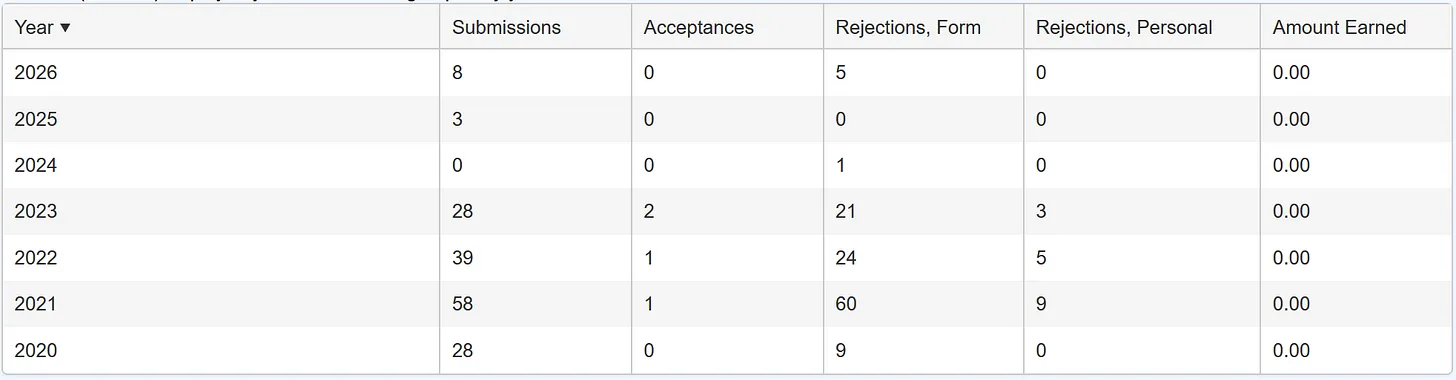
We can discard the amount earned (I earned some peanuts, but I didn’t care enough to track them). What this graph says is that I basically gave up early 2023 to focus on other things - mainly, my Italian fiction. In 2024 and 2025 I wrote and sent out two books to publish, which is a great result.
Now, some of the pieces I used to send around graduated (in the short story collection Consultancy Blues). The graph also doesn’t track other efforts, e.g. Italian short stories and stuff I’ve put here on vocal. Still: with 3 meager submissions in 2025, I couldn’t expect much of a response from the market.
I might have a real best-selling, Nebula worth short story, but it won’t matter much if it’s sitting in a folder on my laptop.
In very much the same vein, I’ve went back and consider how many novels I’ve written. I counted 6 attempts: the doomed one I mentioned here, the two published in the Italian market, a magical realism/horror that I’ll probably stick in a drawer, and my last project (still in its first draft), and an almost complete cyberpunk anthology.
My last project will probably find a home somewhere, and the cyberpunk project will be self published. Four on six is not a bad score.
Even then, I’m nowhere near where I want to be artistically. While the urge to flip the table is very strong, what allowed me to publish was keeping at it. For us laymen without friends in publishing agencies, unlimited funds and ivy league connections, perseverance does the trick.
This is also what King calls, in On Writing, showing up. If you don’t show up you can’t expect anything to happen.
2: Simplicity (Keep it Simple, Stupid)
I think most of us tend to overcomplicate things. This goes mostly for more novice writers, but you can have several books under your belt and still tackle more than you can chew (read: be a youngster at heart).
I think Calvino wrote about simplicity in his Six Memos for the Next Millennium. I won’t pretend I understand Calvino, because he had a galaxy brain and I have a overactive peanut. What you’re gonna get here is discount Calvino, then.
Getting to the point: why would you start your writing career with a trilogy? Why would you write a 300-years spanning familiar saga with multiple point of views, when you’re not sure you can tackle one? Why would you try conlangs, when you can’t write realistic dialogue?
I deeply respect the idea of biting more than you can chew. That’s when growth happens. But I come from fantasy - the crew that tried to chew up Tolkien and mostly turned out with broken teeth. Maybe in the English market this is less relevant. It surely is less relevant in other genres - I hear my horror writers peers have no need for trilogies.
Most wannabe writers (there’s a kinder term: novice) have aspirations. Aspirations are what make you sit down and write in the first place, but should be tempered with realism. Signing a book deal for a 180k trilogy is hard, especially if that trilogy doesn’t exist, and if you have never completed a novel.
Writing a 60k novel is, on the other way, achievable. Cutting that down to 40k - a respectable length in most genres - and have functioning plot, two sufficiently shaded characters and an interesting premise is no small feat.
Especially if you’re worried you might not make it, ask yourself: what is the simplest version possible of this book that still brings home the central themes? Can I do a simpler, functioning novel?
Maybe you can’t. Some stories really do need to be told on a longer scale. But then, it’s better to practice your craft on ‘simpler’ stuff. Learn to make a chair before committing to furnish a whole house.
3: Humility
Novice writers might have too much of it, but true humility is lost easily. Even assuming you had it, in the first place.
Now when I say you gotta be humble I don’t mean you ought to make a big show of it. Especially you shouldn’t wail and cry all over yourself in public spaces to try and elicit some kind of easy pity. That’s not humility, that’s a performance. If you think it doesn’t apply to you, great - but IMHO the urge to raise your voice and cry out can be an insidious thing, so it’s better to be on the lookout.
What I mean by humble is that, like it or not, you have much to learn.
I started writing “seriously” 8 years ago and hell I do have much to learn still. When people hear me talk about my own work, they always mistake my self-criticism for lack of self esteem or worse - the same catch-all, attention seeking, easy-bake deprecating humor. I am just trying to be objective. I can look at my work - say, Consultancy Blues - with fondness, while also striving to pick apart the way it’s lacking. How would (or wouldn’t) I make it different, today? What is a genuine mistake? Was I at fault for the mistakes, or did I do what I genuinely thought best at the time?
Being humble means being able to recognize (even just partially) you have space for improvement. If you know that, you can tackle that space and learn aggressively. One of the ways I like to do it is by sticking close to writers I admire, that are able to write in a way that I cannot reach quite yet. Your learning space might look different to you, as long as you know it’s there.
Perfect people attend no classes.
Another side effect of humility is practicing a healthy detatchment from your past work. You don’t always have to stick to your guns - you don’t need to defend your work against everything and everyone. If someone spots a flaw, you want to be able to assess how bad it is. Not because you can go back in the past and fix it. Just to be better next time.
4: Curiosity
More on the idea of learning spaces.
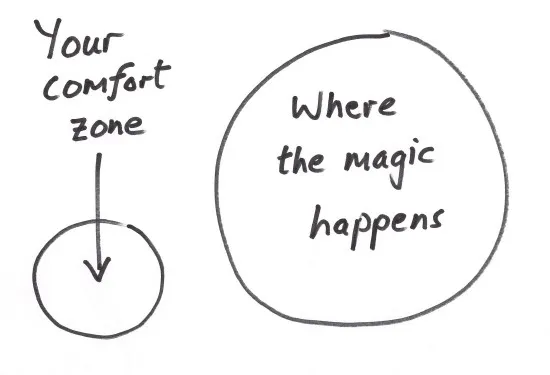
The article I’ve read about it was more complicated than this picture that I shamelessly lifted off LinkedIn. But the idea is more or less valid, in writing too: you can stay in your lane and have a jolly good time, or you can foray into the unknown, outside your comfort zone, and tackle something you know you’re not a pro at yet.
This means you need to push yourself into the unfamiliar to get better (remember: we’re humble now, so we know we can get better). In writing this might mean tackling a genre outside your usual circles, using a new literary technique, trying out a new character who’s not in your usual rooster, and letting your preferred tropes rest in the closet for once.
Being outside the comfort zone, of course, is meant to be uncomfortable. But luckily for us the cost of failure in writing is quite low. At worst, you have wasted time on a page you’ll scrap: hardly a life and death situation.
How do you write something you don’t know? Easy enough: you read a lot. You try to be realistic. You ask for feedback. You accept that you might be doing a mess. In other words, you go out there and be curious. Of course you can’t always push yourself outside of your comfort and there’s nothing wrong with falling back to the safety of your homebase - just don’t let it become a castle (with toxic mold on the wall, if you catch my drift).
Curiosity has also less practical implications. Not everything you go out there to learn will - or needs to - become an avenue of betterment. It’s fine to know things just for the sake of it. You don’t have to accumulate knowledge and skills in the hope of becoming, one day, some kind of ubermensch. If it finds its way into your writing, good. Else it might be come in handy in some other way, maybe just because knowing random shit is also cool.
5: Sanity
Last, but not least. It’s all worth nothing if you can’t safeguard your mental being.
Let’s talk in ugly production terms for a bit. Whatever your goal is - finishing a book, publishing a book, building a backlog, reaching an audience - you need sustained effort over time to get there. Perseverance: see point one. If you miss your goal, or you fall just a little short, you might to try again. As Murakami once said: writing a novel is like running a marathon, but nobody tells you beforehand how long it’s gonna be.
You cannot run the marathon if you collapse on the track.
What is burnout? A state of extreme tiredness and lack of motivation often caused by intense periods of stress. Writing might give you burnout if you are too hard on yourself, but most importantly, everything else in your life might also give you burnout. In the likely case you’re not paying your bills with your writing, this is even more important.
Now, don’t take me on my word on this - because I don’t have a clear source on the science - but it might take up to six months to recover from burnout. Let’s say it’s even half of that to be conservative. Can you afford three whole months of not being able to do anything because you’re too exhausted? Probably not. Exhaustion doesn’t care if you have dreams. Exhaustion doesn’t care if you used to find pleasure in your hobbies. Exhaustion doesn’t care if your novel is just sitting there, but you can’t bring yourself to finish the last draft.
In other words, you want to save yourself the trouble. Much better to avoid the heartbreak if you can (if you can catch it) than to have to recover. Crucially, managing stress is a difficult thing. You might not have much control on what happens around you (or at your day job). But you do have control on how you approach writing.
Which means, you can only persevere if you don’t burn yourself out.
Little update on what I’ve been doing. My new scifi book is coming up soon (on the Italian market). As the submission grinder screenshot suggests, I’m also coming back to English fiction. I am retiring yet another novel, and starting to write another. I’m looking into small presses and spec fic again. I try to follow my own advice.
Till next time,
M.
About the Creator
M.
Half-time writer, all time joker. M. Maponi specializes in speculative fiction, and speculates on the best way to get his shit together.
Author of "Reality and Contagion" and "Consultancy Blues"
Enjoyed the story? Support the Creator.
Subscribe for free to receive all their stories in your feed. You could also become a paid subscriber, letting them know you appreciate their work.
Comments
There are no comments for this story
Be the first to respond and start the conversation.