
every third thought
a meditation on the frailty of old age and King Lear


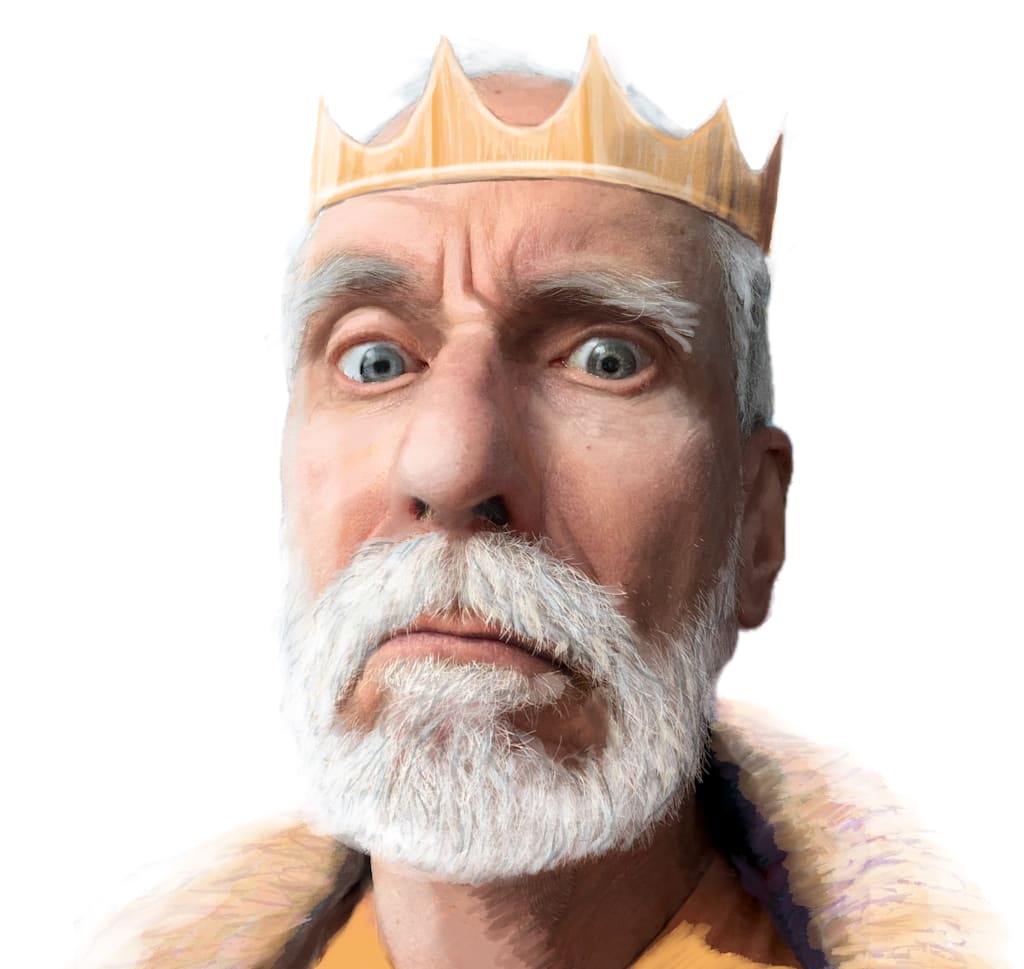
Lear’s torments are central to us, almost all of us, since the sorrows of generational strife are necessarily universal.
Shakespeare: The Invention of the Human, Harold Bloom
Lear is many things in this play: tyrant, fool, madman, grief stricken father. In the beginning he strides upon the stage like a god and by the end he is reduced to penury and fear for his life and for the life of the only daughter who truly loves him.
But what and who he was before the play’s opening we can only surmise. The fact that he once loved his youngest daughter more than her elder sisters suggests some radical change, but why?
When we meet Lear in the first act, he appears to suffer from the blindness of this present age, and all the great ills that befall him seem its natural consequence. All who speak the truth he unjustly hates, and those who tickle his ears with lies and deceive him with flattery, he lifts up. The parallels to our own day and political climate are terrifying.
Wearied by the demands of the crown he divests himself of his kingdom in the play’s opening, thinking he can still enjoy the life of a sovereign without the burden of its responsibility.
Lear. Know that we have divided in three our kingdom; and it is our fast intent to shake all cares and business from our age, conferring them on younger strengths while we unburdened crawl toward death.
King Lear, Act 1, Scene 1, lines 37 - 41
Circling back to my earlier question, what or who was he before the play’s opening act? we see him in the above speech suggest his advanced age as a plausible reason for changing from a man who once recognized his daughter Cordelia’s worth and his eldest daughters Goneril and Regan’s worthlessness, to one who is now utterly blinded to both.
When he then demands protestations of love as condition for each daughter’s share of the kingdom, the two oldest daughters play along. But Cordelia, does not, quickly offending her father:
Lear. So young, and so untender?"
Cordelia. So young, my lord, and true.
Lear. Let it be so; thy truth then be thy dower!
King Lear, Act 1, Scene 1, lines 206 - 208
But can that be the sole reason for his former wisdom’s descension? Having personally witnessed the consequences of both Alzheimer’s and dementia and how angry sufferers sometimes become when they misunderstand their circumstances or when they treat those who love them as strangers or worse —enemies— it’s easy to imagine.
Even the elder sisters are alarmed at Lear’s unexpected choler:
Goneril. You see how full of changes his age is…. He always loved our sister most, and with what poor judgment he hath now cast her off appears too grossly.
Regan. Tis infirmity of his age, yet he hath ever but slenderly known himself.
King Lear, Act 1, Scene 1, lines 287, 289 - 292
In this scene the destinies of both the king and his three daughters must shift based on the daughters’ reaction to Lear’s absurd demand. The two eldest see an opportunity to raise their fortune’s. But instead of responding to her father’s demented request with pity, Cordelia reacts in revulsion, ensuring her own downfall and her father’s in the bargain.
In Aristotle’s Poetics he emphasizes that moral ambiguity is at the heart of the tragic hero. Neither bad nor over good, his or her downfall is not the consequence of a moral failing, but by some error or human frailty. In this respect we may argue that if Lear truly suffers from the ‘infirmity of his age,’ he cannot be guilty of hubris like Oedipus, nor excessive introspection and inaction like Hamlet. In this he is more pitiable than either, and also easier for us to relate too, especially if like me, you are at an age where mental decline is a growing concern.
But Lear’s infirmity is not the true tragedy in the play, but merely the opportunity for a much crueler calamity to evince itself through Goneril and Regan’s betrayal of their father and Edmund’s deceit of his own father, Gloucester. After his eldest daughters demonstrate their great love and devotion to Lear by plotting against him, even he no longer knows or recognizes himself:
Lear. Doth any here know me? This is not Lear.
Doth Lear walk thus? speak thus? Where are his eyes?
Either his notion weakens, his discernings
Are lethargied- Ha! waking? 'Tis not so!
Who is it that can tell me who I am?Fool. Lear's shadow.
King Lear, Act 1, Scene 4, Line 237 - 231
We are as bewildered by Gloucester’s consequent rejection of his trusted son, Edgar, as we are of Lear’s rejection of his beloved daughter Cordelia. These are the twin poles on which Shakespeare clothes this tragedy, the base motives and actions taken by Lear’s and Gloucester’s children that destroy the lives of both fathers and ultimately themselves.
Our horror at their actions does not lend itself to either moralizing or redemption. It so effectively stirs both pity and fear, that no catharsis at its ending is possible save for ‘There by the grace of God go we,’ or Gloucester’s more cynical realization at the beginning of Act 4: ‘As flies to wanton boys, are we to the gods; they kill us for sport.’
Senior citizens lose an estimated $3.4 billion annually to scams. The human frailty of old age is not a human fault. And yet its cost in retiree savings and human misery is vast. Lear, far more than Oedipus or Hamlet reminds us of how greatly we may one day need to lean on the empathy and goodness of others, ‘When every third thought shall be my grave.’
(The Tempest, Act 5, Scene 1, lines 301 - 302, William Shakespeare.)
About the Creator
John Cox
Where would you like to travel? Who would you like to meet? No ticket required, a surprise at every destination guaranteed. Strap on your time travel goggles and bring a compass. It's sometimes bumpy in my imagination, so hold on tight!
Enjoyed the story? Support the Creator.
Subscribe for free to receive all their stories in your feed. You could also become a paid subscriber, letting them know you appreciate their work.
Comments
There are no comments for this story
Be the first to respond and start the conversation.