
Enough is Enough
The Cry of South Africans in a Country Losing Control

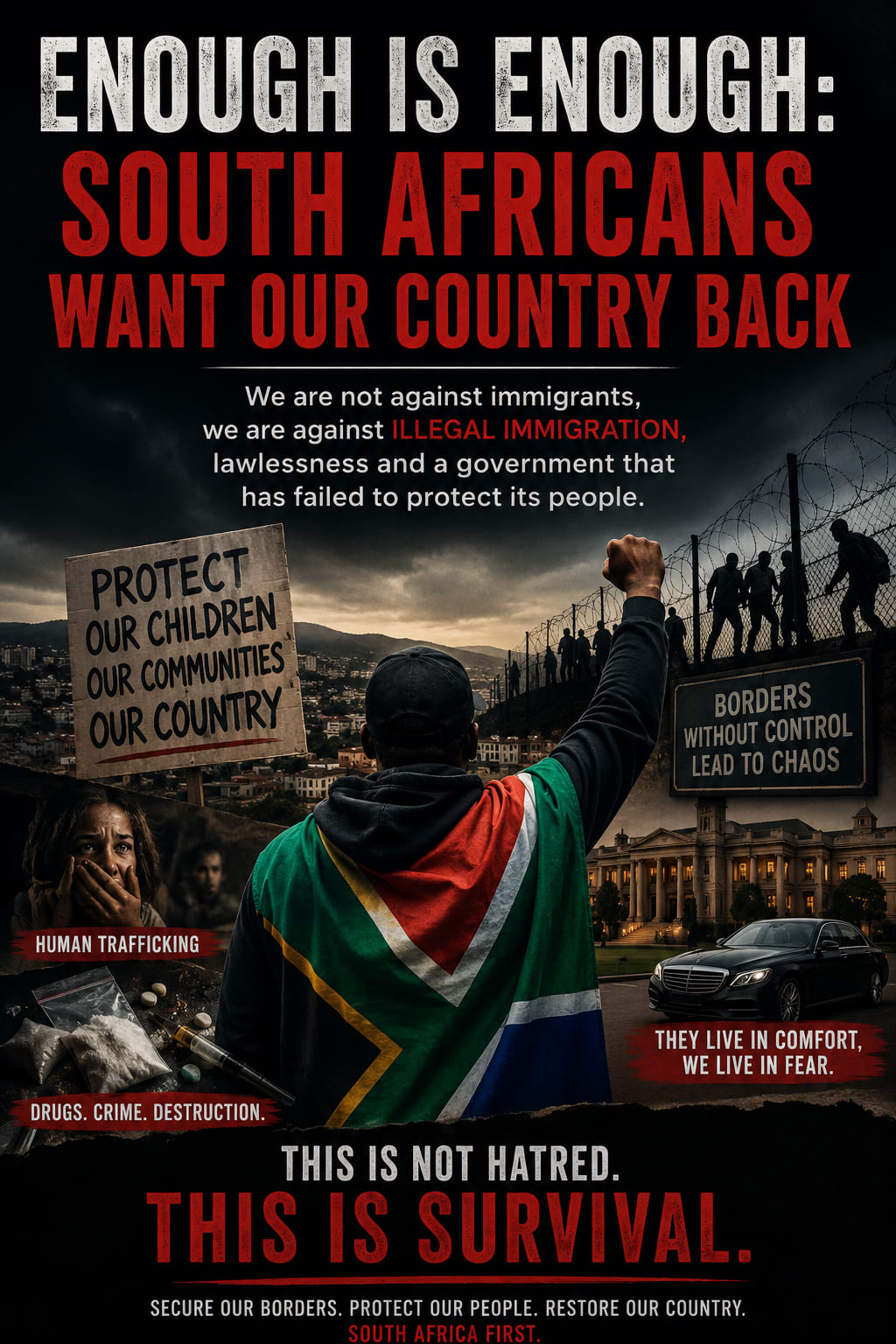
South Africans are constantly being labeled “xenophobic” whenever they raise concerns about illegal immigration, crime, human trafficking, drugs, and border control. But at what point do citizens have the right to say: enough is enough?
If protecting our country, our families, and our communities makes us “xenophobic,” then perhaps people should first ask why ordinary citizens have reached this level of frustration in the first place.
The truth is simple: many South Africans are not against immigrants. We are against lawlessness.
There is a major difference between a person who enters a country legally, respects its laws, contributes positively to society, and someone who enters illegally and disappears into a broken system with no accountability. South Africans are not saying the country should completely shut its doors to foreigners. What people are demanding is proper immigration control, functioning borders, and a government that takes national security seriously.
For years, communities have watched drugs spread through neighborhoods, human trafficking increase, and violent crimes destroy families. Young women are disappearing. Children are growing up surrounded by substance abuse, gangsterism, and hopelessness. Citizens are expected to stay silent while their communities deteriorate, yet politicians continue living comfortably behind security walls, protected from the realities faced by ordinary people every single day.
Many South Africans no longer feel safe in their own country. Parents fear for their daughters. Mothers fear raising sons in communities where drugs are sold openly on street corners. Communities are watching their future slowly collapse while leaders continue making promises that never become reality.
When undocumented individuals commit crimes, identifying them becomes far more difficult because many entered the country outside legal systems. This creates fear and mistrust within communities already struggling with unemployment, poverty, and crime. Whether people like hearing it or not, weak border control has consequences.
The real anger of South Africans should not be directed at innocent foreigners trying to survive honestly. It should be directed at a government that failed to build and maintain a proper immigration system. A nation without controlled borders eventually creates instability for both citizens and lawful immigrants alike.
What frustrates people even more is the silence from leadership. Communities have been speaking out for years, but instead of meaningful action, they are often met with labels, criticism, and accusations. The moment citizens begin raising concerns about illegal immigration, they are immediately painted as hateful people instead of concerned citizens speaking from lived experiences.
But asking for law and order is not hatred.
Wanting safer communities is not hatred.
Demanding accountability from leadership is not hatred.
Every sovereign nation in the world has immigration laws. Every country protects its borders, monitors who enters, and takes action when systems are abused. Why should South Africans be shamed for demanding the same thing?
The reality is that citizens are tired of feeling abandoned by those in power. Government officials live protected lives while ordinary citizens face the dangers daily. Politicians travel with security convoys while communities live under fear. They speak about human rights while citizens are left wondering who will defend their own rights as South Africans.
People are no longer just angry — they are exhausted.
Exhausted from unemployment.
Exhausted from corruption.
Exhausted from crime.
Exhausted from watching communities become unsafe while leaders debate politics instead of solutions.
South Africans are not asking for violence or chaos. They are asking for action. They are asking for stronger borders, proper documentation systems, stricter law enforcement, and a government that prioritizes the safety of its citizens without violating the dignity of others.
There is also a deeper issue many are afraid to discuss openly: economic pressure. Millions of South Africans are unemployed, struggling to survive, and competing for already limited opportunities. In poor communities, tensions rise quickly when people feel resources, jobs, and services are becoming even more strained. Ignoring these frustrations does not make them disappear — it only makes them grow in silence until they eventually explode.
The government cannot continue ignoring the cries of ordinary people and then act shocked when communities begin taking matters into their own hands. Silence from leadership creates anger among citizens. And when people no longer feel protected by the state, frustration eventually turns into resistance.
South Africans deserve to feel safe in their own country.
They deserve communities free from drugs, trafficking, corruption, and violence. They deserve leadership that listens before things spiral further out of control. They deserve a country where laws matter and where citizens do not feel forgotten in the very land they call home.
This is not about hatred.
This is about accountability, law, security, dignity, and survival.
And until those in power begin listening to the people on the ground, the frustration will only continue growing louder.
About the Creator
Nkwenkwezi Mgebisa
Writer and founder of Pulse Sphere Media. I explore culture, identity, entrepreneurship, and the human experience through reflective, purpose-driven storytelling that challenges perspectives and inspires growth.
Enjoyed the story? Support the Creator.
Subscribe for free to receive all their stories in your feed.
Comments
There are no comments for this story
Be the first to respond and start the conversation.