
Eliot
Again


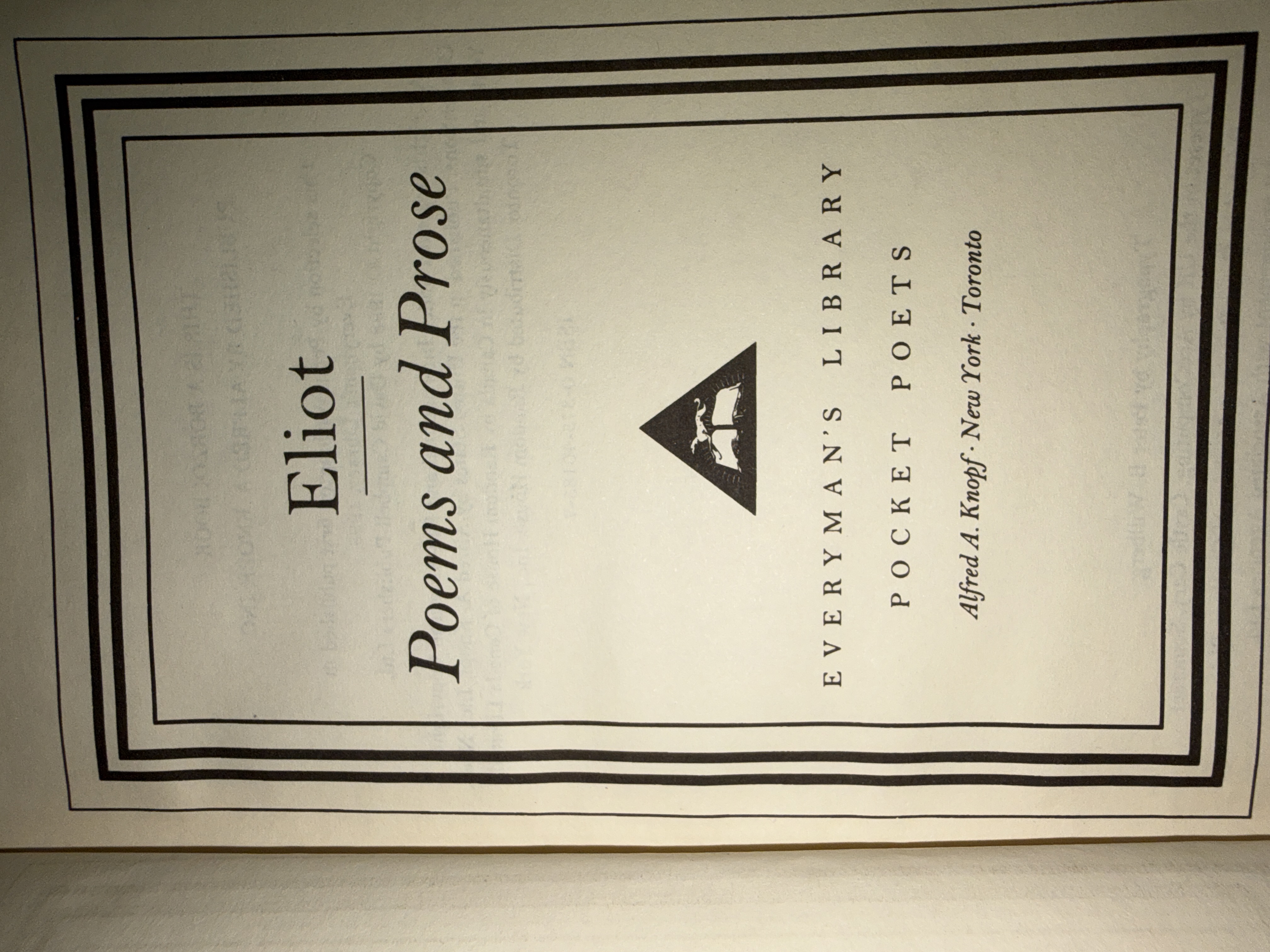
Once upon a time before everyone had access to the interwebs at their fingertips, there were these things called books. Further, the Everyman Classics were handy pocket books, not to be confused with pocketbooks, which are handbags.
The fine folks at Knopf make these wonderful little pocket poetry books, complete with a ribbon bookmark and blank pages in the back for notes.
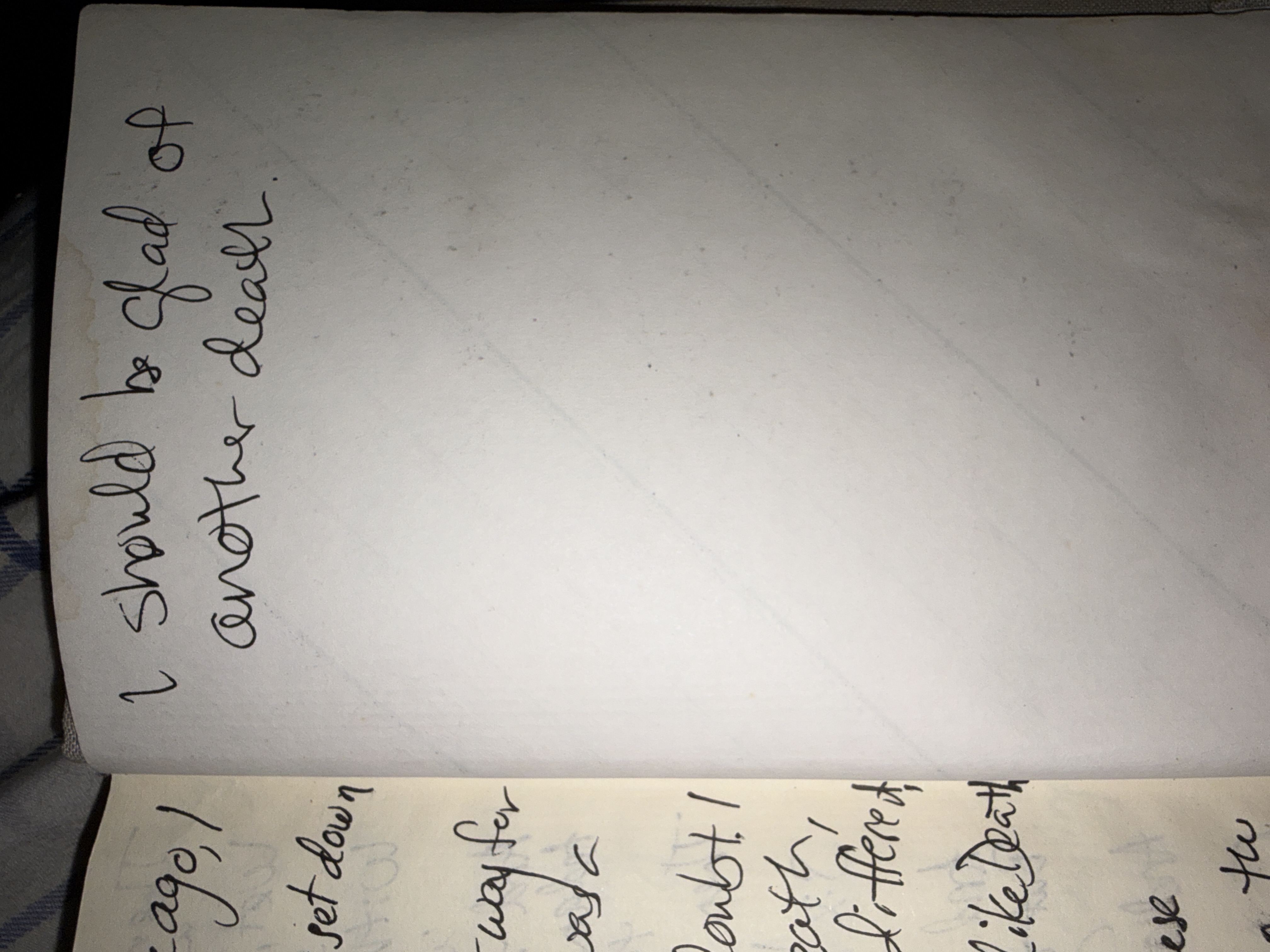
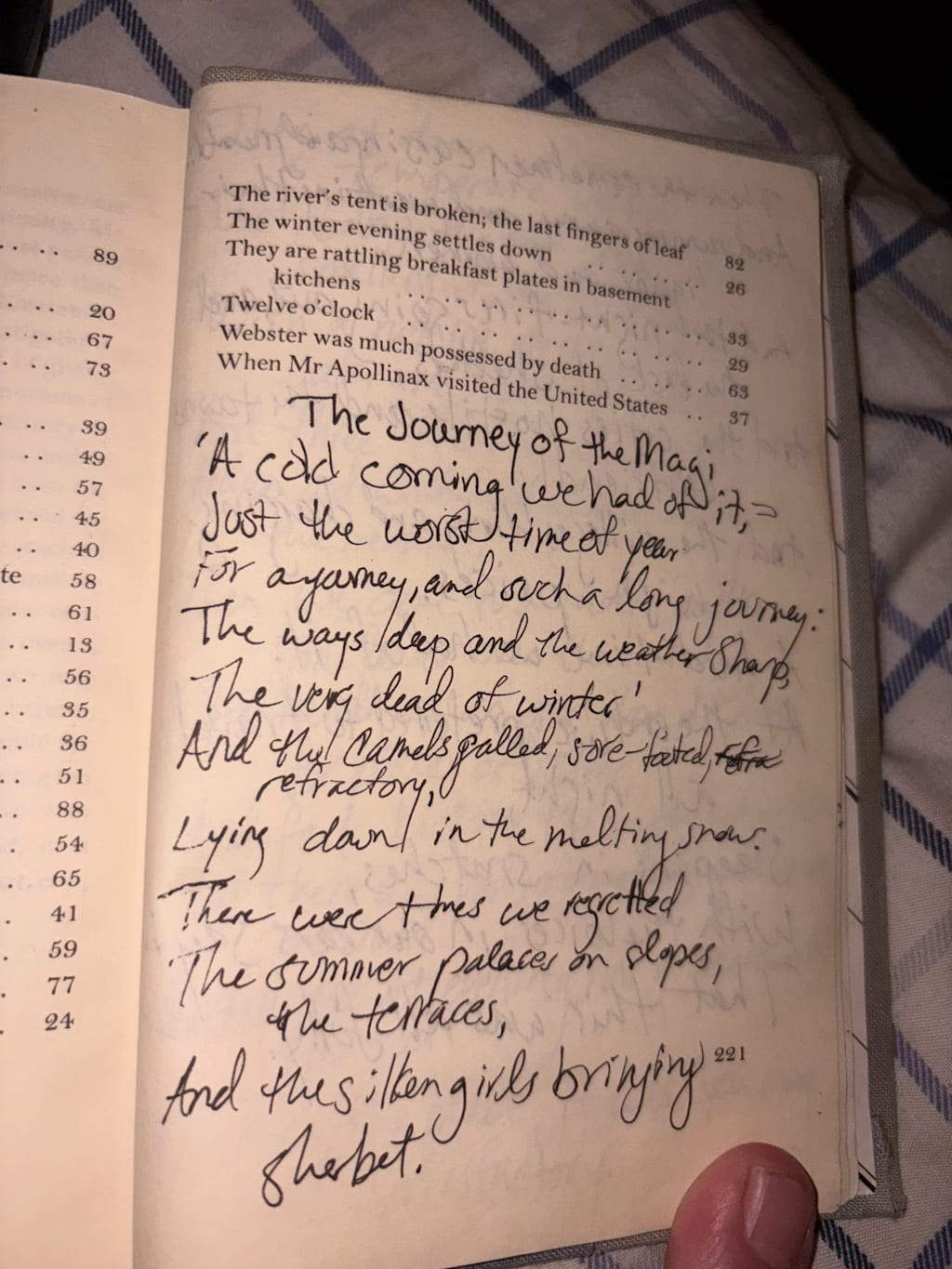
I have most of a page left, but the rest are filled with an Eliot poem that wasn’t included. It so happens that it’s my favorite Eliot poem, “The Journey of the Magi,” so I hand wrote it in the notes pages.
Before that, I would call(classmate) friends with literary emergencies, usually Eliot or Faulkner, and respectively, either Krista or Paige, who both always came to my rescue. The canon has never let me down, nor have the keepers of it.
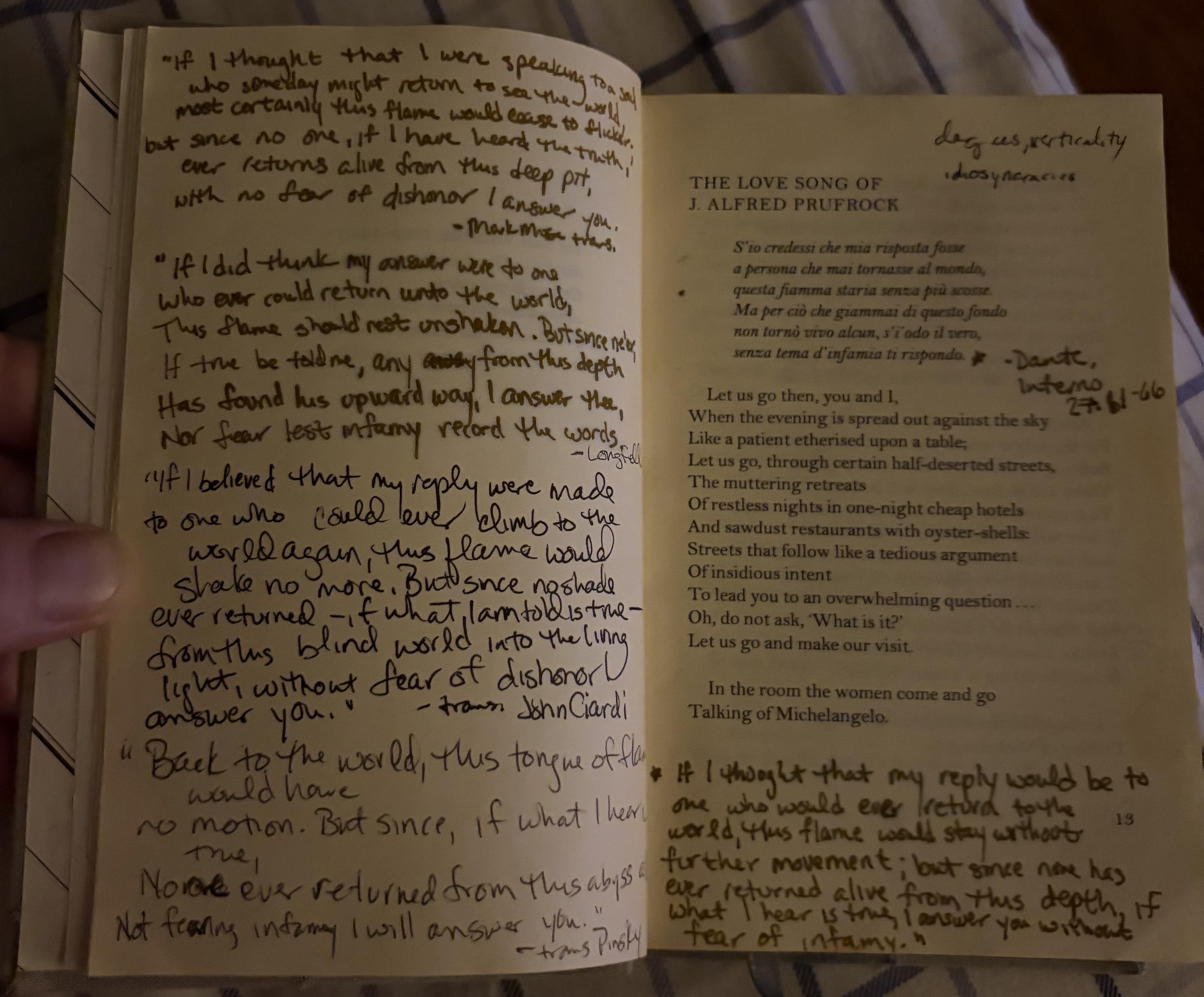
I take my Eliot very seriously, love him, try my best to understand him as best I can, to the degree that I sought multiple translations of the Dante epigraph on Prufrock in order to deepen my understanding of the poem. I was taught, by my good teachers, to write in my books, have a dialogue with the text, to make my copy truly mine. I learned it well.
What brings me back to Eliot year after year, season after season? I think it’s his restraint as well as his beautiful use of enjambment (in my opinion, no one does it better). His poetry also feels deeply personal to me— I feel the presence of code, even though I don’t know the code. And I love that it’s there. I recognize the different audiences, and I see three: the surface readers who think “Magi” is a religious poem are the first audience, and it includes some literary scholars, but they’re all missing the true beauty and textual layering in his poetry.
The next audience is the one I call Eliot’s true audience, the readers who truly understand “Tradition and the Individual Talent,” who read it like the love letter it is. We’re the ones he’s talking to, and we’re also who Faulkner was addressing in his Banquet speech. If you’re one of us, you feel the weight on your shoulders, the responsibility, the obligation to tell it true, even if it rips your spleen out of your body. We know that “The Wasteland” isn’t for us; it cannot touch us because we are inside the tradition. The tradition is the gatekeeper of the ideas of humanity, and it cannot be breached.
That’s two audiences. The third (unless there are four, including an additional layer of readers who know the code but haven’t lived it.) is the audience of one. This person, presumably Eliot’s great love, Emily Hale, lived the code with him. When she read his poetry, she read much deeper, more complex, sometimes completely different poems than you and I read.
How do I know this? Kinship is the one word answer. Eliot and I are family in this, for I, too, have an audience of one. Maybe two audiences of one (that’s really none of your business), and many of my poems are two different poems.
Eliot was brilliant, and I thank God for him every day. Don’t get bogged down in The Wasteland—it’s mainly showing off. Increase your enjoyment of poetry by reading more deeply, actively looking for subtext instead of taking poetry at face value. If that’s all you’re doing, you’re only getting the tip of the iceberg.
About the Creator
Harper Lewis
Intrusive rhyme bothers me, except as a weapon.
Intertextuality is my passion.
Formalist/ New Critical are my guiding theories.
My words are mine, not a robot’s.
MA English literature, CofC
Enjoyed the story? Support the Creator.
Subscribe for free to receive all their stories in your feed. You could also become a paid subscriber, letting them know you appreciate their work.
Comments
There are no comments for this story
Be the first to respond and start the conversation.