
Dismay
What to look out for (as a writer) on the battlefield

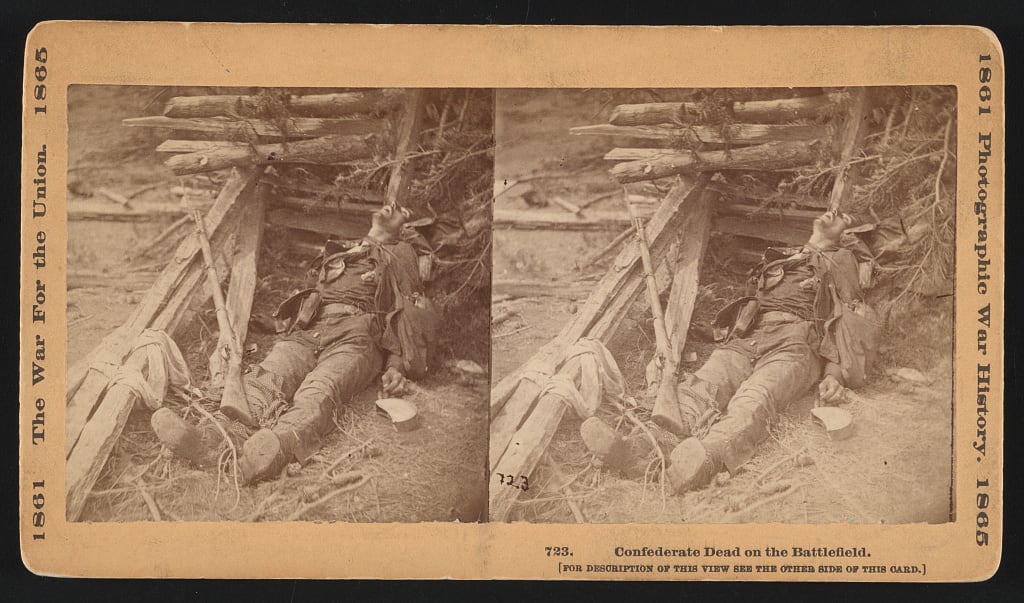
Lieutenant Jeremiah Lockwood looked over the field with dismay. A dozen gray-clad bodies lay around. He was too late. Ahead, a group of Union soldiers were celebrating their victory. Anger boiled within him, as he spurred his horse towards them. Lockwood drew his revolver and fired once into the air. The soldiers looked up. One raised a rifle… then lowered it again.
“Where’s your picket, soldier?” Lockwood shouted at the man.
“We jus’ whipped them rebs, lieutenant,” he replied.
“Hell, you did! It was a diversion. There’s a hundred of Mosby’s raiders just beyond the ridge, headed for the Potomac.”
The above Drabble is an extract from my 2020 book: A Town Called Raymond, which is available in Kindle. I have a couple of the original hard copies of this limited edition, wee chapbook, hiding somewhere at home. Let me know if you would like one. The Kindle is only $0.99 and, if you don't have a Kindle reader, you can download the free app to read it. You can also read the first few stories for free by clicking on the link.
Don't be a meanie! Show your appreciation of poor old Ray's work by investing a dollar in his little book. Most of my books are available in Kindle for the same price. Check them out. And do please leave a review. If you think the book is rubbish, feel free to say so. You won't be the first!
Why do I like writing flash fiction?
As a reader, I am quickly bored. Who wants to read "It was a lovely sunny day, the fluffy clouds were a puffing about the azure sky and I was wearing my best floral print dress..."??? BORING! Get on with the story, I say.
Likewise I get bored when writing a lengthy story, and just want to get to the point. With flash fiction, that's just it. That's the point! Particularly when writing a Drabble (exactly 100 words), the point is to tell a complete story in just 100, well-chosen words. To me, that means a beginning that immediately captivates the reader, a gripping middle, and a knock-out ending, often with a twist to the tail. The ending also, for me, should be a pay-off that completes the beginning, as if you could have had just the start and the finish of the story in one sentence.
Have I achieved this in the "Dismay" story? The first time I paid a professional editor to look at a short story, he told me the ending was far too obvious. Since that time, I have tried to come up with something unexpected. Problem is, I sometimes end up with a storyline that is too obscure to follow. Is this one? You be the judge.
An explanation of my approach to writing “dismay”.
As I say, I am looking for impact when I begin a Drabble or, for that matter, any other story. Does the opening achieve this. A civil war officer looks at a battlefield strewn with dead Confederate bodies. If you didn't work this out, it may be because you are not familiar with the history of the American Civil War. Union soldiers generally wore blue, Confederate: gray. Did you take, from this opener, that Lockwood was dismayed at the loss of his comrades, arriving too late to provide a reinforcement? You did? Splendid! I had intended to mislead my reader thus, as you will have seen if you had read on.
Angered by this loss of life (you might have thought) the lieutenant gallops toward a cluster of Union soldiers, celebrating nearby, to exact revenge (or so the reader might assume). He raises his pistol and fires, one of the Union soldiers raises his rifle, the tension mounting, what will happen next? Well, the Union infantryman lowers his rifle. Wait... what? Why is he not firing on the approaching enemy?
The following line reveals all (to those still paying attention). Lockwood shouts a question to the rifleman, and the answer indicates the man recognises that the officer approaching is one of his own. A group of soldiers in hostile territory should always have guards posted to detect any approaching enemy. It is this military failing that has angered the man we now know to be a Union Officer, not the loss of life. Already, the story has turned through 180 degrees, but there is more.
Why worry about the enemy, when we have already defeated them ("We jus’ whipped them rebs..." ["rebels" or Confederates)? From this crisis, this petulant retort to an over-bearing officer, we reach the climax and conclusion.
Despite the number of casualties, there has been no defeat of the enemy... far from it. Lockwood is angry that his men have been stupid enough to fall for this ruse. The enemy had bigger things in mind when they launched the diversionary attack against the Union force, as the conclusion of the story tells us. It doesn’t matter that we don’t know who Mosby is. Look it up if you are interested. All we need to know is that there is an enemy raid taking place and it’s so important that it has angered Lieutenant Lockwood. Hence the “dismay” of the title and the opening line, now paid off by the ending.
If you want to know more about my approach to micro fiction...
READ THE BOOK.
Thanks for reading
I hope you find my example and explanation useful to your own writing endeavours.
Ray
About the Creator
Raymond G Taylor
Author based in Margate on the English Kent coast, having moved from London. Known for his short stories and flash fiction, as well as poetry and non-fiction writing on subjects such as art, science, technology and the human condition
Enjoyed the story? Support the Creator.
Subscribe for free to receive all their stories in your feed. You could also become a paid subscriber, letting them know you appreciate their work.
Comments
There are no comments for this story
Be the first to respond and start the conversation.