
Choosing the Right AI Chatbot for Your Business in 2026
Before you invest in an AI chatbot, understand which approach delivers the best return for your business goals.

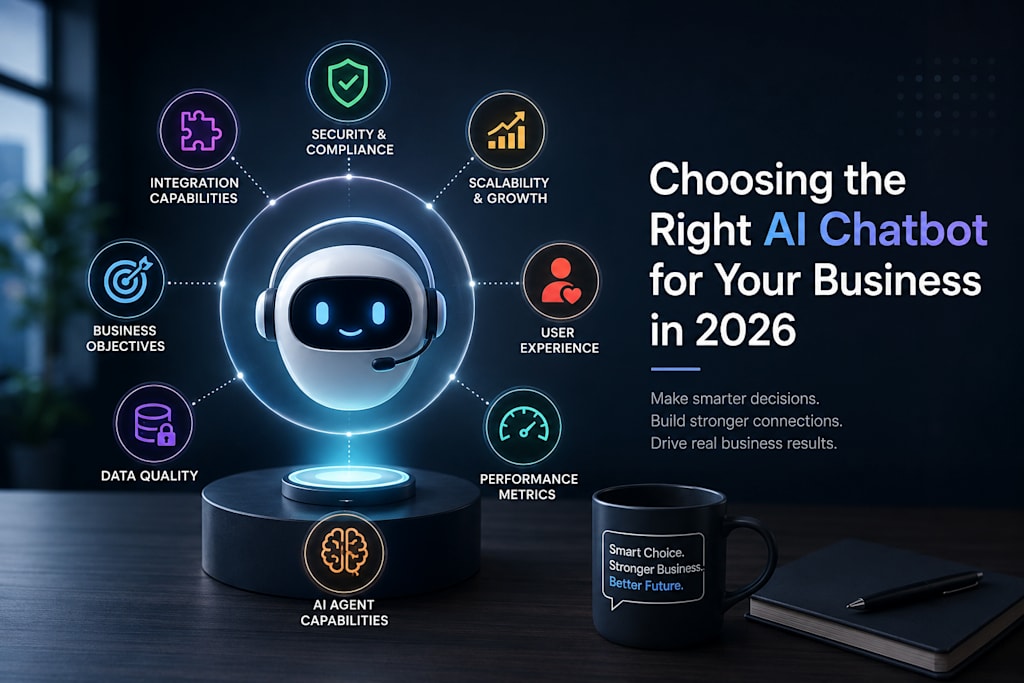
The Ultimate Guide to Making a Smart AI Investment
Artificial intelligence is no longer a futuristic concept reserved for tech giants. In 2026, businesses of all sizes are integrating AI-powered chatbots into their operations to improve customer experiences, automate repetitive tasks, and enhance productivity. Yet one question continues to challenge decision-makers:
Which AI chatbot is the right fit for my business?
The answer is rarely straightforward.
With hundreds of chatbot platforms available and custom AI solutions becoming more accessible, organizations often find themselves overwhelmed by options. Choosing the wrong solution can lead to wasted budgets, poor user experiences, and limited long-term value. Choosing the right one, however, can create measurable improvements across customer service, sales, marketing, and internal operations.
This guide explores the key factors businesses should consider when selecting an AI chatbot in 2026 and how to make a decision that aligns with both current needs and future growth.
Why AI Chatbots Matter More Than Ever
Modern consumers expect immediate responses. Employees expect streamlined workflows. Businesses expect technology investments to deliver measurable returns.
AI chatbots help bridge these expectations by providing:
- 24/7 customer support
- Faster response times
- Reduced operational costs
- Improved lead generation
- Enhanced employee assistance
- Better knowledge management
Unlike earlier rule-based chatbots, today's AI systems can understand context, maintain conversations, retrieve information, and generate human-like responses. As large language models continue to evolve, chatbot capabilities are becoming increasingly sophisticated.
The challenge is no longer whether to adopt AI but determining which solution delivers the best results.
Understanding Your Business Objectives
Before evaluating vendors or technologies, organizations should clearly define their goals.
A chatbot designed for customer support may require entirely different capabilities than one built for internal employee assistance.
Ask the following questions:
- What problem are we trying to solve?
- Who will use the chatbot?
- What outcomes do we expect?
- How will success be measured?
- What systems need integration?
Businesses that start with technology instead of objectives often end up with solutions that look impressive but fail to generate meaningful value.
Custom AI Chatbots vs. Off-the-Shelf Solutions
One of the most important decisions involves choosing between a custom-built chatbot and a ready-made platform.
Off-the-Shelf Solutions
Prebuilt chatbot platforms offer:
- Faster deployment
- Lower initial costs
- Simplified maintenance
- User-friendly interfaces
These solutions work well for organizations seeking quick implementation and standard functionality.
However, they may present limitations regarding customization, proprietary workflows, and unique business requirements.
Custom AI Chatbots
Custom solutions provide:
- Greater flexibility
- Tailored user experiences
- Deeper system integrations
- Enhanced control over data and workflows
While development costs can be higher initially, custom chatbots often provide stronger long-term value for organizations with complex operational needs.
The right choice depends on business size, budget, scalability requirements, and strategic objectives.
Prioritize Data Security and Compliance
As AI adoption expands, data protection has become a critical concern.
Businesses should carefully evaluate:
- Data storage policies
- Encryption standards
- Access controls
- Compliance certifications
- Privacy regulations
Industries such as healthcare, finance, legal services, and government agencies face especially strict compliance requirements.
A chatbot that performs well but lacks adequate security safeguards may introduce significant risks.
Security should never be treated as an afterthought.
Evaluate Integration Capabilities
An AI chatbot should not operate in isolation.
The most valuable chatbot implementations connect seamlessly with existing systems, including:
Customer Relationship Management (CRM) platforms
- Help desk software
- Knowledge bases
- Enterprise Resource Planning (ERP) systems
- Collaboration tools
- E-commerce platforms
Effective integrations allow chatbots to provide accurate information, automate workflows, and deliver personalized experiences.
The more connected the chatbot becomes, the greater its potential impact.
Consider Scalability from Day One
Many organizations purchase technology based on current needs rather than future growth.
This often creates challenges later.
When evaluating chatbot solutions, consider:
- Expected user growth
- Increasing conversation volume
- Additional use cases
- New business locations
- Expanding product lines
A scalable chatbot architecture prevents costly migrations and disruptions as the organization evolves.
Think beyond the next six months.
Plan for the next five years.
User Experience Is Everything
Even the most advanced AI technology can fail if users find it frustrating.
A successful chatbot should provide:
- Clear communication
- Accurate responses
- Fast interactions
- Easy navigation
- Human escalation options
Businesses should regularly test chatbot performance from a user's perspective.
Questions worth asking include:
- Is the chatbot easy to understand?
- Does it solve problems efficiently?
- Can users quickly reach a human when necessary?
- Does it maintain context throughout conversations?
User satisfaction often determines whether an AI initiative succeeds or struggles.
Measure Performance with Meaningful Metrics
AI chatbot success should be evaluated using measurable outcomes rather than assumptions.
Common performance indicators include:
- Customer Metrics
- Customer satisfaction scores
- Response times
- Resolution rates
- Retention rates
- Business Metrics
- Cost savings
- Lead conversion rates
- Revenue impact
- Productivity improvements
- Operational Metrics
- Automation rates
- Ticket reduction
- Employee efficiency
- Knowledge retrieval speed
Data-driven evaluation enables continuous improvement and better return on investment.
The Rise of AI Agents in 2026
One of the most significant developments this year is the emergence of AI agents.
Unlike traditional chatbots that primarily answer questions, AI agents can perform tasks autonomously.
Examples include:
- Scheduling meetings
- Processing requests
- Managing workflows
- Generating reports
- Coordinating between systems
As businesses evaluate chatbot platforms, they should consider whether future AI agent capabilities align with long-term strategic goals.
The distinction between chatbot and digital assistant continues to blur.
Common Mistakes Businesses Should Avoid
Organizations frequently encounter challenges because of preventable mistakes.
Some of the most common include:
Focusing Only on Cost
The cheapest option may not provide the best long-term value.
Ignoring User Feedback
Real-world feedback often reveals issues that testing environments miss.
Overestimating AI Capabilities
AI remains powerful but imperfect. Human oversight is still essential.
Neglecting Data Quality
Poor data leads to poor chatbot performance.
Skipping Strategic Planning
Without clear objectives, even sophisticated AI solutions can fail to deliver results.
Avoiding these mistakes significantly improves implementation success.
What the Future Holds
The AI chatbot landscape continues to evolve rapidly.
Future developments are likely to include:
- More advanced reasoning capabilities
- Stronger personalization
- Improved multimodal interactions
- Greater workflow automation
- Enhanced enterprise integrations
Businesses that establish a thoughtful AI strategy today will be better positioned to leverage these innovations tomorrow.
The goal should not be adopting AI for the sake of following trends.
The goal should be solving real business problems more effectively.
Final Thoughts
Choosing the right AI chatbot in 2026 is not simply a technology decision—it is a business strategy decision.
The most successful organizations begin by understanding their objectives, evaluating long-term requirements, prioritizing security, and focusing on user experience. Whether selecting an off-the-shelf platform or investing in a custom solution, the best chatbot is the one that aligns with organizational goals and creates measurable value.
As AI capabilities continue to expand, businesses that make informed decisions today will gain a competitive advantage in an increasingly digital future.
The question is no longer whether AI belongs in your business.
The real question is whether you're choosing the right AI to help your business grow.
About the Creator
DZ Insights
Best Guest Blogging for Authors to share their stories and ideas.
Enjoyed the story? Support the Creator.
Subscribe for free to receive all their stories in your feed.
Comments
There are no comments for this story
Be the first to respond and start the conversation.