
Choosing Between Java and Node.js for Modern Business Applications
Discover the key differences between Java and Node.js, including their strengths, limitations, and ideal use cases for modern business applications.

Technology decisions don’t fail because teams pick “bad tools.” They fail because the tool doesn’t match the problem.
When businesses build modern applications today, two backend choices come up again and again: Java and Node.js. Both are widely used, both are reliable, and both power large-scale systems. But they come from different design philosophies, and that difference matters more than most people realize.
Instead of asking “Which one is better?”, the real question should be:
“Which one fits the kind of system I’m building?”
Two Different Ways of Thinking
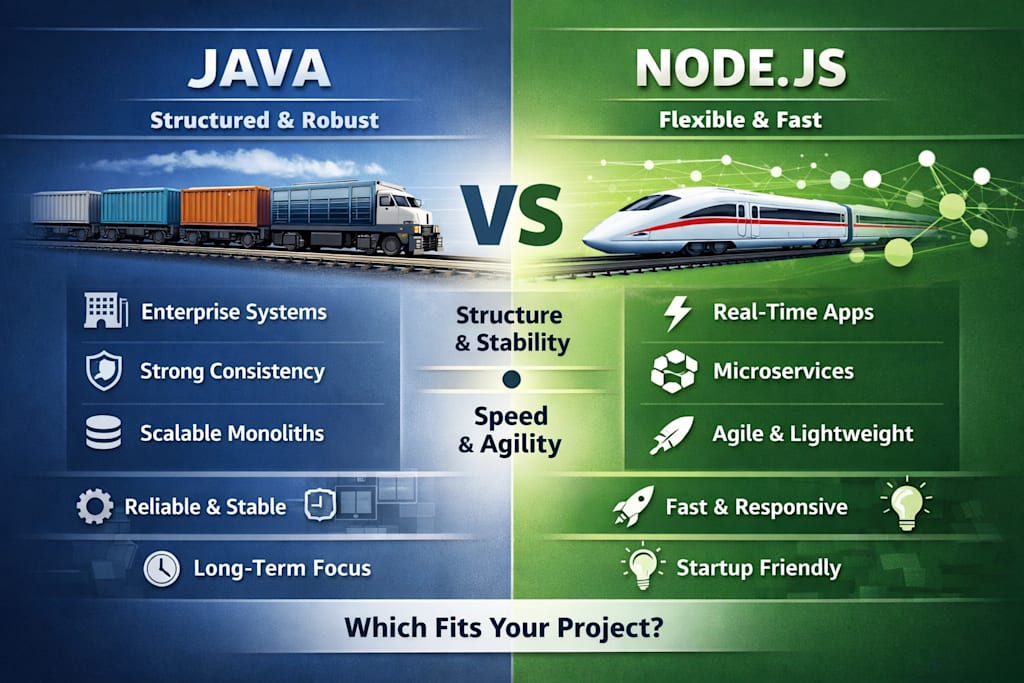
Java was built with structure in mind. It encourages strict architecture, predictable behavior, and long-term maintainability. It has been the backbone of enterprise software for decades, especially in environments where failure is expensive.
Node.js takes a different path. It is lightweight, flexible, and built around the idea of handling many tasks at once without waiting. It thrives in environments where speed of delivery and responsiveness matter more than rigid structure.
One is disciplined. The other is fluid. Neither is outdated—they simply solve different problems.
How They Handle Real-World Workloads
In practical use, Java behaves like a system designed for heavy-duty operations. It manages complex business logic, large transactions, and layered workflows without breaking consistency. This is why industries like banking, insurance, and logistics still depend heavily on it.
Node.js, in contrast, shines when the workload is constantly changing and user interactions happen in real time. Think of live dashboards, messaging platforms, collaborative tools, or streaming services. It processes many small requests efficiently without getting bogged down.
If Java is a freight train moving massive weight reliably, Node.js is a high-speed network handling constant traffic flow.
Scaling in Different Directions
Growth is where architecture decisions start to show their impact.
Java scales in a very structured way. It supports complex systems that grow vertically and horizontally while maintaining strict control over performance and memory usage. Large organizations prefer it because expansion doesn’t easily break existing systems.
Node.js scales differently. It favors distributed systems and microservices. Instead of building one giant engine, it allows you to assemble smaller services that grow independently. This makes it especially attractive for fast-growing digital products.
One prioritizes control. The other prioritizes adaptability.
Development Experience and Team Efficiency
From a team perspective, Node.js often feels faster to work with. Since it uses JavaScript, teams can share logic between frontend and backend, reducing context switching. This can significantly speed up early-stage product development.
Java requires more setup and structure. It feels heavier at first, but that structure pays off when projects grow larger and more people are involved. It enforces consistency, which helps prevent messy codebases over time.
So the trade-off is clear:
- Node.js speeds up early delivery
- Java strengthens long-term maintainability
- Stability vs Flexibility in Production
In production environments, stability becomes more important than development speed.
Java has a long-standing reputation for reliability under pressure. It is heavily tested in mission-critical systems where downtime is unacceptable. Its strict typing and mature ecosystem reduce unexpected behavior.
Node.js is stable as well, but its flexibility can sometimes introduce risks if dependencies are not carefully managed. Since it relies heavily on external packages, system quality often depends on how well the ecosystem is maintained.
This doesn’t make Node.js unsafe—it just requires more discipline at the architectural level.
Cost, Hiring, and Business Practicality
From a hiring standpoint, Node.js benefits from the massive JavaScript talent pool. Many developers already know it, which reduces onboarding time and hiring friction.
Java developers tend to be more specialized, which can increase hiring costs but also brings deeper expertise in large-scale system design.
In terms of cost efficiency:
- Node.js reduces initial development overhead
- Java reduces long-term system maintenance risks
The financial impact depends on whether you prioritize launch speed or system longevity.
When Java Makes More Sense
Java is often the stronger fit when:
- The application is large and complex
- Data integrity is critical
- Long-term stability matters more than rapid iteration
The system is expected to run for many years with minimal disruption
When Node.js Becomes the Better Fit
Node.js is usually the better choice when:
- You need to build quickly and iterate fast
- The product relies on real-time user interaction
- You’re working with a startup or MVP stage product
- You prefer a unified JavaScript-based stack
Final Thought
There is no universal winner here, only context.
Java brings order, structure, and resilience. Node.js brings speed, simplicity, and flexibility. The right decision depends less on popularity and more on what kind of system you want to maintain five years from now.
Learn more about Java vs Node.js to better understand which backend suits your business goals and long-term scalability.
Good architecture is not about choosing the strongest tool—it’s about choosing the most appropriate one.
About the Creator
DZ Insights
Best Guest Blogging for Authors to share their stories and ideas.
Enjoyed the story? Support the Creator.
Subscribe for free to receive all their stories in your feed.
Comments
There are no comments for this story
Be the first to respond and start the conversation.