
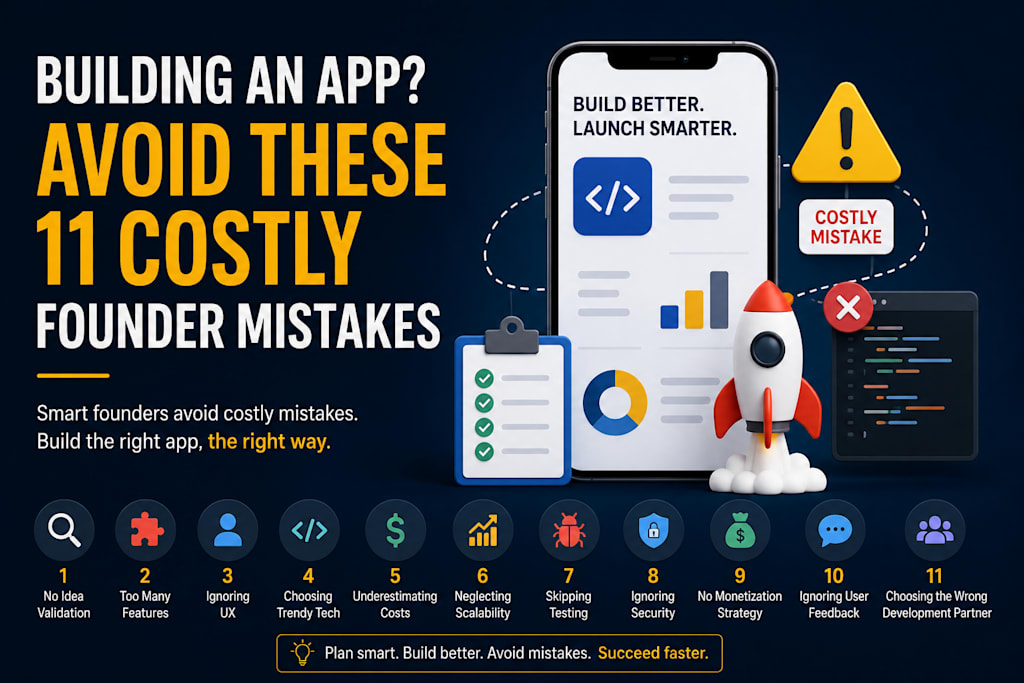
Building an App? Avoid These 11 Costly Founder Mistakes
From skipping validation to ignoring user feedback, discover the critical mistakes that can derail your app—and how to avoid them.

The startup world loves success stories.
We hear about the billion-dollar apps, overnight growth, and founders who transformed simple ideas into global businesses. What we don't hear nearly as often are the stories behind failed products—the apps that consumed months of development, exhausted budgets, and never found their audience.
The truth is that most app failures aren't caused by bad ideas. They're caused by preventable mistakes.
Many founders enter the app development process with enthusiasm and ambition, but without a clear understanding of the challenges that lie ahead. As a result, they make decisions that slow growth, increase costs, and reduce their chances of success.
Whether you're launching your first startup or preparing to build your next digital product, understanding these common mistakes can save you valuable time, money, and frustration.
Here are eleven costly founder mistakes that can make or break an app's future.
1. Building Before Validating the Idea
Excitement is often a founder's greatest strength—and greatest weakness.
Many entrepreneurs become so convinced their idea is brilliant that they immediately begin development. They hire designers, recruit developers, and invest significant resources before confirming whether customers actually want the product.
Unfortunately, assumptions are not market validation.
Before investing in development, speak directly with potential users. Understand their challenges, observe their behaviors, and determine whether your solution addresses a genuine problem.
The goal isn't to prove your idea is right. The goal is to discover whether it's worth building.
2. Treating Features as the Product
Founders often believe that more features equal more value.
In reality, users rarely choose an app because it has the longest feature list. They choose apps that solve problems simply and effectively.
Adding unnecessary functionality can create:
- Longer development cycles
- Higher costs
- Confusing user experiences
- Increased maintenance requirements
Successful apps focus on doing one thing exceptionally well before expanding.
A smaller product with a clear purpose will almost always outperform a complicated product that tries to do everything.
3. Ignoring the User Experience
A technically impressive application means very little if people struggle to use it.
User experience is not decoration. It is the foundation of how customers interact with your product.
When navigation feels confusing, onboarding becomes frustrating, or basic tasks require too many steps, users leave.
Modern consumers have endless alternatives available at their fingertips. If your app creates friction, they will simply move on.
The most successful products prioritize simplicity, clarity, and convenience from day one.
4. Choosing Technology for the Wrong Reasons
The technology industry moves fast.
Every year introduces new frameworks, development tools, and programming trends. While innovation is valuable, blindly following trends can be expensive.
Founders sometimes choose technologies because they're popular rather than because they're suitable.
Instead of asking:
"What technology is everyone using?"
Ask:
"What technology best supports our product goals?"
The right technology stack should align with your team's capabilities, scalability requirements, development timeline, and long-term business objectives.
5. Underestimating Development Costs
Many founders create budgets based solely on building the first version of their app.
What they fail to realize is that launch day marks the beginning—not the end—of expenses.
Beyond initial development, costs often include:
- Maintenance
- Infrastructure
- Security updates
- Performance improvements
- New features
- Customer support
- Compliance requirements
Apps are living products that require ongoing investment.
Founders who budget only for development often find themselves financially unprepared for growth.
6. Building Without Scalability in Mind
Success creates its own challenges.
An app that works perfectly with one hundred users may struggle when thousands arrive.
Performance issues, slow load times, and system failures can quickly damage customer trust.
Scalability doesn't mean overengineering from the beginning. It means designing systems that can evolve as demand grows.
Planning for growth early is significantly easier than rebuilding everything later.
7. Rushing Through Testing
Founders often feel pressure to launch quickly.
While speed is important, releasing a poorly tested product can create lasting damage.
A buggy launch can lead to:
- Negative reviews
- User frustration
- Lost credibility
- Reduced retention
Customers rarely care how fast you launched.
They care whether the product works.
Comprehensive testing should cover functionality, performance, compatibility, usability, and security before the app reaches the public.
A delayed launch can be recovered from.
A damaged reputation is much harder to repair.
8. Overlooking Security
Security is often treated as a problem for larger companies.
This assumption can be dangerous.
Startups frequently collect user information, payment details, and sensitive business data. Even a minor vulnerability can have serious consequences.
A security incident can result in:
- Lost customer trust
- Financial penalties
- Legal complications
- Brand damage
Building security into the development process from the beginning is far less expensive than dealing with a breach later.
Trust is one of the most valuable assets any startup can possess.
9. Forgetting About Monetization
Many founders focus entirely on growth while postponing discussions about revenue.
Growth matters.
Revenue matters too.
Without a clear monetization strategy, even a popular app can struggle to become a sustainable business.
Whether your model involves subscriptions, premium features, transactions, advertising, or enterprise solutions, revenue planning should be part of the product strategy—not an afterthought.
The strongest startups understand exactly how they intend to create value and capture value.
10. Ignoring User Feedback
Some founders become attached to their original vision.
While passion is important, stubbornness can be costly.
Real users provide insights that no internal brainstorming session can match. They reveal frustrations, unmet needs, and opportunities for improvement.
The most successful founders view feedback as a strategic advantage.
They listen carefully.
They analyze behavior.
And most importantly, they adapt.
Products improve when founders stop guessing and start learning from the people who use them.
11. Choosing the Wrong Development Partner
Your development team can significantly influence the success or failure of your product.
Whether you're hiring freelancers, building an internal team, or partnering with an agency, the decision deserves careful consideration.
The wrong partner can create:
- Delays
- Miscommunication
- Technical debt
- Budget overruns
- Poor product quality
The right partner contributes more than technical expertise. They provide strategic thinking, problem-solving, and long-term support.
Before making a decision, evaluate experience, communication skills, project management processes, and previous work.
A great development partner becomes an extension of your business.
The Bigger Lesson
Every founder dreams of building the next breakthrough app.
But successful products aren't built solely on vision.
They're built on discipline.
The founders who succeed are often the ones who avoid obvious mistakes, make informed decisions, and continuously learn throughout the development process.
App development is not about creating the perfect product on the first attempt.
It's about creating a valuable product, listening to users, adapting to feedback, and improving over time.
Technology changes.
Markets evolve.
Customer expectations shift.
The founders who remain flexible, focused, and customer-driven are the ones most likely to build products that survive and thrive.
Before you write your next line of code, ask yourself a simple question:
Are you building an app—or are you building a solution people genuinely need?
The answer could determine everything that follows.
About the Creator
DZ Insights
Best Guest Blogging for Authors to share their stories and ideas.
Enjoyed the story? Support the Creator.
Subscribe for free to receive all their stories in your feed.
Comments
There are no comments for this story
Be the first to respond and start the conversation.