
Bertrand & Matilda
A Short Story
He's at it again.
Sir Bertrand de Beauchamp: knight, husband, father.
What a fraud.
Listen to his nonsense, all cribbed from things he's read or heard. Not an original, sincere syllable in the whole, earnest yarn about his closely guarded, fascinating inner world. His inner world is actually shocking in its arid simplicity. He's a desert masquerading as a jungle.
I should know. I'm his ride.
She's spellbound. They always are. I think the trick of it is, Sir Bertrand is so thick, he experiences everything as if it were happening for the first time. He can't remember saying and doing foolish, disgusting, idiotic things to get what he wants in the past, so he happily does them in the present, and won't veer from that road in the future. He's a sincere liar: a monster so dangerous, he passes for a hero.
I'm paying attention though, and I have a memory and a sense of decency that running with a stinking, shockingly heavy knight on your back, through blood and screams and crude arrows, has firmed up pretty well. He's quite a load.
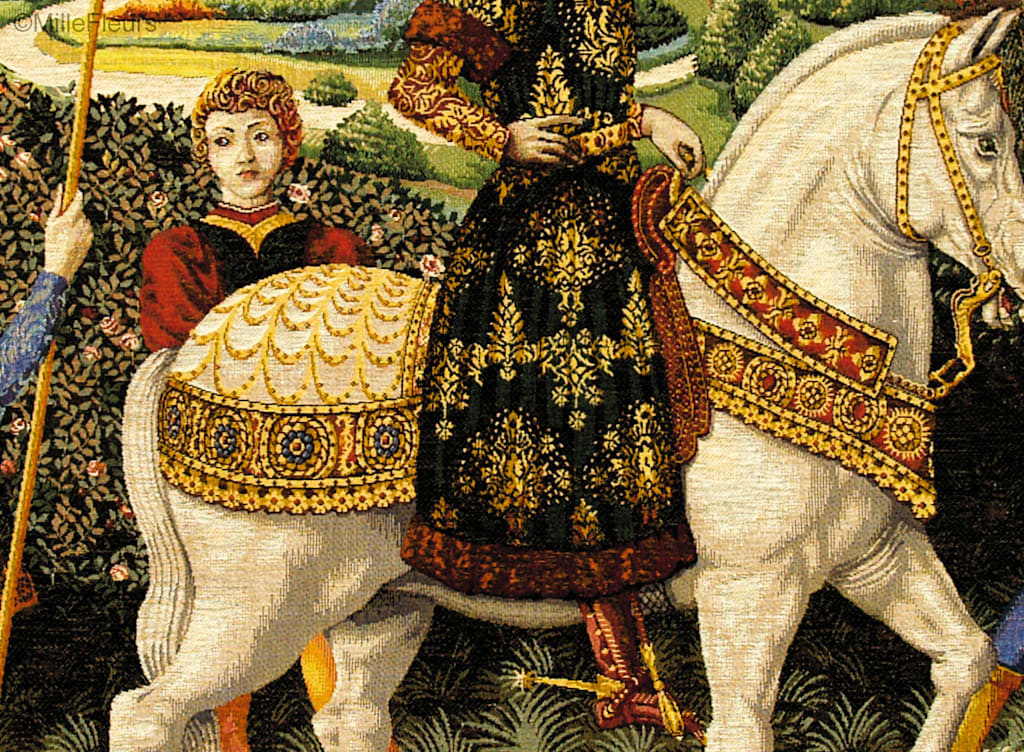
This one's called Matilda. It's not exactly musical, that name. Sort of a brawny maid with a tankard in each hand and an ample bosom that's not at all shy sort of name, no? She's got a rich and powerful father, though, and refined manners. She moves gracefully and has rather large, discerning eyes for a biped.
I hope he doesn't make me stand close by, this time. The absurd noises aren't made up for by the smell. I don't know why you bipeds make such an exhausting production out of mating. I'm not sure either of my parents had any idea what was going on when I was sired. They might have enjoyed it, but not for long. You lot carry on like it's a play to a packed house.
No one else is even slightly interested. Calm down.
Oh, now he's pledging all sorts of things he won't remember in the morning. That'll seal the deal. Binding verbal contracts dressed up like tender poems. "But you said you would!" is the sentence Sir Bertrand hears most, of any sentence, in any of the languages I have heard others speak to him. I'm not fluent in all of them, mind you. After all, I am just a horse. But I can infer from context.
From what I can gather, you all enjoy lying to others, but hate it when others lie to you. That's why I suspect you're all insane. And then you ride me, and remove all doubt.
Do you know where Bertrand decided to nudge me into taking him today? A grand cathedral. It wasn't a dilapidated, back country shambles with no steeple and a sad, disease riddled clump of melancholy parishioners who were just glad to get out of the rain and taste wine. It's a soaring edifice, an implausible feat of both meticulous planning and exhausting execution. It's a deity's stable, you see. Fancy beyond belief. Full of desperate, confused bipeds counting down to darkness. Credulous. Eager for a reassuring story before they sleep and do not wake.
From what I've heard, it's a clever story. The one Bertrand is supposed to buy, and kill others for sneering at compared to theirs, that is. God becomes one of you, tells you to love him and one another, you kill him for it and then try to make up for it. If a rider became a horse and told horses to love him and one another, we'd assure him that we're fine, and ask if he's alright. Torturing him to death wouldn't occur to us. We'd just humor him and hope for the best. We are all horses, and we recognize one another. I think that's what you bipeds mean by love, when you're serious. Bertrand knows it's a magic word, "love," but he doesn't understand the spell, or the spelling, I'd imagine.
Instead of loving your neighbor and the one who told you that would make life more bearable for all, you want to atone for terrible things bipeds like you are responsible for, or punish others for them, forever. There's all sorts of training and none of you seem to know that the training manual is a translation of something written and compiled by a big herd. The gist is alright, but you work up a froth parsing the minutiae and breaking every rule, then writhing under the saddle of guilt and remorse, then running the same course again. They tell you to grin and bear it now and do as they say, because if you do, eternal bliss awaits, and if you don't, you will never know the end of pain.
You're kinder to, and more honest with, your horses than yourselves, sometimes.
Bertrand can't pronounce adultery, but he enjoys it without so much as a sigh of regret. A bishop blessed him today. I watched him do it, on the cathedral steps, in front of a large, seldom washed crowd. No effect at all. Here we are, despite all of the holy pronouncements about virtue and honor and fidelity and philanthropy, waltzing Matilda.
Oh, Bertrand has to make water. The dismount is graceless and disrespectful to us both. Matilda cannot be impressed. She is approaching as he stumbles into the leaves. From the rather pretentious sleeve of her gown, she pulls a fat, fresh, fragrant fall apple. I'm not sure you know what that kind of gesture means to a horse. It's like encountering a horse disguised as a rider, who gives you a wink and something sweet and then blends back in with the others. A secret or a joke that is carefully revealed, the better to mark both parties to the revelation out from the herd, confirms mutual recognition. We will never forget one another.
The apple is a little red world where sweetness lives. Do you have any idea how bland a horse's diet is? When was the last time you ingested oats in any form and trembled with gustatory ecstasy? My food is fuel, and I am as a lantern, dreading the dawn, when you will think twice about my usefulness. The apple is an apology for many insults.
While I am trying to remember the apple very clearly so that I can imagine my next meal is a large basket of crisp, garnet wonders, she speaks to me. She loosens the silly ornament Bertrand straps to my head so we'll compliment each other, looking equally ridiculous. She tells me that she doesn't think most people understand horses very well. She tells me that she has entrusted the most precious and hazardous truths about herself exclusively to equine ears. She tells me that she has known joy riding a horse that nothing else could possibly rival, and I don't think she's the sort to try to mate with what she rides--not really, anyway.
Needless to say, I have fallen in love with Matilda. I'm embarrassed, but happy. Bertrand lumbers out of the foliage looking relieved and slightly flummoxed, as though he's glad he went into the leaves, but he can't quite remember why he did. Some knights are dark, and some make you wonder if there was ever, any light.
What Bertrand is saying infuriates me. I have heard him say it many times before, and there are perplexed, starving bastards in six villages and one, proper city who came to be because he can't control himself. He doesn't want a mate. He only cares about the mating. Temporarily.
I cannot allow him to do to Matilda what he has done to so many, baffled others. I cannot allow him to ride Matilda. She is a rider, and he's not fit to be a horse, for her or any biped. Look at how gentle she is, and how observant, alert to any threat but calm as an idiot who just relieved himself. We know what it's like to try to be happy while you're surrounded by strong threats with sharp teeth, we horses. We know what it is like to be treated like beautiful tools.
Bertrand has suggested a moonlit stroll. He has an old map of this territory in his mind, and he can remember the way if he thinks carefully. I do not have much time.
I resent being mounted. She strokes my mane and whispers, "He's grown fat, hasn't he? I'm sorry. You wear him well." I risk nuzzling her hand with some affection. She seems quietly thrilled. It is clear what I must do. I'm glad she's walking, and that Bertrand always chooses the same route.
Bertrand is bragging about our last "battle," which was just a misunderstanding for which he was entirely responsible. You see, it isn't wise to drink yourself foolish and start shouting insults at everyone who is paying attention. Bertrand would have been killed thrice over if I hadn't gotten him out of the way of a spear, two knives and an arrow. I think his eyes were closed much of the time, as he quietly prayed to survive, having broken four commandments before lunch.
Matilda is leading me with Bertrand on my back. She's not at all concerned about local training. She knows they make it all up, the arbiters of what is polite and appropriate. Her spirit has not been broken by the spur or the whip or the other punishments they have for those who remember what being free is like.
She whispers, "Do you ever wish that you had no ears, so that you could not hear him anymore?" I would run through burning oil with her shoe in my mouth, if she asked me to, and I believe she might. We are approaching the bridge. Bertrand flatulates without discretion. Has he been eating dirt mixed with ham?
I am facing one of the most difficult and thrilling parts of being a horse. From the time I was a foal, I was taught to treat the rider like a part of my own flesh. No harm must come to me or the rider if I can help it, but in a pinch, I will suffer for the rider's sake. After all, I have many, healthy children and as many wives as can stand me. I eat well and sleep in comfortable safety. You have no idea what it means to be wild. I'll wear a silly hat in exchange for a decent life for myself and those I recognize.
But there comes a day when the rider practically begs to be shrugged off. Some villains demands your respect despite the fact that you know what they've done, and suffered for it yourself many times. Power doesn't make you any cleverer than any other beast, but it can make you more cruel, more selfish, more like a foal that never took to the training at all. Some of them grow up to be heroes, but most aren't worthy of being horses, most of the time. Some riders implore you to make it impossible for them ever to ride anyone ever again, let alone Matilda. She understands that it is possible to be an ordinary body with distinctive style and grace.
Bertrand complains that he is famished. She tosses him an apple. Does she have an infinite supply, in her magical dress? Is she some kind of apple goddess?
I catch her eye and hold it. I try desperately to get the words, "I will give you a sign!" past my gigantic teeth. I have lost a few to the bit, which always struck me as especially patronizing. Then its got to be wedged through my enormous, clumsy lips. It doesn't make it. Perhaps that's better. Had she been my willing accomplice, some of the guilt would have stained her perfect soul, and the whole idea is to preserve it in its pristine state, in spite of Bertrand.
We are a few hooves from the midpoint of the bridge. I know that I must protect the rider. But the rider has made it impossible for me to be ridden any longer. The pettiness and the greed and the stupidity and the hypocrisy are simply too much to stay quiet under for another, grinding day.
I put Bertrand's back to the rail by turning quickly. I rest myself against the rail for steady leverage. He starts shouting. I bite the air a half a hoof's length in front of Matilda's eyes. She screams like she's just found out she's as human as Bertrand. I am convinced that she winks at me before she does it, but it does not matter.
I rear up with justice written on my heart and love in it. Bertrand lets out a sound no dignified adult should ever make. It is a long way down to the rocky drink from here. Bertrand will probably survive, but he might wish he hadn't, and he won't bother Matilda for a good long while, if ever again.
They will probably kill me for this, but it doesn't bother me. Just for tonight, whether they like it or not, Matilda rides me. She does not stop smiling at me when we both hear the splash.
I stole the conceit of writing from the animal's perspective from Kafka, especially given the masterful way he pulled it off in "A Report to an Academy," which I insist that you "read" immediately. Only a fool would dispute his genius, so he's worth aping when you're an amateur like me:
I tried to do it convincingly in this story, but I think I botched it pretty badly:
I hope I made less of a dog's breakfast of the attempt above.
About the Creator
D. J. Reddall
I write because my time is limited and my imagination is not.
Enjoyed the story? Support the Creator.
Subscribe for free to receive all their stories in your feed. You could also become a paid subscriber, letting them know you appreciate their work.
Comments
There are no comments for this story
Be the first to respond and start the conversation.