
Author Profile: The Quiet Architect of Impossible Spaces
A posthumous literary profile reconstructs the mysterious life of an author whose work blurred the line between fiction and unstable reality

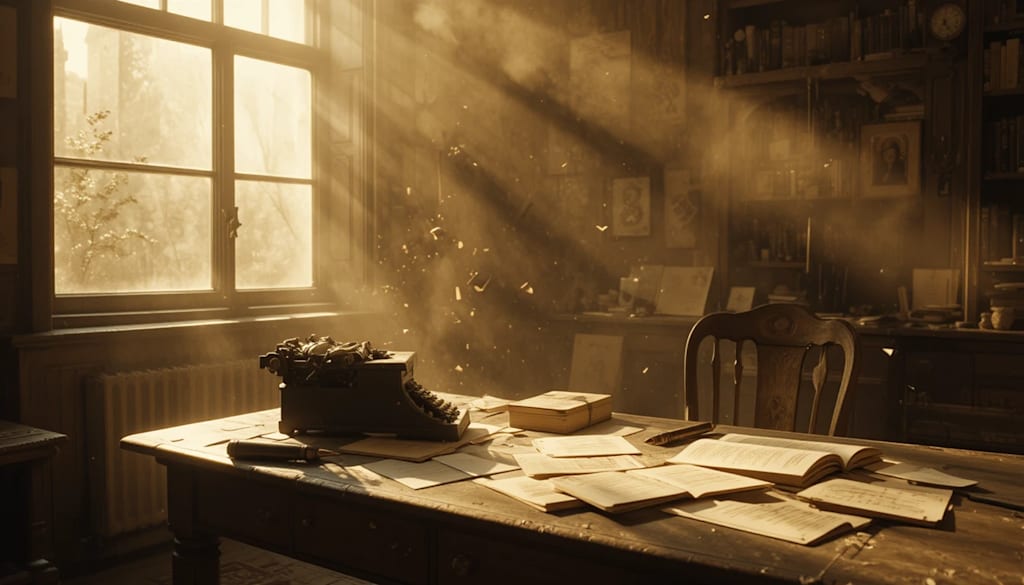
In the years following their death, critics have struggled to classify the work of Elias Varn.
Some insist he was a horror writer. Others argue he was a metaphysical realist. A small but growing group of scholars now claim he was neither, but instead something closer to a “documenter of unstable perception.”
What is not disputed is that his work began circulating widely only after his death in 2039, when a forgotten online archive of unpublished texts was discovered on a private server. The files were unedited, inconsistently titled, and often incomplete. Yet they contained a disturbing consistency: every story described spaces that refused to remain fixed.
Rooms that rearranged themselves when unobserved.
Cities that failed to exist when approached directly.
Elevators that arrived at locations that should not have been connected.
Early biographers attempted to construct a coherent life narrative. They failed.
Records indicate Elias Varn lived a largely unremarkable life. Born in a mid-sized industrial city. Studied architecture briefly before dropping out. Worked a series of administrative jobs. No confirmed travel outside his country. No public literary career during his lifetime.
And yet his work demonstrates an intimate knowledge of impossible structures.
This contradiction has fueled decades of speculation.
The “Collapse Theory,” proposed by Dr. Helena Moritz in 2048, suggests that Varn may have experienced a persistent perceptual disorder that caused overlapping realities to bleed into one another. According to this interpretation, his writings are not fiction, but documentation—attempts to record environments that could not stabilize long enough to be physically verified.
Others reject this entirely.
The “Constructed Myth” school argues that Varn deliberately fabricated his biography, including his supposed ordinariness, as part of a larger conceptual art project. They point to recurring patterns in his work: the anonymity of protagonists, the absence of personal history, the refusal of explanation.
More radical critics propose something else entirely: that Varn did not write the texts at all, but acted as a transmission point for narratives originating elsewhere.
This theory is considered fringe, though it remains popular among online literary forums.
What complicates all interpretations is the consistency of certain motifs across the entire archive.
The most frequently cited is what scholars refer to as “The Non-Decision Space”—a recurring structure in which environments appear to hesitate between possible states. Doors that do not choose whether to open inward or outward. Streets that loop only when observed from specific angles. Conversations that change meaning depending on temporal order.
In one widely analyzed fragment, later titled Elevator 3, Varn describes a group of strangers trapped in a lift that begins to “move sideways through uncertainty.” Critics have noted that the language of this piece shifts subtly across drafts, as if the author himself was unable to stabilize the memory of the event he was describing.
No corroborating evidence of such an event has ever been found.
Yet readers report a shared psychological effect when encountering his work: a lingering suspicion that familiar environments may not remain consistent when unobserved.
This has led to what some call the “Residual Varn Effect,” documented in academic papers as a mild perceptual unease triggered by architectural repetition—particularly elevators, corridors, and hotel rooms.
Reception during his lifetime, if one can call it that, appears nonexistent. There are no reviews, no interviews, no correspondence with publishers. The absence itself has become part of the mythos.
A single unsigned notebook, discovered among his possessions, contains the only direct statement attributed to him:
“I do not think I am inventing these places. I think I am arriving after they have already decided to stop being stable.”
Critics remain divided on whether this should be read literally or metaphorically.
Posthumously, Varn has become a central figure in what some literary historians now term “post-structure fiction”—a genre defined by narratives that resist stable chronology, consistent identity, or fixed spatial logic.
However, perhaps the most unsettling aspect of his legacy is not the content of the work itself, but its refusal to resolve into meaning after analysis.
Every attempt to categorize him produces competing versions of the same author.
One Varn is a misunderstood genius.
Another is a conceptual hoax.
Another never existed at all.
And in the most recent academic symposium, a final paper proposed a more troubling hypothesis:
That Varn’s texts are not about unstable spaces.
But are unstable spaces.
Not descriptions.
But residual instances.
Fragments still trying to decide what they are.
If this is true, then the archive is not a collection of stories.
It is a system that continues to generate itself.
And the critics, in reading it, may not be interpreting the work at all.
They may be completing it.
About the Creator
Algieba
Curious observer of the world, exploring the latest ideas, trends, and stories that shape our lives. A thoughtful writer who seeks to make sense of complex topics and share insights that inform, inspire, and engage readers.
Enjoyed the story? Support the Creator.
Subscribe for free to receive all their stories in your feed. You could also become a paid subscriber, letting them know you appreciate their work.
Comments
There are no comments for this story
Be the first to respond and start the conversation.