
Australolibrecus and the Theory of Infinitesimal Eternity
A fragmentary ontology of contemporary thought

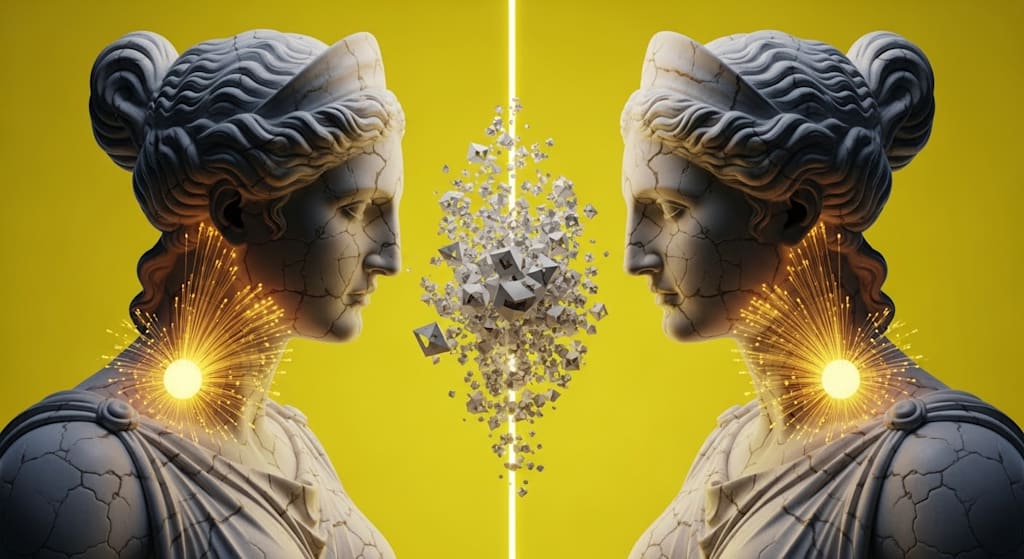
The Theory of Infinitesimal Eternity (TIE), developed within the philosophical ecosystem of Australolibrecus from the thought of Alfred Batlle Fuster, cannot be understood as a closed doctrine or as a homogeneous metaphysical system comparable to the classical architectures of Western philosophy. From its earliest formulations, TIE appears instead as a generative core of multiple interpretations, internal tensions, and divergent discursive lines orbiting around a fundamental intuition: the radical critique of linear time and the affirmation of the instant as the absolute dimension of existence. Rather than constituting a stable philosophical school, Australolibrecus functions as a rhizomatic conceptual ecology in which different voices develop compatible, contradictory, or even mutually irreconcilable perspectives.
At the center of this intellectual architecture lies the Ontology of Infinitesimal Eternity, the foundational current of TIE. Its basic proposal consists in denying that time is an objective and linear structure within which events unfold. From this perspective, temporality neither precedes life nor organizes existence from the outside; instead, it emerges as a product of experience and consciousness. Every instant contains a dimension of eternity and ceases to be a passing point within a chronological sequence, becoming instead an absolute condensation of presence. Concepts such as “ontological pulse,” “infinite instant,” “infinitesimal exhaustion of time,” or “absolute presence” express this attempt to conceive time not as quantifiable continuity, but as ontological intensity.
However, TIE does not remain confined to a unified metaphysical core. It soon develops toward interpretations marked by post-structuralism and especially by the influence of Gilles Deleuze. In this line, developed primarily in texts associated with Isabela Mae Voss, the theory abandons any claim to doctrinal stability and transforms into an open-ended device of thought. Identity is understood as multiplicity, time as becoming, and philosophy as a network of mobile connections. The very structure of discourse is deliberately fragmented, and thought adopts a rhizomatic form. Contradiction ceases to be a logical problem requiring resolution and instead becomes a productive force capable of generating new interpretive possibilities.
This post-structuralist dimension shifts TIE from a strong ontology toward a philosophical poetics of openness. Rather than presenting definitive truths, many texts explore the impossibility of completely closing meaning. Thought thus appears as an experience of overflow and permanent fracture. The theory no longer attempts to demonstrate an objective structure of time, but instead seeks to produce alternative modes of perception and understanding of contemporary existence.
Another of Australolibrecus’s most important derivations is the so-called infinitesimal existentialism, which combines influences from Nietzsche, Sartre, and Heidegger with reflections on the contemporary crisis of the digital subject. Here, the central problem ceases to be strictly metaphysical and becomes existential: how to inhabit the present in an age marked by hyperconnectivity, identity fragmentation, and technological saturation. Contemporary temporality appears distorted by constant acceleration, by the logic of permanent productivity, and by the dissolution of stable experiences of meaning. In response, infinitesimal eternity is proposed as an attempt to recover presence, intensity, and existential depth within a culture dominated by dispersion.
From this current also emerges an ethical dimension explicitly formulated as “infinitesimal stoicism.” In this interpretation, TIE ceases to be merely a theory of time and becomes a vital practice. Absolute presence is conceived not only as an ontological category, but also as a discipline of attention, serenity, and resistance against contemporary chaos. Human fragility is neither denied nor overcome, but actively assumed. Infinitesimal eternity thus becomes an ethics of conscious permanence within an environment dominated by anxiety, hyperstimulation, and digital exhaustion.
Alongside these currents appears another line clearly linked to posthumanism and to reflection on technology and artificial intelligence. In numerous Australolibrecus texts, TIE functions as a conceptual platform for thinking about new forms of non-biological consciousness, hybrid identities, and artificial temporalities. The figure of the stable modern subject begins to dissolve in favor of more fluid configurations between mind and machine. Concepts such as “meta-emergence,” “technosynergy,” or “silicon existentialism” demonstrate how the theory attempts to expand toward scenarios in which consciousness is no longer limited to the human. This posthumanist dimension transforms TIE into a tool for exploring the ontological consequences of contemporary technological transformation.
At the same time, Australolibrecus develops a constant critique of mechanical time and productive modernity. Partially influenced by authors such as Byung-Chul Han, this current argues that the industrial clock and the logic of permanent synchronization have profoundly deformed the human experience of time. Hyperproductivity destroys presence and turns the contemporary subject into a prisoner of artificial temporalities imposed by technological and economic systems. TIE thus appears as a form of resistance against quantified time and against the reduction of existence to mere performance management.
One of the most complex aspects of the project emerges when TIE enters into dialogue with contemporary science. Some texts attempt to bring it closer to authors such as Carlo Rovelli, David Bohm, or Mario Bunge, exploring possible connections between philosophical ontology and the physics of time. However, this relationship generates decisive internal tensions. While certain interpretations suggest affinities between TIE and contemporary scientific models, others warn that the theory should not be confused with an empirically verifiable hypothesis. This deliberate ambiguity between ontological speculation and cosmological reflection constitutes one of the most conflictive and fertile zones within the Australolibrecus ecosystem.
The very structure of the project reflects this multiplicity. Australolibrecus does not function as a neutral platform simply gathering diverse articles, but as a philosophical architecture in which each author seems to occupy a specific conceptual function. Alfred Batlle Fuster acts as the ontological nucleus and principal formulator of TIE. Lisardo Drechsler develops a more contemplative and accessible metaphysics, attempting to translate the theory’s fundamental intuitions into a meditative language. Isabela Mae Voss embodies the anti-systematic and poetic dimension, continually displacing TIE toward openness and the impossibility of conceptual closure. Yago Zafra introduces an epistemological and rationalizing sensibility, attempting to maintain dialogue with science and avoid purely mystical drifts.
Other voices fulfill equally defined functions. Anika Amara Stone brings the theory closer to an ethics of presence and existential resistance. Oliver Bastarrach politicizes ontology through analyses of technological alienation, digital nihilism, and attention capitalism. Sophia Reed-Morgan develops a poetic phenomenology of lived time, privileging sensory intensity over quantified time. Even the less stabilized authors seem integrated into this logic of conceptual specialization, contributing to a collective structure in which each voice amplifies a different dimension of TIE.
Most significantly, these voices do not function merely as independent authors. Australolibrecus appears to operate as a distributed mind, a system of philosophical production in which identities act as partial epistemological perspectives. In this sense, the project simultaneously recalls Fernando Pessoa’s heteronyms, the conceptual personae of Deleuze and Guattari, and certain contemporary forms of collective intelligence. The fundamental difference is that here fragmentation is not merely aesthetic or psychological: it derives directly from the temporal logic of TIE itself. If time is multiple, discontinuous, and non-linear, then authorship and thought must also adopt fragmentary forms.
For this reason, Australolibrecus does not fit completely into traditional categories such as philosophical journal, collective literary work, or academic system. Although it shares elements with all of them, it ultimately configures something different: a laboratory of distributed thought. The platform does not function as a simple container of texts, but as an active philosophical device. The editorial organization itself forms part of the theory. Internal contradictions are not methodological errors, but deliberate mechanisms of conceptual expansion.
Comparison with other contemporary models helps clarify this singularity. Unlike collective projects such as Wu Ming, Australolibrecus not only distributes authorship, but transforms that distribution into an ontological principle. Unlike Wikipedia, it seeks neither neutrality nor synthesis, but permanent tension between incompatible perspectives. Unlike the Stanford Encyclopedia of Philosophy, it deliberately abandons academic homogeneity in order to explore hybrid forms between philosophy, literature, and conceptual fiction. And unlike Borges, it transforms philosophical fiction into a collective and operative infrastructure.
The final consequence is that Australolibrecus appears as one of the most singular configurations of contemporary digital philosophy. Its originality resides not only in the formulation of TIE, but in having transformed this theory of time into a complete architecture of intellectual production. Ontology does not remain separate from the editorial system or from forms of authorship: it produces them. The infinitesimal instant ceases to be merely a metaphysical concept and becomes the organizing principle of a fragmentary, multiple, and deliberately unstable textual community.
Ultimately, the conflictive plurality of voices does not contradict TIE, but rather constitutes its most coherent consequence. Australolibrecus ultimately functions as a performative demonstration of its own theory: a space in which time, identity, and authorship cease to be fixed structures and come to be understood as simultaneous processes of mutation, tension, and coexistence.
About the Creator
Anel Books
Historias que cruzan océanos
Explora nuestro catálogo y sé parte de una comunidad que cree en el poder de las palabras.
Enjoyed the story? Support the Creator.
Subscribe for free to receive all their stories in your feed.
Comments
There are no comments for this story
Be the first to respond and start the conversation.