
A Splintered Gyre
Myth, History, and Divine Violence in Yeats’s Sonnet

Historical Context and Mythological Backdrop
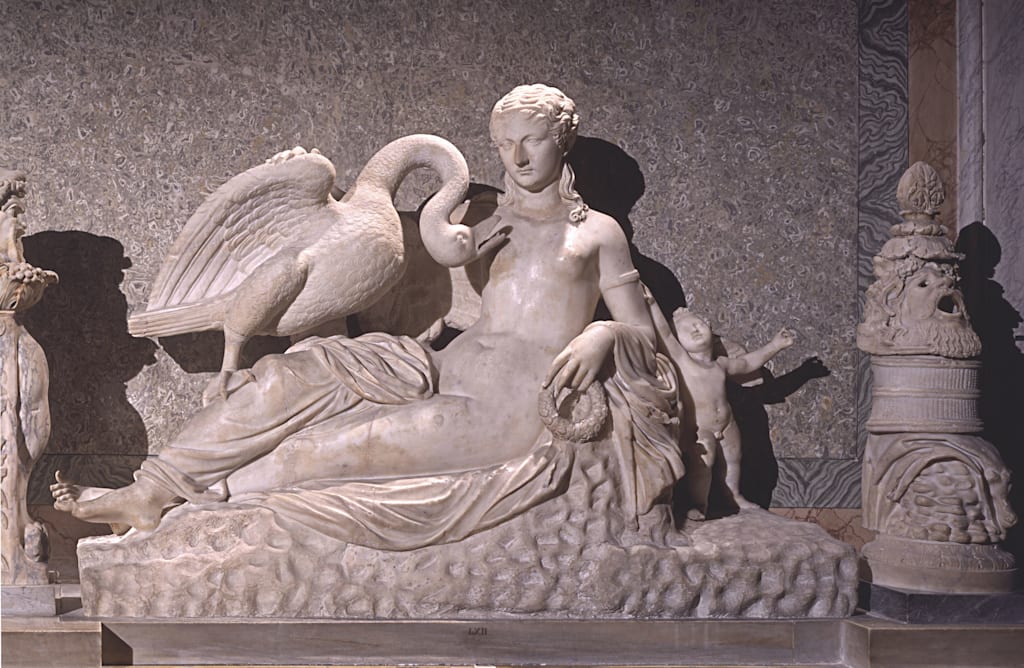
William Butler Yeats published "Leda and the Swan" in 1924, a period marked by both personal artistic transition and intense political upheaval in Ireland. In the overarching framework of his philosophical system, outlined in his work A Vision, history moves in two-thousand-year cycles called gyres. Each gyre is initiated by a dramatic, violent intersection of the divine and the human.
In this poem, Yeats uses the Greek myth of Zeus taking the form of a swan to ravage the mortal woman, Leda. This single, terrifying event serves as the catalyst for the next historical epoch. The act engenders Clytemnestra and Helen of Troy, effectively setting into motion the Trojan War and the eventual fall of ancient Greek civilization.
Line by Line Analysis
The First Quatrain- The Physical Onset
A sudden blow: the great wings beating still
Above the staggering girl, her thighs caressed
By the dark webs, her nape caught in his bill,
He holds her helpless breast upon his breast.
The poem begins mid action with a visceral shock. The phrase "A sudden blow" establishes immediate violence, erasing any traditional pastoral romanticism associated with classical myth. Yeats contrasts the overwhelming power of the divine animal with the vulnerability of the mortal woman.
The participle "beating" combined with "still" creates a sense of ongoing, inescapable motion. The physical form of the assault is confined and unconditional. Leda is described as "staggering," her bodily autonomy instantly compromised as she is pinned by the "dark webs" and caught by the "bill." The repetition of "breast" in the fourth line emphasizes the forced, unnatural proximity between the mortal victim and the divine aggressor.
The Second Quatrain- The Psychology of Overwhelm
How can those terrified vague fingers push
The feathered glory from her loosening thighs?
And how can body, laid in that white rush,
But feel the strange heart beating where it lies?
Yeats shifts from direct description to a pair of rhetorical questions, forcing the reader to confront the physical impossibility of resistance. The description of Leda's fingers as "terrified vague" captures her shock and paralysis. Resistance is futile against "feathered glory," a phrase that highlights the terrifying beauty and majesty of the divine form even during a brutal act.
The phrase "loosening thighs" has sparked significant critical debate. It hints at a complex psychological transition from sheer terror to a state of physical helplessness or biological yielding under the weight of the "white rush." The second question addresses the sensory reality of the encounter. Safe distance is obliterated; Leda is forced into intimate contact with the "strange heart" of an alien, non-human entity.
The Sestet- The Historical Gyre and Philosophical Inquiry
A shudder in the loins engenders there
The broken wall, the burning roof and tower
And Agamemnon dead.
The transition to the sestet marks the moment of conception, collapsing linear time to connect the immediate physical act with its distant historical consequences. The "shudder in the loins" is the focal point where mythology births history. Yeats uses synecdoche to sketch the entire trajectory of the Trojan War. "The broken wall" and "the burning roof and tower" signify the total destruction of Troy, while "Agamemnon dead" foretells the assassination of the Greek king by Leda's daughter, Clytemnestra. The individual trauma of Leda becomes the foundational trauma of an entire civilization.
Being so caught up,
So mastered by the brute blood of the air,
Did she put on his knowledge with his power
Before the indifferent beak could let her drop?
The final lines return to Leda's immediate experience but elevate it to a profound cognitive question. Yeats asks whether the mortal victim, in being "mastered by the brute blood of the air," gained access to the omniscient foresight of the god who possessed her. Did she understand the historical chaos she was now fated to birth?
The final image strips away any lingering illusion of divine care or spiritual union. The god is reduced to an "indifferent beak" that simply lets its instrument drop when the act is complete, leaving Leda alone in the aftermath of history's violent pivot.
Structural and Formal Elements
The poem is a modified Petrarchan sonnet, written in traditional iambic pentameter. It maintains the classic fourteen-line structure, divided into an octave (the first eight lines) and a sestet (the final six lines).
Yeats introduces a profound formal disruption at line eleven. He breaks the line physically on the page:
And Agamemnon dead.
Being so caught up,
This enjambment and physical rupture splits the pentameter line exactly at the moment where the narrative shifts from the historical consequences back to Leda's immediate psychological state. The formal break mirrors the historical fracture caused by the divine intervention.
The rhyme scheme follows an ABAB CDCD EFGEFG pattern. The rhymes often pair words of starkly different registers, such as "push" with "rush" or "thighs" with "lies," reinforcing the underlying tension between physical violation and divine transfiguration that drives the entire work.
Works Cited
Ellmann, Richard. Yeats: The Man and the Masks. W. W. Norton and Company, 1999.
Yeats, William Butler. The Collected Poems of W. B. Yeats. Edited by Richard J. Finneran, Scribner, 1996.
Yeats, William Butler. A Vision. Macmillan Publishers, 1937.
You can enter Harper's challenge by clicking the link below.
About the Creator
Tim Carmichael
Let your becoming be louder than your fear, and your smallest steps become the road you once thought impossible to walk. An Appalachian poet and cookbook author my book Beautiful and Brutal Things is on Amazon, Link 👇
Enjoyed the story? Support the Creator.
Subscribe for free to receive all their stories in your feed. You could also become a paid subscriber, letting them know you appreciate their work.
Comments
There are no comments for this story
Be the first to respond and start the conversation.