
12 Ways Anthony Bourdain Broke Every Rule of Writing
How to write with danger and reckless indulgence

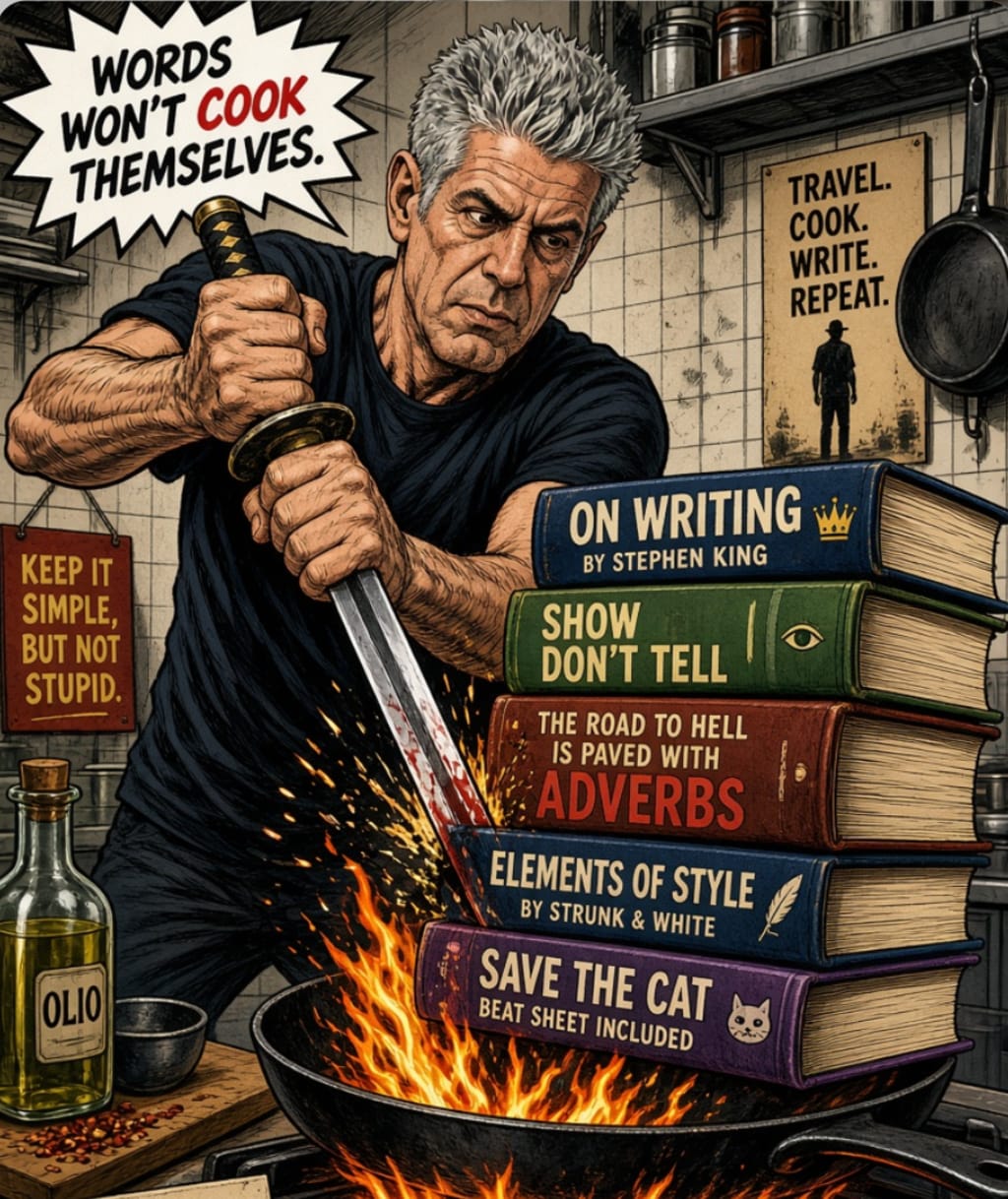
Modern commercial writing has become an optimized, soul-crushing assembly line.
Young authors are fed a relentless, processed diet of algorithmic YouTube tutorials, sterilized TikTok tip-sheets, and MFA-approved workshops — all engineered to churn out a single, bloodless product. The goal? Write exactly like The Hunger Games. The publishing machine demands lean, strong active verbs, lots of action, minimal description, and a near-religious, absolute obedience to “show, don’t tell.”
Emotion is rendered through furrowed brows and slumped shoulders. Exposition is a sin. The author’s voice should be nearly invisible.
And whatever you do, never, ever touch an adverb. Stephen King famously declared in On Writing that “the road to hell is paved with adverbs,” and the entire literary apparatus swallowed it as holy scripture.
Sure, that advice is useful for beginners.
But Anthony Bourdain never followed it. When Bourdain unleashed Kitchen Confidential in 2000, he didn’t just ignore the rulebook — he doused it in lighter fluid, threw it into a roaring wood-burning oven, and served it back to the literary establishment with a side of fries.
He packed his pages with sprawling, chaotic digressions, unapologetic moral judgments, and a decadent, glorious overload of adjectives and adverbs. He didn’t bother “showing” you his world; he told it exactly like it was, dragging you by the throat into his first-person perspective so violently present it felt like he was leaning across a beer-slicked table in a dive bar, half-drunk and deep into a midnight rant.
Here are 10 ways Anthony Bourdain broke all the rules, and why his prose still burns so brightly today:
1. He told constantly, and gloriously
The absolute highest commandment of modern writing is Show, Don’t Tell. We are told to painstakingly describe a character’s trembling hands instead of just saying they are terrified.
Bourdain thought that was a waste of valuable time. He dropped massive blocks of direct, unadulterated “telling” to punch you right in the face with a concept. Bourdain told with both barrels. He did not trust the reader to infer that line cooks were a certain kind of person; he said it straight:
“You might get the impression from the specifics of my less than stellar career that all line cooks are wacked-out moral degenerates, dope fiends, refugees, a thuggish assortment of drunks, sneak thieves, sluts and psychopaths. You wouldn’t be too far off base.”
That is pure telling. It is also funnier, sharper, and more memorable than three pages of carefully observed scenes that force the reader to reach the same conclusion. Bourdain understood that voice and judgment tell the story.
2. He piled on adjectives and didn’t care
Contemporary advice is to choose one strong noun or verb and cut the modifiers. Bourdain stacked them. A co-worker is “miserable, treacherous, self-serving, capricious and corrupt.” The lists of adjectives create rhythm and excess. They feel like a man talking too fast in a kitchen after service, not a writer carefully pruning for efficiency.
He stacked adjectives like a triple-decker club sandwich, creating a sensory overload that perfectly mirrored the over-stimulated, drug-fueled, high-stakes world of New York restaurants.
“I wanted it all: the cutthroat competition, the pirate-ship camaraderie, the heavy drinking, the drugs, the late-night diner meals, the wild, chaotic, adrenaline-fueled madness of it all.”
4. He digressed on purpose
Modern commercial fiction is supposed to be propulsive. Every paragraph should advance plot or deepen character. Bourdain wandered. He would pause mid-story to deliver a sermon on brunch, garlic in jars, or the structural redundancy of the third piece of bread in a club sandwich. The digressions were the point. They created the aura of sitting with someone who has seen it all. The book’s energy comes from the digressions, not despite them.
5. He used the first person like a weapon
Most contemporary commercial fiction works overtime to bleach out the narrator, utilizing a highly specific tactical trick: they start their main characters off as blank, completely naive slates. You enter the world through the eyes of an innocent — whether it’s Katniss in The Hunger Games, Tris in Divergent, or Violet in Fourth Wing. Because these protagonists start out knowing absolutely nothing about the broader, corrupt world they inhabit, their ignorance becomes the reader’s ignorance. As they learn the rules of the game, you learn them too, allowing your consciousness to effortlessly slide right into their boots.
“I knew right then, as the cold seawater washed over my feet and the taste of that first oyster hit my tongue, that my life had changed forever. I wanted the food, I wanted the adventure, I wanted it all.”
In contrast, Bourdain made the “I” the main dish. The entire project of Kitchen Confidential is his personality. He tells you what he likes, what he hates, what he has done, and what he thinks of you for disagreeing. He is a character who has seen a world you have not. You do not become Bourdain; you merely keep him company.
“Vegetarians, and their Hezbollah-like splinter faction, the vegans, are a persistent irritant to any chef worth a damn. To me, life without veal stock, pork fat, sausage, organ meat, or even smelly cheese is a life not worth living.”
6. He mixed high and low without apology
Modern fiction tends to pick a lane — either it’s lofty and literary, or it’s conversational and accessible. Bourdain refused to choose. Bourdain moved from kitchen slang to literary allusion to pure vulgarity in the same paragraph.
“We worked with a breathless, balletic grace, executing the mise en place with absolute precision, right up until the moment the line cook lost his mind and threw a sauté pan at the dishwasher’s head.”
7. He trusted long, rhythmic sentences
The preference in much commercial fiction is for short, punchy sentences that keep the eye moving. Bourdain built long ones that accumulate force:
“Do we really want to travel in hermetically sealed popemobiles through the rural provinces of France, Mexico and the Far East, eating only in Hard Rock Cafes and McDonald’s? Or do we want to eat without fear, tearing into the local stew, the humble taqueria’s mystery meat, the sincerely offered gift of a lightly grilled fish head?”
The sentence is a performance. It has cadence, parallel structure, and a final turn into personal declaration.
8. He Weaponized Passive Verbs
Editors will tell you that passive voice is weak, lazy, and dead on arrival. But Bourdain understood that in the chaotic, high-pressure ecosystem of a professional kitchen, things don’t just happen because an actor initiates them; humans are frequently battered, pushed, and acted upon by their environment.
“Line cooks are trapped in a sweaty, claustrophobic world of steam and fire, where orders are barked and sanity is tested on a nightly basis.”
9. He Kept the First Paragraph
Creative writing teachers tell you to cut the preamble and dive straight into the action. Bourdain loved the preamble. His digressions, rants, and philosophical musings weren’t fluff — they were the very connective tissue that made his writing feel alive, conversational, and deeply human.
“Before we begin, let’s get one thing straight. I am not a great chef. I am a competent journeyman, a survivor of a brutal industry, and someone who has seen the dark, greasy underbelly of the beast.”
10. He Revelled in Cliché and Hyperbole
Writers are taught to flee from cliches like the plague. Bourdain ran straight toward them, reinventing them with bravado. He leaned into the archetype of the kitchen as a pirate ship and the chef as a doomed anti-hero, making the mundane act of chopping onions feel like an epic, tragic saga.
“We were mercenaries, a band of brothers fighting a losing war against time, hunger, and our own worst impulses, bound together by blood, sweat, and a mutual hatred of brunch.”
Writing workshops teach you to be measured, reasonable, and to ground your descriptions in objective reality. Bourdain preferred pure, unadulterated hyperbole to convey a visceral emotional truth.
“Once you’ve been to Cambodia, you’ll never stop wanting to beat Henry Kissinger to death with your bare hands.
Editors will tell you not to rely on cultural clichés or string together long, exhausting lists of tropes without variation. Bourdain used them like a machine gun.
“Bluntly stated, members of families who eat together regularly are statistically less likely to stick up liquor stores, blow up meth labs, give birth to crack babies, commit suicide, or make donkey porn.”
11. He Left the Loose Ends Untied
The Hollywood model of storytelling demands a clean arc — a setup, a conflict, and a neat, satisfying resolution. Bourdain’s writing structure was episodic, messy, and unresolved. He understood that life doesn’t have a clean third act, and a good story doesn’t need to wrap up with a pretty little bow. It just needs to leave you feeling a little raw.
“In the end, we are all just passing through. The kitchens change, the faces change, but the hunger remains. You take the hits, you celebrate the wins, and you keep moving forward into the dark.”
12. He used adverbs without shame
While modern writers treat words ending in “-ly” like a kitchen outbreak of salmonella, Bourdain embraced them. He knew that sometimes a verb needs a little extra grease to really slide off the page. He didn’t care about Stephen King’s hell; he cared about rhythm and texture.
“Character, as we know, is a complicated matrix of traits… Look at your chef. Is he pathologically insecure? Insanely jealous? Megalomaniacally possessed of a desire to rule a tiny, sweaty kingdom?”
— Anthony Bourdain, Kitchen Confidential
His prose is full of adverbs that do real work: they carry attitude. “Hermetically sealed popemobiles.” “Lightly grilled fish head.” “Sincerely offered gift.” These adverbs are not padding; they are part of the sneer. When the voice is this strong, the adverb becomes another tool of personality rather than a crutch.
Now Let’s be honest about Stephen King
There was a time when Stephen King was a goddamn pirate. In the ’70s and ’80s, fueled by a mountain of cocaine, cheap beer, and a raw, bleeding conduit to the American subconscious, he was dangerous. He was a literary lunatic throwing ghost peppers and an animal-based fat into a roaring cauldron, serving dishes like The Shining and IT — stuff that didn’t just scare you; it infected you. It was greasy, unpolished, visceral, and it left a mark.
Now? He’s become the Rachael Ray of the writing world.
He’s the comfortable, mass-market brand name sitting on the pristine, daytime television set of American literature. He’s completely codified. He sits on his porch in Maine, pontificating on Twitter, tweeting out safe, perfectly politically correct liberal platitudes that get applauded by the exact same bourgeois establishment he used to terrify. He’s become a professional hall monitor, handing out recipes on how to write — tighter plotting, edit out the adverbs, watch your syntax — while serving up a literary menu that wouldn’t surprise a toddler.
It is “30-Minute Meals” for the brain.
Then look at his modern catalog. It is a succession of polite, neatly structured crime procedurals and accessible dark fantasies. It is food engineered for people who don’t want to get their hands dirty.
Nobody is gagging, nobody is sweating, and nobody is staring at the ceiling at three in the morning wondering if the world is fundamentally broken.
He is cooking exactly what the market expects him to cook, precisely when they expect it, with the soul-crushing consistency of a high-end corporate franchise.
It’s competent. It’s got “great structure.” But there is no danger left. The knives have all been dulled for safety, the open flames have been replaced by induction burners, and the wild, unpredictable genius who used to burn down the house just to see the colors of the flames has vanished, replaced by a smiling celebrity chef serving up comfort food for an audience that forgot what it feels like to actually be hungry.
About the Creator
Scott Christenson🌴
Born and raised in Milwaukee WI, living in Hong Kong. Hoping to share some of my experiences w short story & non-fiction writing.
Enjoyed the story? Support the Creator.
Subscribe for free to receive all their stories in your feed. You could also become a paid subscriber, letting them know you appreciate their work.
Comments
There are no comments for this story
Be the first to respond and start the conversation.