
Your EV's battery is under the floor for a reason
Trunk placement sounds safer, but it puts the pack in the rear-end crash path and changes how the whole car behaves.
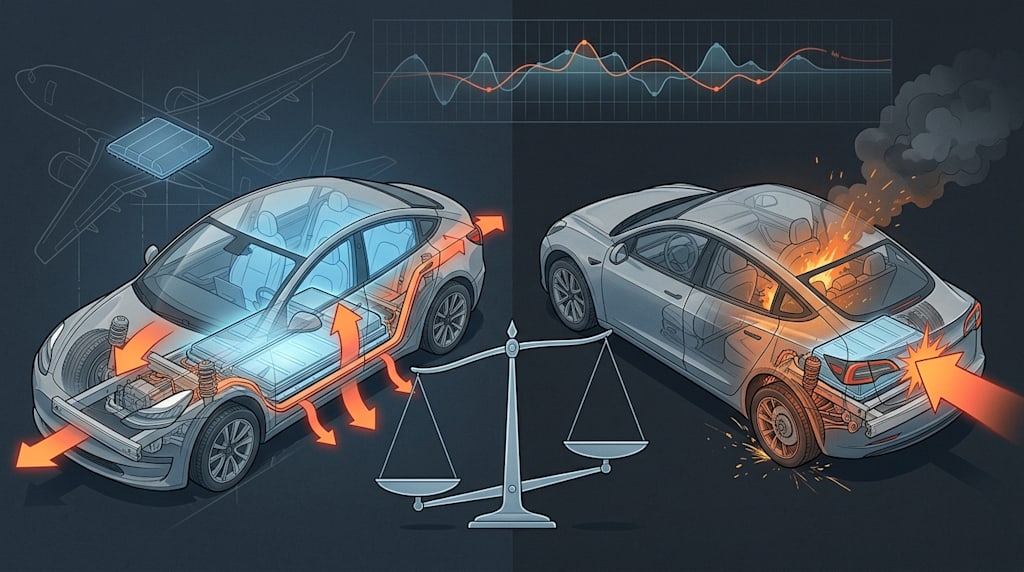
Putting an EV battery in the trunk does not make it safer
The pack sits under the floor because that is where crash structure, weight distribution, and venting work together.
I work in battery management. I often hear one sentence: put the battery in the trunk, farther away from people, and then it will be safer.
That idea fits intuition. The farther danger is from people, the better. Car safety does not work that way. Where the battery should go depends on who takes the hit first in a crash, where smoke goes during thermal runaway, where hundreds of kilograms of weight sit, and how the body absorbs energy.
Move the battery to the trunk, and it looks like you are keeping danger away from passengers. In a rear-end collision, the trunk becomes the first row.
1. In a rear-end crash, a trunk battery takes the first hit
Rear-end collisions are common on city roads. A red light, a traffic jam, a sudden stop on the highway, and the car behind slams into you. That is a typical crash pattern.
The front has an engine bay or front trunk as a crumple zone. The rear has a different problem. Many cars have a much shorter rear crumple space. The rear bumper beam, rear longitudinal beams, and rear crumple zone have to take the force first. If the battery pack is in the trunk, it is large and heavy, often several hundred kilograms. In a rear-end collision, the other car hits the rear bumper beam first. The beam transmits force to the rear longitudinal beams. The longitudinal beams transmit it to the body. If the battery pack sits right there in the rear, it directly suffers compression.
Once the battery pack deforms, the cells inside can be squeezed or pierced. The risk of thermal runaway rises immediately.
The idea of being farther away from people does not hold for rear passengers. The battery is right behind the rear seat. Once smoke, fire, or hot gas breaks through the partition, the rear row suffers first. You think you have put the battery far away, but you have pushed the rear passengers in front of the battery.
A chassis battery sits in a different place. The side sills, cross members, and floor wrap around it. In a frontal crash, the front compartment absorbs energy first. In a side crash, the rocker rails and battery pack frame take the load. In a rear-end crash, the rear crumple zone takes the first hit. The battery does not sit naked under the cells. Between it and the passenger compartment are the body floor, cross members, thermal insulation, sealing, and venting design.
Safety depends on structure. Distance alone does not decide it.
2. Hundreds of kilograms behind the rear axle change how the car behaves
Top Gear once mocked BMW for putting ballast in the trunk to tune rear-drive weight distribution. That was only a few dozen kilograms. A battery pack is several hundred kilograms. The difference matters.
Put several hundred kilograms of battery in the trunk, and the vehicle's center of gravity shifts rearward. The rear axle carries too much load. The driver feels a heavier tail and a lighter front axle. Steering may become dull. On wet roads, in emergency lane changes, or at high-speed cornering, oversteer and fishtailing become more likely.
For an ordinary family car, that is loss-of-control risk.
Put the pack in the middle of the chassis, and it lowers the center of gravity and balances front-rear weight. A lower center of gravity brings a more stable stance, less body roll in emergency lane changes, and lower rollover risk.
Safety is not only about whether the battery burns. It is also about whether the car loses control and crashes first. Many accidents do not start with the battery catching fire. The car loses control first.
3. A floor battery becomes part of the body. A trunk battery becomes cargo
Many EVs now use CTB, CTC, or skateboard chassis designs. The battery pack upper cover and the body floor become one. The battery pack itself contributes to body rigidity. Remove the battery, and the body floor leaves a large empty space. Passengers still do not sit directly on the cells. Structure, thermal insulation, sealing, and high-voltage protection sit in between.
The benefits are direct.
A floor battery does not take up the trunk. The trunk stays a trunk and can carry luggage. Cooling and wiring are shorter. High-voltage connections, cooling loops, and BMS sampling lines are all shorter, which means higher efficiency and fewer failure points. Body rigidity is better. The battery pack becomes a structural member, like a large reinforcement plate in the chassis. Space utilization is higher. The battery does not fight passengers for the trunk, and it does not fight luggage for space.
Put the pack in the trunk, and you have to add a separate crash protection frame, cooling loop, high-voltage wiring, and venting path. The result is heavier, more expensive, more space-consuming, and less efficient.
The so-called new-energy ballast is meant to keep a ship stable. A car is not a ship. A car still has to turn, brake, and get rear-ended.
4. Thermal runaway follows gaps, not straight lines
The biggest fear in battery thermal runaway is flame and toxic gas entering the passenger compartment.
A chassis layout usually has a vent valve pointing downward. During thermal runaway, high-temperature gas and flame can be discharged downward. Between modules are thermal insulation materials and fire barriers. After a single cell goes into thermal runaway, the system tries to delay heat propagation to other cells and prevent a domino-style chain reaction. The BMS also monitors voltage, temperature, current, and charge-discharge status in real time. When something is abnormal, it warns, limits power, and cuts off relays.
A trunk layout has a different problem. The trunk and the passenger compartment are often separated only by the rear seat and a partition. Once thermal runaway occurs, smoke and gas are more likely to move toward people. The trunk space is relatively enclosed, and the venting direction is hard to design.
You want the battery far from people, but smoke and fire do not travel by straight-line distance. They move through gaps, air conditioning, and body seams into the passenger compartment.
So far from people cannot be judged only by straight-line distance. It also depends on isolation, venting, warning, and escape time.
5. Airplanes put fuel in the wings for structural reasons
On modern airliners, wings provide lift and store fuel. The wing box is a structural volume, and the fuel sits inside it.
Putting the fuel tank in the tail would keep passengers farther from it. It would also put the tank in the crash path and hurt weight distribution. Wing tanks work because they combine structure, weight distribution, space utilization, and risk dispersion.
This is similar in principle to putting an EV battery in the chassis. A wing tank is both structure and space, and it disperses risk. A chassis battery is both structure and ballast, and it wraps the battery in the middle of the body.
When Musk talked with BMS experts about whether making batteries bigger and bigger was too dangerous, he made a point. Gasoline is also a flammable hazardous material, but with a safe fuel tank, the gasoline car became possible. In the new-energy era, we should not push the battery away because it is dangerous. We should manage its safety with materials, structure, BMS, and validation systems.
6. The battery management system and validation standards do the real work
Battery safety in new-generation EVs is no longer a matter of position determinism. It is a system.
At the cell level, manufacturers improve materials, coat separators, and design vent paths. At the module level, they add thermal insulation, fire barriers, and isolation. At the pack level, they use structural beams, liquid cooling plates, vent valves, and sealing. At the vehicle level, the body absorbs energy through crumple zones, rocker rails, and underbody shields. Electronics monitor voltage, temperature, current, and charge state, then cut relays when something goes wrong. Validation standards such as China Automotive Technology and Research Center's NESTA new-energy electrical safety validation test water wading, underbody safety, battery system ripple immunity, fast-charging condition safety, and mechanical reliability safety.
The battery sits in the chassis because the body, structure, BMS, and validation system manage it there. Putting the battery in the trunk means rebuilding all these systems, and they may not be built any better.
7. What a trunk battery would cost you
Commercial vehicles and special battery-swap models may have rear-mounted layouts. That requires strong rear crash structures, thermal isolation, and venting design. The cost is huge.
If an ordinary passenger car insists on putting the battery in the trunk, the costs add up. Rear-end protection costs rise because the rear needs more crash structure. Weight distribution worsens because hundreds of kilograms sit behind the rear axle. Space disappears because the trunk becomes a battery box. Cooling and wiring become more complex because lines run farther. Thermal venting becomes harder because the rear is enclosed. Body rigidity may not improve because the pack is no longer a structural floor member.
After doing the math, putting the battery in the trunk is heavier, more expensive, more space-consuming, and harder to manage.
Conclusion: The trunk stays a trunk
Putting the battery in the trunk sounds like new-energy ballast. In a rear-end collision, it invites risk into the rear row.
Safety comes from systems engineering. The battery sits under the floor because the body, structure, BMS, and validation system manage it there.
The trunk stays a trunk. The battery stays under the chassis. Move the battery backward, and on the surface you keep danger away from passengers. In reality, you keep passengers away from the trunk while leaving danger in the front row of a rear-end collision.
About the Creator
Jin
Writer of reamstories
https://reamstories.com/jin
Enjoyed the story? Support the Creator.
Subscribe for free to receive all their stories in your feed. You could also become a paid subscriber, letting them know you appreciate their work.
Comments
There are no comments for this story
Be the first to respond and start the conversation.