
When the Embankment Broke: Thailand's Auto Belt Braces for a Week That Could Define Its Recovery
The collapse of an earthen barrier at Amata City Chonburi has idled more than ten auto-parts factories and five vehicle makers exposing, once again, the fragility hidden inside the world's most efficient supply chains

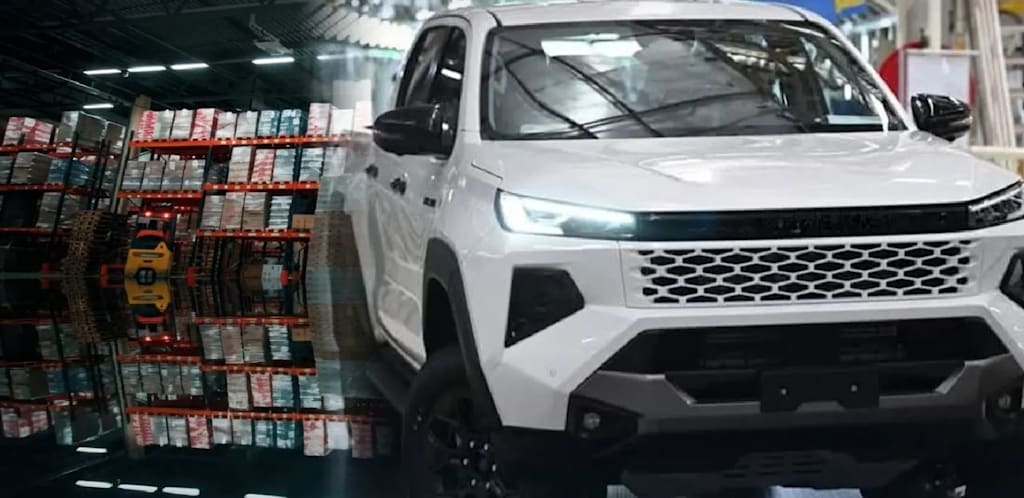
Bangkok, 8 October 2026, The floodwater at Amata City Chonburi Industrial Estate has largely drained away, but the machinery inside tells a slower story. More than ten auto-parts factories remain halted in zones 7, 8, and 9 of the estate, where an earthen flood embankment collapsed and sent water coursing through one of Southeast Asia's most concentrated manufacturing corridors. According to the Federation of Thai Industries (FTI), suppliers are provisionally targeting October 12 to restart production and deliveries, a date now circled in red across the dashboards of Japanese carmakers from Chachoengsao to Prachin Buri.
The disruption has been surgical in its effects. No vehicle assembly plant was directly flooded, a hard-won victory attributable to the flood barriers and raised embankments the industry built after the catastrophic inundations of 2011, and to Honda's decision years ago to relocate production to higher ground in Prachin Buri. Yet five vehicle manufacturers have nonetheless suspended production, unable to obtain components or, in some cases, unable to bring workers through waterlogged roads. Toyota, the country's industrial bellwether, has not operated since September 30, when flooding first prevented employees from reaching its plants, including the facility at Ban Pho in Chachoengsao before parts shortages compounded the shutdown.
A tale of two supply chains
Perhaps the most revealing detail is who escaped. Chinese and European carmakers are operating normally, their assembly lines humming on supplier networks distinct from the Japanese ecosystem that clusters around the Amata estate. Most Japanese manufacturers, by contrast, remain in assessment mode, issuing updates day by day. The asymmetry is a live demonstration of a strategic truth that procurement theorists have long debated: efficiency and resilience pull in opposite directions.
Japanese production philosophy, the just-in-time discipline of the Toyota Production System deliberately eschews large component inventories. It works brilliantly until the moment a single flooded supplier sits between an assembly line and its next vehicle. Suwat Supakarndechakul, chairman of the FTI's Automotive Industry Club, explained the resulting arithmetic in binary terms. Where a component has multiple manufacturers or can be temporarily sourced from elsewhere in ASEAN, production limps onward. Where a part is single-sourced from an Amata factory with no alternative anywhere in the region, carmakers have no choice but to wait.
Even unaffected suppliers are constrained. Without warehouse capacity to accumulate stock, they must throttle their own output rather than buffer the system.
The October 12 cliff edge
The recovery timetable rests on a narrow foundation. Parts manufacturers expect machinery restoration to take no more than a week after waters fully recede, with transport routes, employee commutes and outside-plant infrastructure, wastewater treatment, waste disposal the principal obstacles rather than the production equipment itself. Core machinery largely survived because business continuity plans, reviewed annually since the 2011 floods, had raised factory floors and stockpiled sandbags, pumps, and inflatable boats.
FTI Secretary-General Panitarn Pavarolavidya framed the stakes plainly. Assembly plants hold enough parts to keep going for now, he said, but if the situation is not resolved by October 12, "problems will begin because there will be no parts to assemble." The provisional restart is already calendar-pocked: Toyota plans to resume on Monday the 12th, pause for the October 13 holiday, and continue on the 14th, subject to reassessment.
Suppliers who miss the window face unpalatable choices. Supoj Sukpisan, honorary chairman of the FTI's Auto Parts Industry Club, said those unable to restore production would have to import components at higher cost to fulfil contracts and avoid penalties and that switching suppliers offers little relief, since qualifying a new source can take nearly a year, particularly for pickup trucks, a category for which Thailand is the global production base.
Counting the cost, and the lessons
The FTI's preliminary estimate of industrial flood losses has tripled within a week, rising from 1.5 billion to nearly 6 billion baht, with the auto-parts sector the hardest hit. The figure remains provisional flooding has not fully ended, and surveys continue. The Industry Ministry has deployed pumps to accelerate drainage, convened manufacturers to compile damage assessments and relief proposals, and discussed measures including discounts on replacement parts and repair services for flood-damaged vehicles. A joint monitoring centre now links the FTI with the Thai Auto-Parts Manufacturers Association to track conditions in real time.
Beyond the immediate ledger lies the longer lesson. This flood arrived not from the northern runoff that drowned industrial estates in 2011, but from overflowing local rivers and canals, a different hydrology defeating different defences, and finding the seam between plant-level preparedness and regional infrastructure. Thailand's automotive corridor has absorbed the blow far better than it did fifteen years ago. Whether October 12 holds will determine whether that progress is a story of resilience or merely a stay of execution for the world's most finely tuned production machine.
About the Creator
Mark Lim
Hi I am mark an automotive student and a car, tech and food enthusiast ! Im gonna try and post daily & hope you enjoy what I write and do share my page with people you know. I would gladly appreciate it! Cheers
Enjoyed the story? Support the Creator.
Subscribe for free to receive all their stories in your feed.
Comments
There are no comments for this story
Be the first to respond and start the conversation.