
Volkswagen’s Historic Crisis
Volkswagen’s Historic Crisis and the New Era of Global Automotive Competition

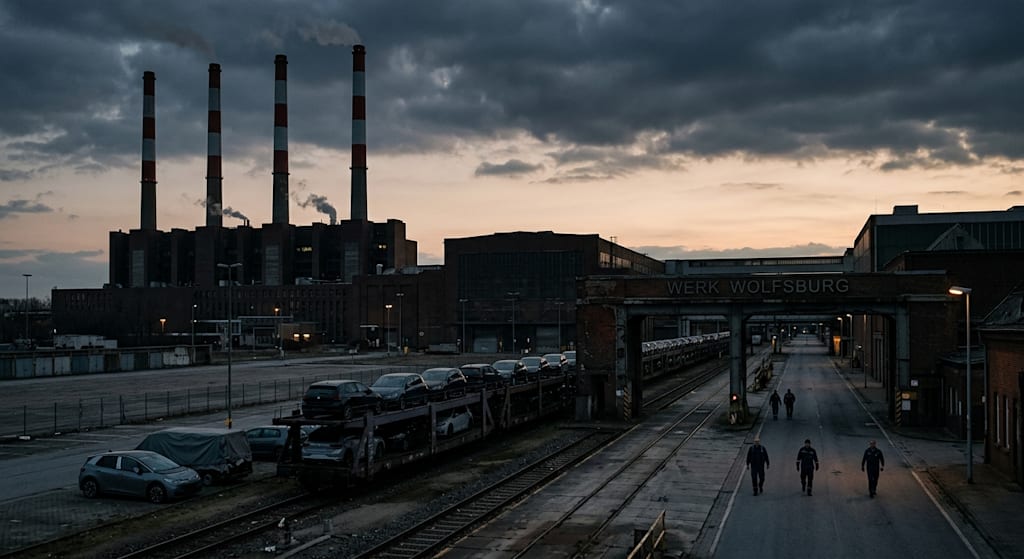
Volkswagen’s Historic Crisis and the New Era of Global Automotive Competition
For decades, Volkswagen Group stood at the heart of Europe’s automotive industry. Its vast production network, globally recognized brands and economies of scale made it one of the most powerful automotive groups in the world. Today, however, Volkswagen is facing one of the most challenging periods in its modern history.
The company’s difficulties are not simply the result of weaker sales. They reflect a much deeper transformation in the global automotive industry, where traditional European manufacturers are being squeezed by rising costs, the transition to electric vehicles, slowing demand in key markets and the increasingly aggressive expansion of Chinese competitors.
Volkswagen’s Historic Crisis
Volkswagen’s recent financial performance illustrates the scale of the challenge. In 2025, the group delivered around nine million vehicles and generated €321.9 billion in revenue. Yet operating profit fell dramatically from €19.1 billion to €8.9 billion, while its operating margin declined from 5.9% to just 2.8%.
This gap between sales volume and profitability is crucial. Volkswagen is still selling millions of vehicles, but generating significantly less profit from them.
The company is therefore facing a structural profitability problem rather than simply a temporary decline in demand. High production costs in Europe, substantial investment requirements for electrification, weaker performance in China and growing international trade barriers are putting increasing pressure on its business model.
Why Did Volkswagen Group Reach This Point?
Volkswagen’s current difficulties cannot be attributed to a single strategic mistake. They are the result of several structural problems that have accumulated over time.
One of the biggest challenges is the company’s high-cost European production structure. Germany remains an important manufacturing base, but high labor, energy and operating costs have made some facilities increasingly difficult to justify economically.
At the same time, Volkswagen has had to invest enormous amounts of capital in the transition from internal combustion engines to electric vehicles. This transformation requires not only new production facilities, but also investments in batteries, software, electronics and new vehicle platforms.
The company is therefore trying to finance a technological transformation while simultaneously dealing with declining margins.
Another major problem is China.
For years, Volkswagen was one of the dominant foreign automakers in the Chinese market. China was a major source of both sales and growth. But the competitive landscape has changed dramatically.
Chinese manufacturers have moved from being relatively low-cost producers to technologically capable global competitors. Companies such as BYD, Geely, SAIC, Chery, NIO and XPeng are increasingly competing in areas that were traditionally dominated by European, Japanese and American manufacturers.
Why Are Jobs Being Cut?
Volkswagen’s workforce reductions should not simply be interpreted as a response to falling sales.
At the core of the problem is overcapacity.
When production volumes are insufficient to keep factories operating efficiently, fixed costs are spread across fewer vehicles. This increases the cost per vehicle and makes high-cost production sites increasingly difficult to maintain.
This problem is particularly significant in Germany, where labor and energy costs are relatively high.
Volkswagen has therefore been pursuing a broad restructuring strategy involving early retirement, reduced recruitment, voluntary departures and changes to production capacity. In some cases, the future of entire factories has come under discussion.
The objective is not merely to reduce the number of employees. Volkswagen is attempting to redesign its entire production network and create a cost structure that is more compatible with the realities of the electric vehicle era.
Volkswagen Is Not Alone
Volkswagen’s problems are part of a broader crisis affecting the European automotive industry.
Other major manufacturers are also under pressure to reduce costs, restructure production and reconsider their long-term strategies.
Stellantis, for example, has been dealing with weak demand and underutilized production capacity in Europe. Ford has been restructuring its European operations and reconsidering its strategy for electric vehicles. Nissan is also facing questions about the future of some of its European manufacturing operations.
Even premium manufacturers such as Mercedes-Benz and BMW are not immune.
Although their business models and profit margins differ from those of mass-market manufacturers, they are facing significant challenges in China, where domestic brands are increasingly moving into higher-value segments.
The issue is therefore no longer limited to Volkswagen. It is becoming a broader question about the competitiveness of the European automotive model itself.
The Growing Threat from Chinese Automakers
Perhaps the most important transformation in the automotive industry is the rise of Chinese manufacturers.
Their advantage is not simply that they can produce cheaper cars. Their real strength lies in their ability to combine cost efficiency, technological development and speed.
China has developed a powerful industrial ecosystem around batteries, electric motors, electronics and vehicle manufacturing. Companies operating within this ecosystem can benefit from enormous production volumes and highly integrated supply chains.
Battery technology is particularly important.
Chinese manufacturers have developed significant advantages in battery production, raw materials, supply-chain integration and manufacturing scale. This allows them to reduce vehicle costs while continuing to add increasingly sophisticated technological features.
European manufacturers, meanwhile, are dealing with older production networks, higher labor costs, more complex organizational structures and expensive industrial assets.
The nature of competition has therefore changed.
The question is no longer simply:
Which company makes the better car?
The more important questions are:
Who can develop new technology faster? Who can manufacture it more efficiently? Who can offer more features at a lower price? And who can adapt to changing consumer preferences most quickly?
This is where Chinese manufacturers are putting traditional automotive giants under unprecedented pressure.
Rising Pressure on Europe’s Automotive Giants
European automakers are now being squeezed from several directions simultaneously.
They face high energy and labor costs, enormous investment requirements for electrification, intense competition in batteries and software, weak demand in parts of the European market, declining market share in China and increasing geopolitical uncertainty.
Regulatory pressure is another factor.
European manufacturers must invest heavily to comply with increasingly demanding emissions standards while simultaneously developing electric vehicles and maintaining their existing combustion-engine businesses during the transition period.
This creates a difficult financial equation.
Automakers must invest billions in the future while still protecting the profitability of their current businesses.
The result is a growing pressure to become leaner, more automated and more technologically focused.
What Could Happen in the Coming Years?
The next few years are likely to bring significant consolidation across the global automotive industry.
First, manufacturers are likely to reassess their production footprints. Factories operating below efficient capacity may be closed, consolidated or repurposed.
Second, strategic partnerships are likely to become increasingly important.
The distinction between competitor and partner may become less clear as European manufacturers seek access to Chinese expertise in batteries, software and electric vehicle technologies.
Third, automakers will increasingly operate like technology companies.
Software, artificial intelligence, battery technology, autonomous driving and digital services are becoming just as important to a vehicle’s competitiveness as its engine and mechanical engineering once were.
Finally, the industry could experience a major shakeout.
Companies that can achieve economies of scale, control costs, develop competitive electric vehicles and move quickly enough to respond to technological change are likely to emerge stronger.
Those with high-cost structures, slow decision-making processes and outdated production networks may be forced into mergers, partnerships, restructuring or significant downsizing.
The Bigger Picture
Volkswagen’s crisis should therefore not be viewed simply as the story of one struggling company.
It is a symptom of a much larger transformation.
For decades, European automakers benefited from technological expertise, strong brands, sophisticated engineering and highly developed manufacturing systems. But the electric vehicle revolution has changed the competitive landscape.
Chinese manufacturers have rapidly narrowed — and in some areas surpassed — the technological and cost advantages that European companies once enjoyed.
For Volkswagen and its European competitors, the coming years will not simply be about producing electric vehicles.
They will be about producing them faster, cheaper and more efficiently while developing the software and technologies that increasingly define the modern automobile.
The fundamental question is no longer whether Europe can build great cars.
It is whether Europe can remain competitive in a global automotive industry where the rules of competition are being rewritten.
Volkswagen’s factory closures, workforce reductions and restructuring plans are therefore about much more than cutting costs.
They are part of a much larger battle over who will control the future of the global automotive industry.
About the Creator
Enjoyed the story? Support the Creator.
Subscribe for free to receive all their stories in your feed.
Comments
There are no comments for this story
Be the first to respond and start the conversation.