
This $32,000 SUV Just Broke the Luxury Rulebook
Rear‑wheel steering, air suspension, and lidar – all standard. We ran the numbers against Tesla, Li Auto, and Toyota.
Large new-energy SUVs have been called a "red ocean" for years. The Li L8 sells family lifestyle. The AITO M7 sells Huawei's smart driving. The NIO ES6 sells battery swapping and service. The Xpeng G9 sells ultra‑fast charging. Each carries one distinct label, and buyers pick a label – space or intelligence, chassis composure or purchase price, a third row that works or a trunk that fits luggage.
BYD launched the Sealion 08 in September 2026. Base price: 229,900 RMB. It does not carry a new label. It carries hardware that rivals usually reserve for their top trims.
The price sheet
The official range runs from 229,900 to 279,900 RMB, covering two powertrains (PHEV and BEV), two seating layouts (five and six seats), and two drive configurations (two‑wheel and four‑wheel drive).
Compare that to the competition:
Li L8 base: 339,800 RMB.
AITO M7 base: 249,800 RMB (its fully‑equipped smart‑driving version hits 289,800).
NIO ES6: 338,000 RMB.
Xpeng G9: 263,900 RMB.
Toyota Highlander hybrid: 268,800 RMB.
The price gap matters. But the real distinction sits in the standard‑equipment list.
Three components, one base trim
"Standard across all trims" usually means reversing cameras and dual‑zone climate control. The Sealion 08's list includes:
DiSus‑A Intelligent Body Control System – a closed‑loop dual‑chamber air suspension with continuously variable damping. On a traditional premium brand, this hardware starts above 550,000 RMB. On the Li L8, only the top trim (399,800 RMB) has it. On the AITO M7, it does not exist.
Rear‑wheel steering – The Sealion 08 measures 5,115 mm long with a 3,030 mm wheelbase. Its turning radius is 4.95 metres. On a narrow two‑way street, it turns around in one move. Among similarly sized SUVs, the BMW iX (optional) and Mercedes‑Benz EQS SUV (high‑trim) offer this – both priced above 800,000 RMB.
Lidar + the "God's Eye" 5.0 ADAS – Hardware is pre‑installed on every trim. Urban navigation assistance, highway NOA, and automated parking are all available on the entry‑level car.
No other 229,900‑RMB vehicle offers this combination. The industry standard was to use chassis hardware and sensors as the knife that separates base from premium. BYD's spec sheet throws that knife away.
Space and comfort
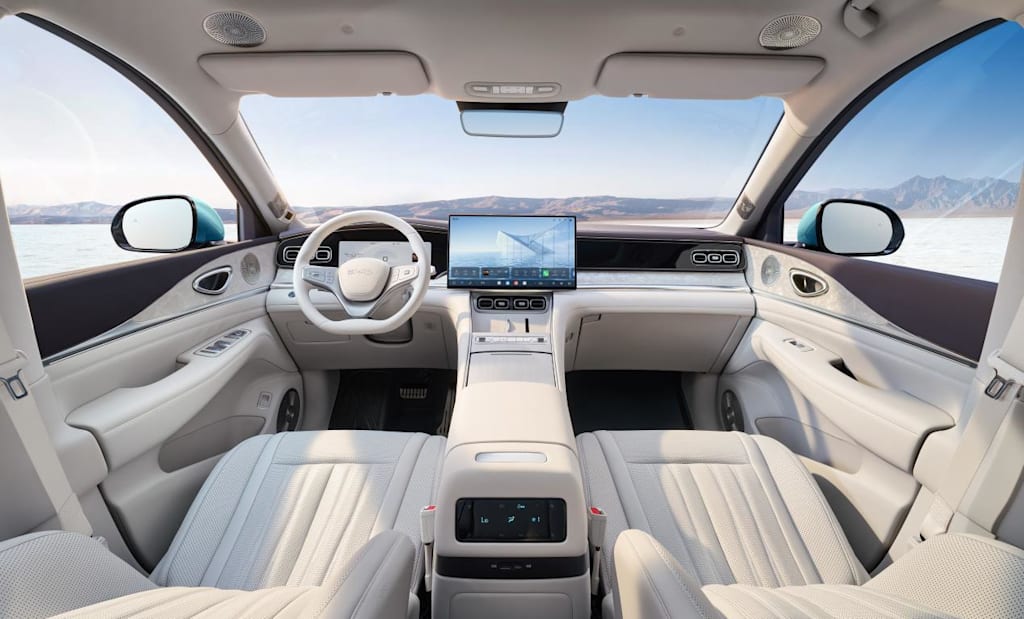
Large‑SUV buyers share a common complaint: "The third row is emergency‑only." The six‑seat Sealion 08 includes a centre aisle wide enough for an adult to pass sideways. The second‑row zero‑gravity seats slide laterally, so you reach the third row without folding the front seats.
BYD published the third‑row cushion height (340 mm) and depth (450 mm). Most competitors omit these numbers because they fall short. Publishing them lets customers bring a tape measure to the showroom.
In the five‑seat version, the rear floor is completely flat – zero rise in the centre footwell. That detail goes unnoticed in reviews, but the passenger sitting in the middle on a three‑hour drive will feel it.
Soft‑close doors and electronic‑release inner handles usually show up on options lists. They are standard here. The interior uses mother‑of‑pearl trim, knitted suede headliners, and baby‑safe soft‑touch wraps on the dashboard and door panels. Devialet audio and 127‑colour ambient lighting appear from the mid‑trim upward.
Range and recharging
The PHEV version uses fifth‑generation DM technology: 400 km of CLTC electric range, 1,650 km combined, and 6.5 L/100 km fuel consumption when the battery is depleted. For a buyer without a home charger, that means refuelling once a month while running daily errands on electricity.
The BEV version uses the second‑generation Blade Battery: 900 km of CLTC range. At a 380 kW+ ultra‑fast charger, it goes from 10% to 80% in 12 minutes.
The four‑wheel‑drive version hits 100 km/h in 3.9 seconds. On a large SUV, that figure once felt like a gimmick. Here it just means the car keeps its composure climbing a mountain pass with six passengers and the air‑conditioning on high.
How the market shifts
Before the Sealion 08, a buyer with a 300,000‑RMB budget made trade‑offs. Choose space, or choose smart driving. Choose a good chassis, or choose a lower monthly payment. Choose a third row, or choose a usable boot.
The Sealion 08 removes those trade‑offs. That removal creates three cascading consequences.
First, family buyers with a 300,000‑RMB ceiling re‑define "enough." They used to accept a base trim with a downgraded suspension or missing sensors because that was the norm. After test‑driving the Sealion 08, they walk into a rival showroom and ask: "Why does your base version lack air suspension?" That question will force competitors to either cut prices or move hardware down the trim ladder.
Second, the conversion channel from joint‑venture fuel SUVs narrows further. The Highlander, Tiguan, and Edge L have dropped to the 240,000‑270,000 RMB band, sustained by brand trust and resale value. The Sealion 08 counters with measurable advantages in chassis, energy cost, space, and driver assistance. A test drive will turn more fuel buyers than any previous EV in this class.
Third, the industry shifts from an "options race" to a "standard equipment race." For the last five years, the game was about how powerful the top trim could be. The Sealion 08 makes it about how capable the base trim is. Over the next twelve months, new models from Li Auto, AITO, and Xpeng will likely re‑examine their SKU strategies. Rear‑wheel steering and air suspension may become the new baseline for 250,000‑RMB‑class SUVs. If that happens, BYD set that baseline.
Four open questions
Impact does not mean perfection.
Service channels remain a question. Ocean Network dealerships are numerous, but their service experience still lags behind the direct‑sales models of Li Auto and NIO. A buyer spending 229,900 RMB expects transparent order tracking, rapid service responses, and a polished handover process. BYD needs to upgrade at least 300 Ocean Network stores to premium service standards within 2026. Otherwise, high‑intent buyers may leave after the showroom visit.
The cockpit ecosystem is another. DiLink is feature‑rich, but in cross‑device continuity, natural voice interaction, and app depth, it sits a notch below Huawei's HarmonyOS and Li Auto's Mind GPT. Younger buyers treat the infotainment as a daily digital device. That evaluation is a real hurdle.
Production ramp‑up is a third risk. Rear‑wheel‑steering modules and second‑generation Blade Battery cells may face supply constraints in the first three months. If delivery waits exceed six weeks, urgent buyers will turn to rivals with stock on the lot. BYD did not disclose a monthly production target at the launch – a silence worth noting.
Resale value is the fourth. The Sealion 08 is a new nameplate, so its depreciation curve has no data. Large‑SUV buyers typically hold a car for three to five years, and they mentally compute the three‑year loss before signing. Without an official buyback guarantee or a certified pre‑owned programme, that hesitation is real.
The ruler
The Sealion 08 did not invent rear‑wheel steering, air suspension, lidar, or long‑range batteries. It put all of them into a car that costs 229,900 RMB.
The old game was about who leads by half a step in one dimension. The Sealion 08 answers: "I deliver across every dimension what used to be reserved for top trims – and I price it at entry level."
Whether it sells in volume depends on factory throughput and service execution. But it has already done one fundamental job. It has given every car buyer, before they step into any showroom, a ruler.
On that ruler are engraved: rear‑wheel steering, air suspension, lidar‑based smart driving, and 900 km of range. Beside them: 229,900 RMB.
About the Creator
Jin
Writer of reamstories
https://reamstories.com/jin
Enjoyed the story? Support the Creator.
Subscribe for free to receive all their stories in your feed. You could also become a paid subscriber, letting them know you appreciate their work.
Comments
There are no comments for this story
Be the first to respond and start the conversation.