
The US Auto Industry That Once Dominated the World Is Now Facing the Same Crisis It Faced in the 1980s, Except This Time It May Not Survive
American car makers went from 76% of global production in 1950 to 14% today. China went from 3% to 25% in the same timeframe. And the window to respond is closing.


In 1950, the United States accounted for 76 percent of global vehicle production. American automakers commanded nearly 95 percent of the US market. Detroit was the automotive capital of the world.
That was 76 years ago.
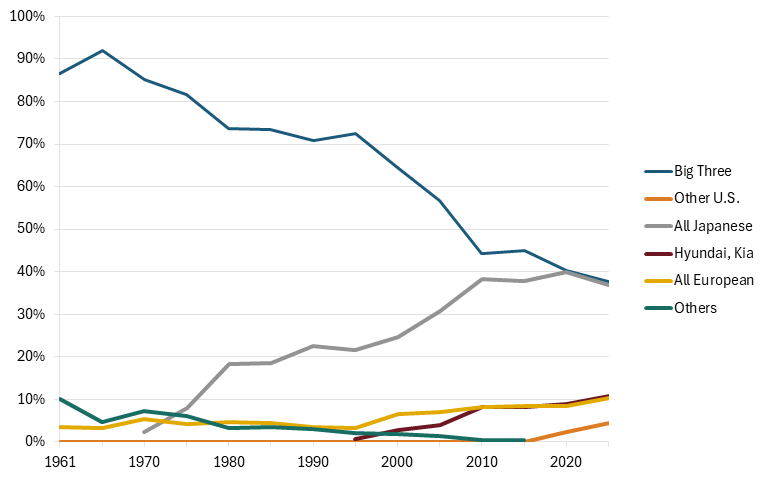
By 2024, the Big Three American automakers General Motors, Ford, and Stellantis (formerly Chrysler) controlled just 38 percent of the US market. The US share of global automotive production had fallen from 23 percent in 1995 to 14 percent by 2022. And Chinese automakers, which produced virtually nothing in 1995, now account for 25 percent of global vehicle output.
This isn't a story about a temporary setback. It's a story about structural decline that's been unfolding for six decades.
How The Big Three Fell
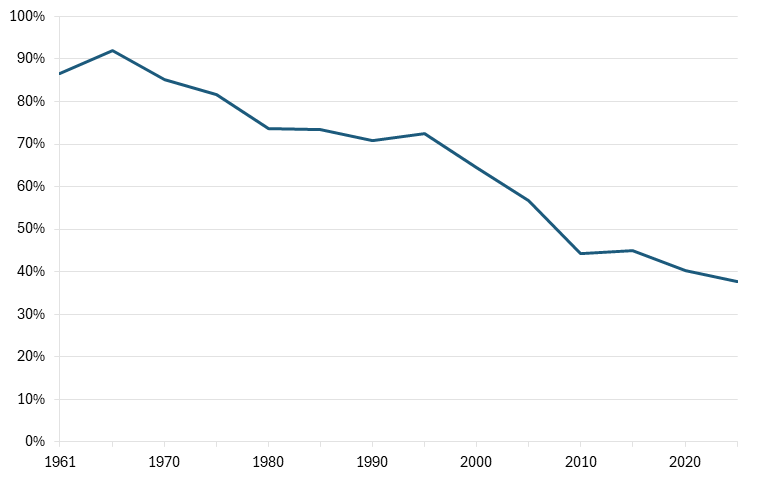
In 1965, General Motors, Ford, and Chrysler accounted for 92 percent of the US automotive market. That's basically all of it. Everyone else was fringe.
By 1978, GM alone still held 46 percent of the market. The Big Three were still the undisputed rulers of American automobile manufacturing.
Then the Japanese arrived. In the 1970s, imported vehicles jumped from 15 percent of the US market to 30 percent. The Big Three, comfortable in their dominance, couldn't respond quickly enough. By 2015, their combined market share had fallen to 45 percent. By 2024, it was 38 percent.
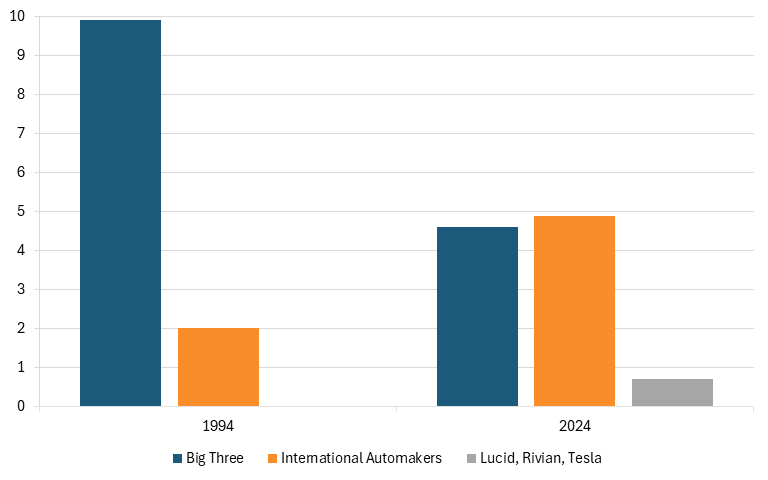
But the real damage wasn't just the loss of market share. It was where that production happened. In 1994, the Big Three manufactured 9.9 million vehicles in the United States, five times more than foreign automakers (transplants) producing in the US. By 2024, the Big Three will have manufactured just 4.6 million vehicles in the United States. A decline of more than 50 percent.
Meanwhile, foreign automakers operating in the US were producing 4.87 million vehicles, nearly matching the Big Three.
What Happened To "Made In America"
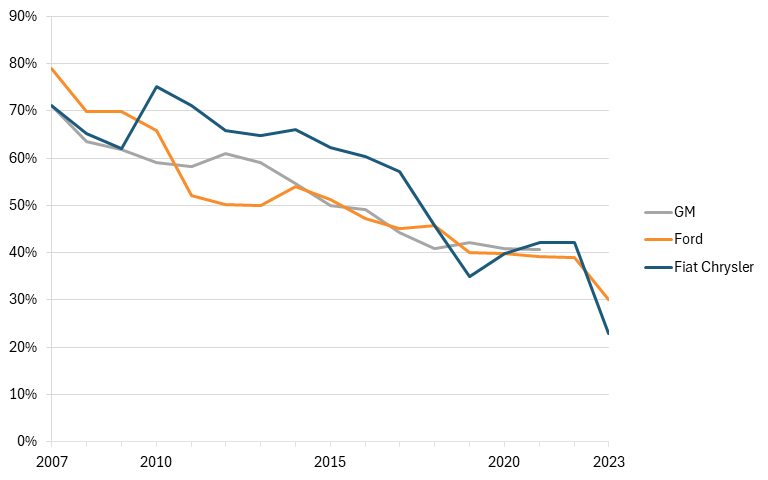
In 2007, cars sold in the United States contained an average of 38 percent US- or Canadian-made content. By 2023, that had fallen to 18 percent.
Think about that. You buy an "American" car. Less than one-fifth of the value actually comes from the United States or Canada.
The Big Three's use of American content fell even further. GM vehicles went from 73 percent US/Canadian content to 40 percent. Ford fell to 30 percent. Stellantis fell to 23 percent.
Overall, by 2024, Americans purchased approximately 16 million cars, SUVs, and light trucks. About 50 percent (8 million units) were imports. Of the 8 million assembled in America, only about 50 percent contained US content, likely closer to 40 percent. That means of the 16 million vehicles bought by Americans, only about 25 percent of the total value is actually American-made.
The Global Collapse
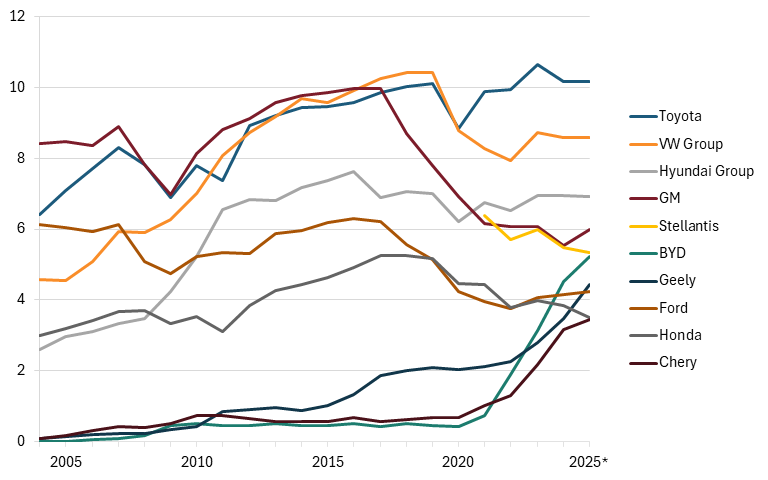
In 2004, GM led the world with 8.4 million vehicle sales. Ford placed third with 6.1 million. Toyota was in the conversation at 6.4 million.
By November 2025, GM had fallen to fourth in global vehicle sales. Ford dropped to eighth. Toyota increased sales to 10.1 million, a 35 percent increase.
Meanwhile, Chinese automakers didn't exist as global players in 2004. By 2025, BYD was producing 5.2 million vehicles annually. Geely was at 4.4 million. Chery ranked 10th globally with 3.5 million.
In 2023 alone, China manufactured over 30 million vehicles, almost three times more than the United States' 10.6 million.
Why This Matters Beyond Cars
The auto industry isn't just about cars. The US automotive ecosystem contributes over $1.2 trillion to the US economy annually, roughly 5 percent of GDP. It supports about 1 in every 20 American jobs, 10.1 million total jobs when you count direct, indirect, and induced effects.
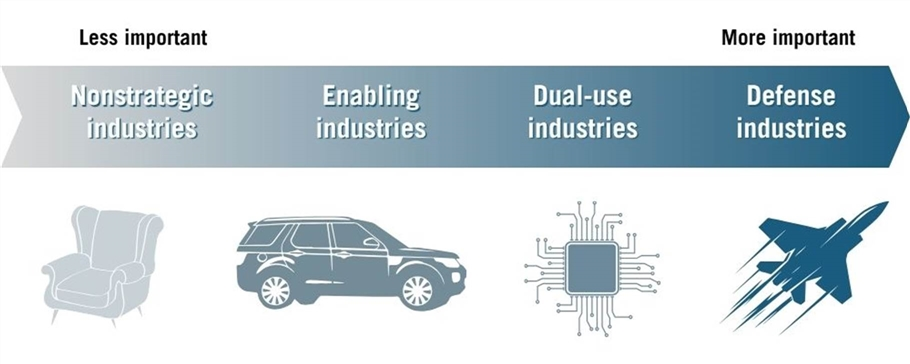
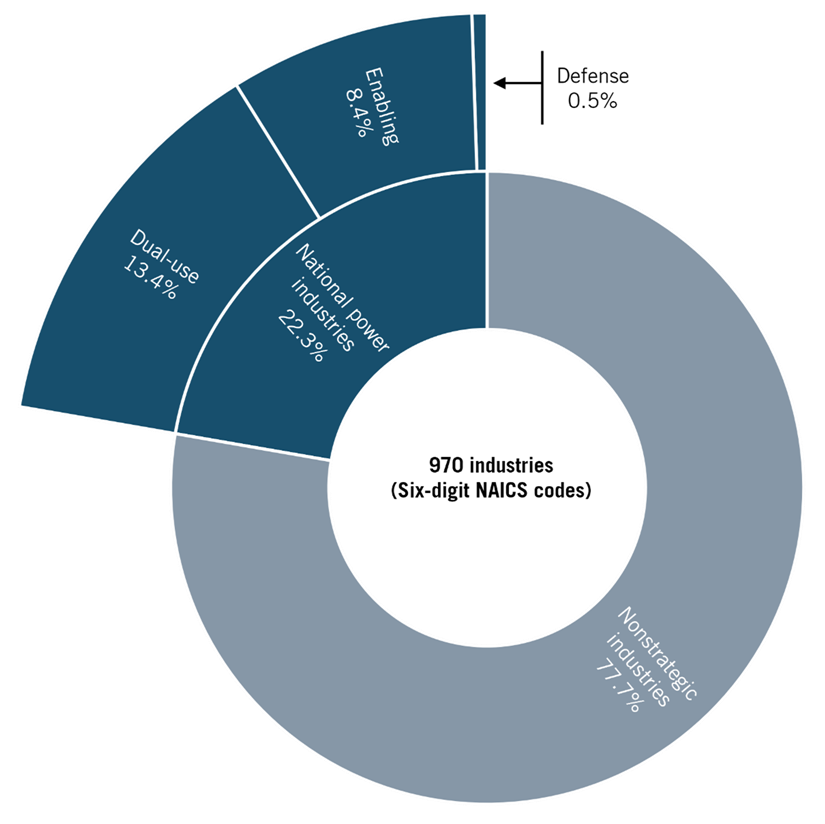
The auto industry is what ITIF calls an "enabling industry," the kind of industry that, if lost, would weaken other strategic sectors. A severely weakened motor vehicle sector weakens the tank and military vehicle ecosystem. It weakens dual-use industries like semiconductors, chemicals, and machine tools that depend on the auto industry demand.
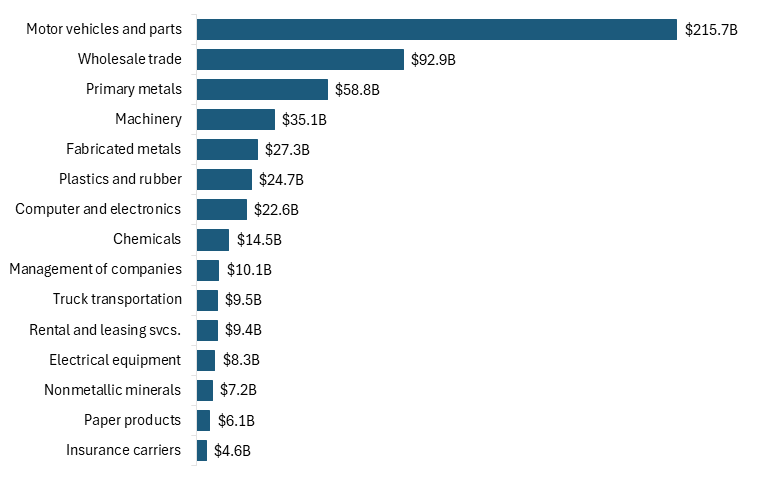
The US motor vehicles industry produces $591 billion in intermediate value for upstream industries, $58.8 billion for the primary metals industry, $35 billion for machinery manufacturing, $27.3 billion for fabricated metals, and $24.7 billion for plastics and rubber.
Lose the auto industry at scale, and you start losing the industrial base that supports everything else.
Mexico And The Hollowing Out
Over the past three decades, Mexico's auto industry has exploded. In 1995, Mexico's auto location quotient (a measure of industrial specialization) was 1.51. By 2022, it had grown to 3.94, meaning the auto industry contributes about four times as much to Mexico's economy as it does to the global economy.
Mexico now accounts for 32 percent of America's vehicle imports by value, far more than Japan (15 percent), Canada (15 percent), or South Korea (15 percent).
In 2024, 3.6 million cars, around half of America's car imports by value, came from Mexico and Canada. Of those, 2.5 million came from Mexico alone.
Around 40 percent of Stellantis vehicles sold in America are assembled in Mexico or Canada. For GM, the share is nearly one-third. Ford assembles about 20 percent in Mexico or Canada.
The US has not had a positive automobile trade balance with Mexico since 1990. By 2023, the cumulative US automobile trade deficit with Mexico since 1990 had reached $530 billion.
This wasn't accidental. Lower labor costs and capital costs in Mexico made manufacturing there attractive. But the result is that American automotive employment has shifted southward while American communities that depended on auto manufacturing have hollowed out.
The China EV Challenge
Then there's China's dominance in electric vehicles.
In 2024, China manufactured 12.4 million EVs. Europe manufactured 2.5 million. America manufactured 1.6 million. That's a ratio of roughly 8:1.
Nearly half the vehicles currently manufactured in China are EVs. As of year-end 2024, 25 percent of cars made in China were pure battery electric vehicles, and another 22 percent were plug-in hybrids or self-charging hybrids.
But the real advantage isn't just in volume. It's in technology and cost. Research firm Bernstein estimates that Chinese EVs can cost half as much to make as European ones, even while boasting better technology.
China dominates EV battery technology. It produces 80 percent of the world's EV batteries. It accounts for 85 percent of global battery cell manufacturing capacity and 94 percent of the market for LFP batteries — the fastest-growing battery technology.
As of November 2025, China holds 74 percent of the world's issued patents for EV batteries. Japan and the United States follow far behind.
How did this happen? Partly through innovation, mercantilist China subsidized its EV sector to the tune of $230.9 billion from 2009 to 2023. Partly through IP theft. Partly through explicit favoritism for domestic producers.
But partly through genuine innovation. CATL, China's leading battery maker, revolutionized LFP battery technology. It developed fast-charging batteries capable of 1,000+ km range off a single charge. Chinese companies have designed high-efficiency systems that integrate batteries and motors in ways Western companies haven't matched.
The Global Market Shift
Chinese automakers now account for 71 percent of overseas EV sales globally, up from 38 percent in 2021. North American automakers saw their overseas EV sales fall from 48 percent to 21 percent in the same period.
Chinese vehicle exports to the Global South increased from 2 percent in 2000 to 22 percent in 2023. US exports fell from 24 percent to 14 percent.
About 3 out of every 10 cars sold in Chile, Ecuador, and Thailand are made by Chinese automakers. In Brazil, Chinese EVs account for 80-99.5 percent of EV market share. In Malaysia and Thailand, their market share exceeds 80 percent.
Analysts estimate that US automakers GM, Ford, and Stellantis have lost over 6 percent of global market share due to the expansion of subsidized Chinese EVs.
Even in Europe, Chinese automakers command 6 percent of the automotive market and are growing.
The US Response And The Wrong Direction
In January 2026, GM announced a $7.1 billion charge for "electric vehicle-related charges primarily in North America" as it realigned its strategy to produce more full-size internal combustion engine trucks and SUVs.
In December 2025, Ford announced it was boosting hybrid and ICE vehicle production while reducing its presence in EV battery manufacturing.
In February 2026, Stellantis announced a $26 billion write-down, saying it "overestimated demand for electric vehicles."
In total, Detroit automakers announced more than $50 billion in combined EV-related write-downs.
These moves made sense in the short term, especially after the Trump administration withdrew Biden-era Inflation Reduction Act tax credits for EVs. Pivot to high-margin ICE trucks and SUVs. Keep profits up. Buy time.
But EV battery technology continues to evolve rapidly. Lower-cost, better-quality Chinese EVs continue gaining market share globally. And the window to catch up is closing.
Why The Urgency
A researcher at the ITIF report noted: "It's like the 1980s and 1990s all over again when the industry faced massively disruptive Japanese import competition, only this time the industry cannot take 15 or more years to respond effectively and hope to survive… and it's already probably through at least 5 of those years."
In the 1980s and 1990s, the US auto industry had time to learn and adapt. It took 10-15 years for the Big Three to adopt lean production techniques from Japanese competitors. But they eventually did.
This time, the technology is moving faster. Chinese EV battery capabilities are advancing at a pace that US companies aren't matching. The global market is shifting toward vehicles US automakers aren't prepared to compete in cost-effectively.
And the clock is ticking.
What's At Stake
This isn't just about cars. It's about whether the United States maintains the industrial capability to manufacture complex, high-value products competitively. It's about whether American workers have jobs in an industry that once defined American manufacturing. It's about whether the US industrial commons, the machine tools, dies, metal fabrication, specialty chemicals, and other foundational manufacturing capabilities, survive.
The auto industry is an enabling industry. Lose it, and you weaken everything that depends on it.
The US auto industry went from 76 percent of global production in 1950 to 14 percent in 2022. From 92 percent of the domestic market in 1965 to 38 percent in 2024. From unquestioned global leadership to struggling competition from Chinese automakers with superior battery technology, lower costs, and growing market share globally.
This didn't happen overnight. It's been happening for 60 years. But the pace has accelerated. And the window to respond is narrowing.
The question isn't whether American automakers can survive. It's whether they can adapt fast enough to compete in an EV-dominated future when they're already losing market share to better-positioned competitors with superior technology and lower costs.
That question doesn't have an obvious answer.
About the Creator
Mark Lim
Hi I am mark an automotive student and a car, tech and food enthusiast ! Im gonna try and post daily & hope you enjoy what I write and do share my page with people you know. I would gladly appreciate it! Cheers
Enjoyed the story? Support the Creator.
Subscribe for free to receive all their stories in your feed.
Comments
There are no comments for this story
Be the first to respond and start the conversation.