
The Reusable Rocket Engine Trap: Why “Just Make It Stronger” Always Fails
Turbine blades, thermal fatigue, and the full-flow cycle that separates expendable rockets from reusable ones.
Five seconds into the test, it exploded on the test stand.
On the monitor, the engine had blown apart, and the test stand was a mess. The failure review result was written on the whiteboard: the turbine blades had shattered. High-speed fragments pierced the turbopump casing, propellant leaked out, and it ignited.
You had taken a very mature expendable engine, added the software and hardware for multiple ignitions, replaced the seals, changed the bearing lubricant, adjusted the valve opening and propellant loading rate, and dealt with the carbon buildup one item at a time. Everything that could be modified had been modified. The ignition command was issued. Five seconds later, the turbine blades shattered first.
The problem was not the seals.
The turbopump fails first
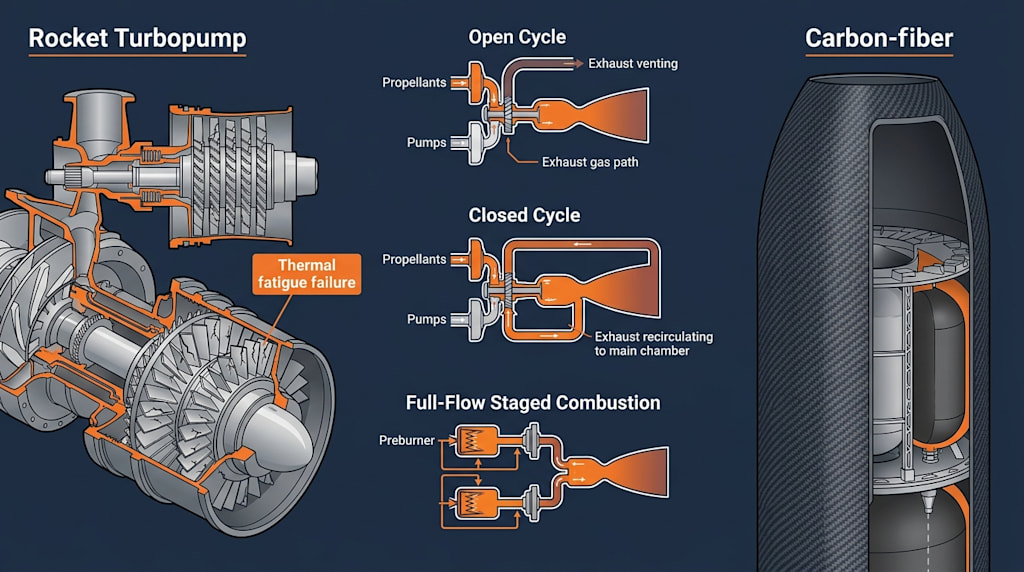
In a liquid rocket engine, the turbopump is the heart. The combustion chamber pressure is very high, so propellant cannot flow in on its own; it must be forced in by a pump. The pump cannot spin by itself. It needs a turbine to drive it. The turbine and the pump are connected on the same shaft, together called the turbopump. The turbine is spun by high-pressure gas pushing on its blades. Where does the high-pressure gas come from? Mounting an extra large gas bottle on the rocket would add too much dead weight. The cost-effective method is to burn a small portion of the rocket’s own propellant to produce high-temperature, high-pressure gas and use it to drive the turbine.
The turbine blades spin at high speed in this gas, bearing centrifugal force and thermal loads.
The design logic of an expendable engine is: as long as it does not burn through or break during a single mission, it is fine. The structure is designed mainly for static strength, allowing the turbine to operate at temperatures close to the material limit. As long as it survives the thermal load of one mission, it passes.
The constraints on a reusable engine are different. The turbine must go through dozens or even hundreds of start–shutdown cycles. In each cycle, the blades are heated rapidly and then cooled rapidly. Repeated thermal cycling produces cyclic plastic strain inside the material, and the blades soon fracture from thermal fatigue.
Changing seals and lubricant cannot fix blade thermal fatigue.
The old leader came over with a teacup: “Now that we’ve found the problem, we need to reach a new level, enter a new realm, adopt new measures, and achieve new breakthroughs.”
The cooling paradox
Thermal fatigue is caused by repeated high-temperature cycling. The obvious fix is to lower the turbine operating temperature. But lowering the temperature also lowers the power.
The amount of thrust an engine must produce determines how much propellant must be pumped into the combustion chamber at what pressure. The pump power is determined by the mission, and it is roughly equal to the turbine output power. Turbine power is roughly proportional to:
mass flow through the turbine × turbine inlet temperature
When pump power demand is fixed, the smaller the mass flow through the turbine, the higher the required turbine inlet temperature; the larger the flow, the lower the temperature can be.
Draw more propellant to drive the turbine, and use a larger mass flow to trade for a lower turbine inlet temperature. Lower the temperature, and the thermal fatigue pressure decreases. But if too much is drawn off, propellant is wasted and specific impulse is lost. The choice of cycle becomes the core issue.
Open cycle: simple, but wastes specific impulse
The direct option is the open cycle, also called the gas generator cycle.
Draw more fuel from the main propellant supply line, ignite it under fuel-rich conditions, and form gas that is not so hot, then use it to drive the turbine. The turbine drives the fuel pump and the oxidizer pump through one shaft, forcing a huge amount of propellant into the main combustion chamber. After driving the turbine, the gas has done its job and is exhausted out of the engine through an exhaust pipe.
The system is simple, reliable, and has high thrust-to-weight ratio. SpaceX’s Falcon 9 Merlin engine takes this path. Chinese commercial space companies also commonly use it: iSpace’s Focus-2, JiuZhouYunJian’s Longyun and Lingyun, and LandSpace’s already operational TQ series all use the gas generator cycle.
The cost is losing some propellant and specific impulse. Specific impulse is the impulse produced per unit of propellant. Some propellant only drives the turbopump and does not participate in the main combustion that produces thrust, which means some fuel is wasted.
An expendable rocket can accept this waste. A reusable rocket has to compete on cost per unit mass to orbit, so specific impulse loss is money on the ledger.
Closed cycle: burn the exhaust gas clean, but a single preburner is not enough
Send the exhaust gas that drove the turbine back into the main combustion chamber and burn it clean. This is the closed cycle, also called the staged combustion cycle.
The simplest closed cycle is single-pre burner staged combustion: most of one propellant burns in the preburner, the gas drives the turbine, and then all of it is injected into the main combustion chamber to burn again with the remaining propellant.
The representative of fuel-rich operation is the RS-25 hydrogen-oxygen engine, once used on the Space Shuttle and now used on NASA’s Space Launch System. Its turbine inlet temperature is still on the order of about 1000 K, so thermal fatigue pressure is still significant. Kerosene engines have great difficulty doing fuel-rich operation because incomplete kerosene combustion produces a large amount of carbon buildup.
Another path is the single-pre burner oxygen-rich design, called the oxygen-rich staged combustion cycle. Russia’s Angara rocket RD-191, Blue Origin’s New Glenn BE-4, and China’s Tianbing Technology use this design, which can immediately improve performance by at least ten percent.
The single preburner has a shortcoming: the vast majority of the other propellant does not flow through the turbine, so the mass flow is still not large enough and the turbine temperature is still on the high side. In an oxygen-rich environment, high-temperature, high-pressure oxygen oxidizes and corrodes the turbine and piping. After long-duration test firings, disassembly revealed oxygen corrosion pitting on the turbine and corrosion flaking on the inner walls of the piping. Material life limits reliability under high-frequency reuse.
Lowering the temperature lowers the power. If the pump pressure rise is insufficient, the main combustion chamber pressure cannot go up. If the main combustion chamber pressure cannot go up, specific impulse and thrust are affected.
The old leader looked at you over the top of his glasses: “Then lower the temperature.”
“Lowering the temperature lowers the power. If the pump pressure rise is insufficient, the main combustion chamber pressure cannot go up.”
The old leader threw his glasses on the table: “Young comrade, there are always more solutions than difficulties. Man can conquer nature. If you have any difficulties, just raise them.”
You closed the report. You knew that “if you have any difficulties, just raise them” meant “stop talking and get back to work.”
Full flow: trade complexity for a low-temperature turbine
The limit of mass flow is to let all the fuel and all the oxidizer flow through the turbine. Use an extremely large mass flow to trade for a lower turbine inlet temperature, while wasting no propellant and preserving high specific impulse.
This is the full-flow concept.
So much fuel and oxidizer cannot be mixed and burned in a single preburner at the stoichiometric ratio. The temperature would be high enough to burn out the turbine. The way out is to split it into two preburners:
Fuel-rich preburner: a small amount of oxidizer plus a large amount of fuel, producing fuel-rich gas to drive the fuel turbopump;
Oxygen-rich preburner: a large amount of oxidizer plus a small amount of fuel, producing oxygen-rich gas to drive the oxidizer turbopump.
The two gas streams each drive their own turbine, and finally both are injected together into the main combustion chamber to complete the final combustion.
This is the full-flow staged combustion cycle, FFSC. The only FFSC engine currently in flight is SpaceX’s Raptor engine used on Starship.
The logic chain is: reusability requires low turbine temperature; low turbine temperature requires full flow; full flow requires fuel and oxidizer to drive their turbines independently; the two propellants cannot be mixed in the same preburner; therefore, they must be split into a fuel-rich preburner and an oxygen-rich preburner.
With two preburners sharing the turbine load, the operating temperature of each individual turbine is actually lower, dropping to the 700–800 K range, below traditional staged combustion. Higher chamber pressure translates into higher specific impulse. Multiple ignitions work normally, and only then does it approach the goal of high-frequency reuse.
FFSC is not a free lunch. Two preburners, two turbopumps, and two high-temperature gas circuits make manufacturing much more difficult. The interior of the oxygen-rich preburner is full of high-temperature, high-pressure oxygen; ordinary alloys oxidize quickly, so special alloys and protective coatings must be developed. The dual ignition timing of the two preburners must be synchronized perfectly. If either side establishes stable combustion first, the turbopump speeds may become mismatched.
Raptor first hot-fired in 2016 and completed its first orbital flight in 2023, about seven years later, with several starts from scratch. The simpler Merlin 1D engine took only two or three years from project launch to first flight.
FFSC trades system complexity for a low-temperature turbine, high specific impulse, and reusability. Under the triple constraints of “high performance + high-frequency reuse + high thrust,” it is currently the cycle scheme with the highest performance ceiling in the liquid rocket engine field. Chinese plans for the FFSC route include LandSpace’s Lanyan, the 6th Academy of CASC’s YF-215, Xingsuo Technology’s Mammoth-1, and Huosheng Aerospace’s Huosheng-1.
After the successful test, the old leader handed you a piece of bread: “Work hard. You young people have high degrees and strong abilities. At year-end, you’ll definitely be the first one considered for outstanding employee.”
You put the bread next to the drawings and continued looking at the next set of data.
Dry mass is another line for reuse
FFSC has pushed engine power performance to the limit. There is one more step. The Tsiolkovsky rocket equation is right there: reducing rocket dry mass increases rocket payload capacity. Dry mass is the dead weight of the rocket other than propellant. FFSC is structurally complex and has high dry mass. In reusable scenarios, payload capacity is sensitive to dry mass. Every kilogram of dry mass reduced can be converted into additional payload.
Carbon fiber was previously used mostly in secondary parts such as fairings and interstages. Tanks and shell structures were still assembled by metal welding or riveting. Carbon fiber can be formed integrally. Used on a rocket, it can eliminate a large number of connectors and welds, reduce part count, avoid stress concentrations caused by metal welding and holes, simplify assembly processes, facilitate automated mass production, and also reduce weight.
If 90% of the rocket body were changed to carbon-fiber composite materials, using linerless all-carbon-fiber common-bulkhead tanks, dry mass could be reduced by about 30%.
On September 5, 2026, the German company Isar Aerospace’s Spectrum rocket lifted off from the Norwegian spaceport and successfully reached orbit. Its main rocket body did not use the traditional metal segmented assembly structure; it used carbon-fiber composite materials. Spectrum’s orbital flight verified that an integrated carbon-fiber primary structure can withstand launch loads, stage separation shocks, and aerodynamic heating, and is capable of orbital missions.
Full-flow cycle pushes engine specific impulse and reuse life to the limit; all-carbon-fiber construction pushes rocket body weight to the minimum. Only then does reducing cost per unit mass to orbit have a foundation. The Chinese commercial space company Weiguang Qihang’s Weiguang-1 is exploring exactly the route of “all-carbon-fiber rocket body + full-flow staged combustion cycle liquid oxygen methane engine.”
Back in the office
You walked into the office with the plan.
The old leader picked up his thermos, was silent for a moment, and said: “This road is not easy to walk.”
You said: “Tackling both propulsion and structure, two tough bones, at the same time carries no small risk. But if it works, the return is also great.”
“Then refine the plan in that direction.”
You rolled up the drawings and, on your way out, casually closed the door of the test stand.
About the Creator
Jin
Writer of reamstories
https://reamstories.com/jin
Enjoyed the story? Support the Creator.
Subscribe for free to receive all their stories in your feed. You could also become a paid subscriber, letting them know you appreciate their work.
Comments
There are no comments for this story
Be the first to respond and start the conversation.