
The Engine That Thinks It's at Le Mans
Ford Racing's Hypercar program comes to life on the dyno, in the simulator, and on the road to the 2027 WEC season.

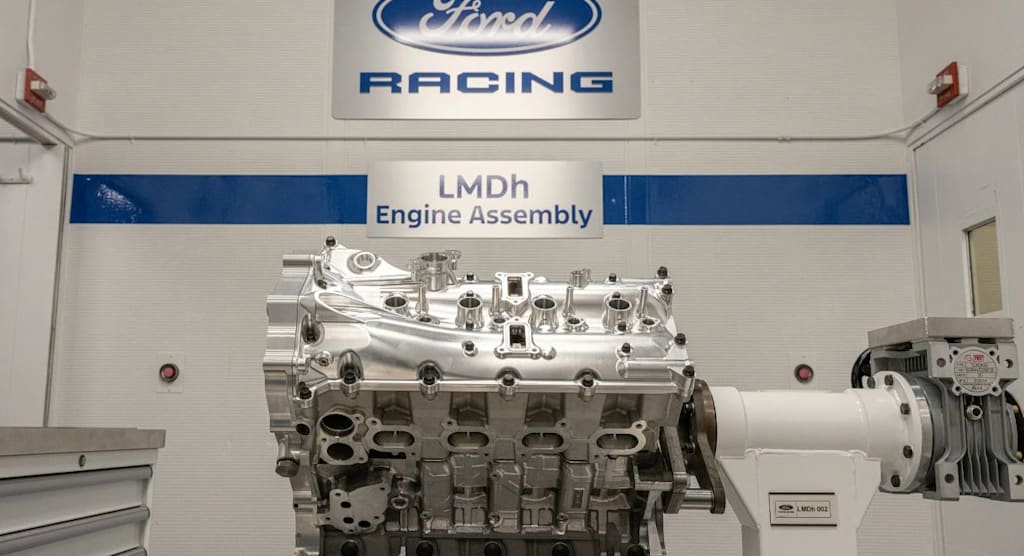
A Room in Dearborn, a Track in France
Every time we fire up our dyno cell in Dearborn, the room holds its breath. Then the engine catches, the numbers climb, and for a few minutes, we're not in Michigan anymore. We're at Le Mans.
That's what you're watching in our latest film. Our 5.4-litre Coyote-based V8 Hypercar engine, running a full simulated lap of the Circuit de la Sarthe right here on the dyno. Every gear change, every braking zone into Mulsanne, every full-throttle charge towards the Ford Chicane, all modelled in real time.
The engine doesn't know the difference, but your ear can tell when it is at wide open throttle and rockets past 9,000 rpm. That's what a world-class virtual proving ground buys you, and this engine work has been going on behind the scenes for months now.
We don't wait for the racetrack to start learning. We can't afford to.
The Philosophy: Build, Interrogate, Learn
Build the engine, interrogate it, and let the data tell us where the real work is. It's a lesson that Ford Racing has carried over from its various other motorsport programs into endurance racing. The approach is simple but relentless: leave nothing to chance, test everything, and let the numbers guide the development.
The dyno cell is where the engine reveals its secrets. Every run produces terabytes of data; every measurement tells a story. The engineers pore over the numbers, looking for patterns, anomalies, and opportunities. The engine doesn't lie, and it doesn't hide. It simply performs, and the data tells the story of what it's capable of.
This is not a process for the impatient. Months of work have gone into this program already, and there will be many more months to come. But that's the price of competing at the highest level of endurance racing. The competition doesn't rest, and neither does Ford Racing.
Lessons from the Past: The GT40 Legacy
We are also taking learnings from the first program to ever do this: our 1960s Le Mans program with the GT40. In fact, the test chamber we are using for the Hypercar sits just yards from where we did the original work on the GT40 more than 60 years ago.
The connection is more than symbolic. The GT40 program was a triumph of engineering ingenuity, a story of determination and innovation that captured the imagination of the world. That same spirit of relentless pursuit drives the Hypercar program today.
What we learned then informs what we do today, and what we do today will inform the future. That is what makes this program so exciting. It's not just about winning races; it's about pushing the boundaries of what's possible, learning from the past, and building a foundation for the future.
The GT40's victory at Le Mans in 1966 was a watershed moment for Ford, a triumph that proved American engineering could compete with the best in the world. The Hypercar program carries that same ambition, but with a modern twist: it's not just about competing, it's about leading.
Beyond the Engine: The Driver-in-the-Loop
However, an engine is only half the job. That's why this film also takes you south, to our Technology Centre in North Carolina, where our Hypercar drivers are testing our buck and feeling the car before they've turned a single wheel on track.
The "buck" is the term for the driver-in-the-loop simulator, a sophisticated rig that allows drivers to experience the car's behavior before it ever leaves the workshop. Every detail gets refined because when our drivers reach Le Mans, there can be no surprises.
The simulator is a critical tool in the development process. It allows drivers to provide feedback on the car's handling, ergonomics, and performance without the expense and logistical challenges of on-track testing. It also allows engineers to test different setups and configurations in a controlled environment, making adjustments based on driver feedback.
The driver-in-the-loop process is iterative and collaborative. Drivers and engineers work together to refine every aspect of the car's behavior. The goal is to ensure that when the car finally hits the track, it feels like an extension of the driver's body responsive, predictable, and fast.
The Road to Le Mans
We're days from our first test in France, but every dyno session and every hour in that buck is essential for our preparation. We intend to arrive ready. And ready we will be.
Ford Racing's Hypercar program continues development ahead of its return to the top class of the FIA World Endurance Championship in 2027. The program represents a significant investment in the future of Ford's motorsport activities, and the lessons learned will inform not just the Hypercar program but also Ford's broader engineering activities.
The return to the top class of endurance racing is a statement of intent. Ford is not content to simply participate; it intends to compete for overall victory. That ambition requires an extraordinary level of commitment, resources, and talent.
The Technology Behind the Sound
The 5.4-litre Coyote-based V8 Hypercar engine is a masterpiece of engineering. Based on the iconic Coyote V8 that has powered some of Ford's most celebrated performance cars, the Hypercar engine has been extensively modified for endurance racing.
Key technical highlights include:
Displacement: 5.4 litres, optimized for the power and torque requirements of the Hypercar class.
Rev limit: Exceeds 9,000 rpm, delivering a sound that is unmistakably Ford.
Construction: Built to withstand the rigors of 24-hour racing, with materials and designs that prioritize durability and performance.
The engine's development has been a collaborative effort, drawing on expertise from across Ford's engineering organization. The result is a powerplant that combines the proven architecture of the Coyote with the specific requirements of endurance racing.
The Legacy Continues
The Hypercar program is the latest chapter in Ford's storied motorsport history. From the GT40's triumph at Le Mans to the Mustang's dominance in Trans-Am and the Focus RS's success in rallying, Ford has always been a force in motorsport.
The Hypercar program is different. It represents Ford's commitment to the future, a statement that the company intends to lead the next generation of motorsport technology. The lessons learned on the track will inform the development of road cars for years to come.
Christian Hertrich, Powertrain Chief Engineer at Ford Racing, has been at the heart of the Hypercar engine development. His team's work is a testament to the dedication and expertise that drives Ford's motorsport activities.
The Hypercar program is a race against time, a race against the competition, and a race against the limits of engineering. Every dyno session brings us closer to our goal. Every hour in the buck refines the car's behavior. Every test is a step forward.
We don't wait for the racetrack to start learning. We can't afford to. The engine doesn't know the difference between a dyno cell in Dearborn and the Mulsanne Straight. But we do. And that's what makes this program so special.
When our Hypercar finally takes to the track at Le Mans, it will carry with it the lessons of thousands of hours of testing, the heritage of the GT40 program, and the ambition of a company that has never been content to follow.
Ford is back. And ready we will be.
About the Creator
Mark Lim
Hi I am mark an automotive student and a car, tech and food enthusiast ! Im gonna try and post daily & hope you enjoy what I write and do share my page with people you know. I would gladly appreciate it! Cheers
Enjoyed the story? Support the Creator.
Subscribe for free to receive all their stories in your feed.
Comments
There are no comments for this story
Be the first to respond and start the conversation.