
The Engine Breakthrough Nobody Puts on the Brochure
China’s best car engines now match the numbers. The harder win happened in the calibration code, and the reliability story is still being written.
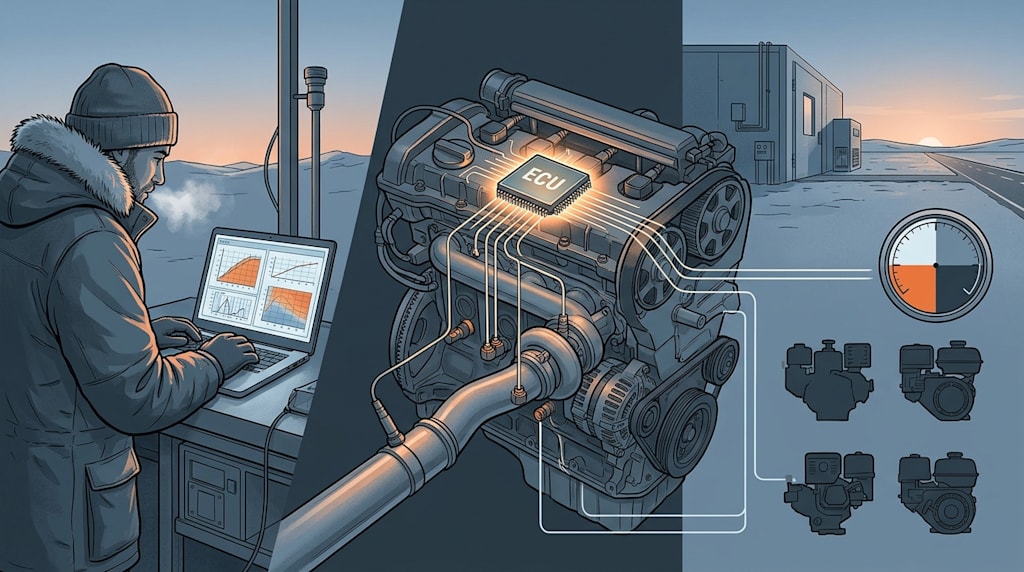
Golmud sits at nearly 3,800 meters. Chery calibration engineers stay there for 19 days. They wait for coolant to hold at 85°C, give or take one degree, then sweep ignition angle, watch knock, exhaust temperature and fuel use. In Heihe, at minus 30°C, another crew starts cold-start tests at 4:30 a.m. Before an engine reaches mass production, it logs more than 15,000 bench hours. The vehicle program runs millions of kilometers across heat, cold, altitude and humidity. That work uses 141 prototype engines and 1.45 million kilometers of bench testing.
None of that makes a brochure. It does explain why Chinese engines started delivering better numbers and better behavior around 2019.
The gap was in the code
For years, people judged engines by hardware: cylinder count, displacement, turbo size, injection pressure. Those numbers are easy to compare. They also hide a simple fact. The same turbo, pistons and block can feel like different engines under different ECU calibration.
At each steady operating point, calibration engineers balance competing goals. More ignition advance helps power and efficiency. It also raises knock risk and exhaust temperature. Earlier injection mixes fuel better. It also raises wall wetting and oil dilution risk. A VVT setting can improve low-end torque and hurt top-end power. Wastegate logic has to balance response, overboost protection and turbo life. The sum of those choices is calibration. Hardware sets the ceiling. Calibration decides what the driver gets.
That is where the old gap lived. In 2019, Bosch held 66.51% of gasoline passenger-car EMS filings for China VI, Continental held 14.84%, Denso held 5.52%, and domestic LianDian held 1.07%. Chinese brands could buy ECU hardware. They could not define the combustion model, torque structure or knock-control logic inside it. So the specs caught up before the driving experience did.
How calibration authority came back
The shift came from many labs and many teams, not one breakthrough. Chery had already exported engines with independently calibrated ECUs to the United States in June 2017. The first 500 units used Chery-defined control strategies and operating parameters. After 2019, that capability spread from a few companies to the leading brands.
The distinction matters. Independent calibration is not the same as independent ECU hardware. Around 2019, domestic teams mainly mastered calibration strategies and MAP definition on Bosch and Continental platforms. They did not yet own the ECU chips or the full basic software stack. LianDian’s prospectus said EMS had long been dominated by multinational suppliers and that domestic replacement in mainstream passenger cars had just begun. The win was the right to define how the engine behaves.
Four engines, four tests
The four engines people cite are useful because each one tests calibration in a different place.
Chery’s Kunpeng 2.0T tests a conventional turbo gasoline engine. Its 350-bar direct injection atomizes fuel to about 8 microns. That also makes knock more likely. Chery’s answer is a layered knock strategy. The knock sensor watches cylinder pressure frequency. The ECU pulls ignition timing in milliseconds. It also trims boost for the current condition. Long-term learning remembers fuel quality and leaves a safety margin. The engine can run on 92-octane fuel. It also opens up reserved performance when it detects better fuel.
The reliability claims need care. Kunpeng 2.0T has a low share of core failures. Early cold-start noise often went away after ECU updates. A CATARC teardown of a 100,000-kilometer 1.6T found acceptable cylinder wear and carbon buildup. But slight oil seepage around the valve cover gasket or pipe seals can still show up near 60,000 kilometers. That is a wear part, not a dead engine. It also means “no common faults” is too strong. Kunpeng sits in the acceptable mainstream range. Long-cycle, large-sample failure data are still thin.
BYD’s Xiaoyun 1.5L Atkinson engine tests a different problem. Atkinson timing delays intake valve closure. Thermal efficiency rises. Low-speed torque falls. Without precise VVT control and motor torque fill, the weak low end would be obvious. Xiaoyun’s 43.04% thermal efficiency works because the ECU keeps the engine in its efficient range and the motor fills the gaps.
The 600,000-kilometer ride-hail story holds up as a single case. It does not prove a failure rate. It also gets mixed up with a different engine. Complaints about “Xiaoyun burning oil and feeling weak” mostly point to the 1.5T gasoline version, not the 1.5L Atkinson hybrid engine. The two have different loads, combustion limits and protection logic. The fair read is simple. Thermal efficiency evidence is solid. High-mileage durability has one strong case. Large-scale long-term reliability data are still being collected.
Great Wall’s 3.0T V6 tests a large-displacement off-road engine. Dual VGT, Miller cycle, 48V and 350-bar direct injection push thermal efficiency to 38.5%. That is rare among similar international gasoline engines. The hard part is not peak power. It is coordinating VGT opening with Miller-cycle valve timing across the rev range. The turbo has to spool early for low-end torque. It also has to control exhaust temperature and knock under load. Early intake valve closure cuts pumping loss. It also demands precise timing and a good torque model. Great Wall’s domestic team calibrated that logic.
Great Wall’s reliability story also needs context. Tank 500 owners have reported high-temperature oil leaks. Some complaints point to turbo failure to engage and engine shudder. Overseas analysis notes GDI carbon buildup, high-pressure pump wear and valve deposits. A Russian review rated the GW6Z30 at 4/5 for reliability. It also noted that first-year cars had more issues, most were fixed, and some throttle-response and power-interruption complaints remained after software updates. This is an engine maturing through iteration. It did not leave the factory perfect.
Hongqi’s 4.0T V8 tests a different standard. A ceremonial flagship needs smoothness, quiet and long-term stability more than a thermal-efficiency trophy. The old 265 kW and 500 N·m tune looked conservative. In that role, conservative is not an insult. The 2026 version pushes output to 400 kW and 725 N·m. That shows the engine had headroom once electronic control and boost hardware improved. Judging it by thermal efficiency misses the point.
What reliability data can and cannot prove
Across all four engines, one tension keeps showing up. The parameter and thermal-efficiency evidence is fairly clear. The reliability evidence is stronger in individual cases than in statistics.
That does not make the individual cases worthless. A Qin PLUS that ran 600,000 kilometers without a major repair matters. A Kunpeng 1.6T that looked acceptable after a 100,000-kilometer teardown matters. 15,000 bench hours and millions of validation kilometers matter. They show that design durability and calibration protection have crossed a quality threshold. The ECU does specific work here. It protects against high temperature. It suppresses knock. It adapts parameters as parts wear. It pulls back ignition and injection when fuel quality drops.
But reliability means failure rates across a large sample and a long period. Bosch and Continental built calibration databases over decades. Those databases hold statistical memory of how engines fail in edge conditions. Domestic brands are catching up with the same method: more bench time, more road testing, more hot, cold, altitude and humidity validation. Time density can be compressed. Time length cannot. Three to five years of pre-launch validation can cover most known failure modes. It cannot replace ten years and hundreds of thousands of real vehicles.
So the honest read is this. Leading domestic engines can now be discussed on design targets, delivered parameters, calibration autonomy and control of known failure modes. Their “won’t break” reputation is still in the middle of its validation cycle. Saying otherwise trades engineering progress for market trust. Denying the progress uses the timescale to erase work that has already happened.
The line is real
The turning point around 2019 was about definition authority. Domestic brands took back control of engine strategies and calibration data. Hardware potential could finally be released according to their own product intent. Kunpeng’s knock control, Xiaoyun’s Atkinson constraints, Great Wall’s VGT logic and Hongqi’s scenario tuning are all versions of that shift.
That is the starting line. The finish is elsewhere. Calibration decides whether an engine can work as designed. Reliability validation decides whether it can repeat that behavior over hundreds of thousands of kilometers and hundreds of thousands of cars. The first question is engineering. The second is time. Domestic engines have answered the first. They are still answering the second.
Golmud’s 19 days, Heihe’s 4:30 a.m. cold starts and 15,000 bench hours sit on one side of the line. The other side needs the next decade.
About the Creator
Jin
Writer of reamstories
https://reamstories.com/jin
Enjoyed the story? Support the Creator.
Subscribe for free to receive all their stories in your feed. You could also become a paid subscriber, letting them know you appreciate their work.
Comments
There are no comments for this story
Be the first to respond and start the conversation.