
The China Crunch: Mercedes-Benz Slashes Profit Guidance as Luxury Demand Falters
As the German automaker joins rivals BMW and Volkswagen in downgrading forecasts, the steep decline in Chinese sales exposes the fragility of a strategy built on premium pricing amid a shifting geopolitical and competitive landscape.

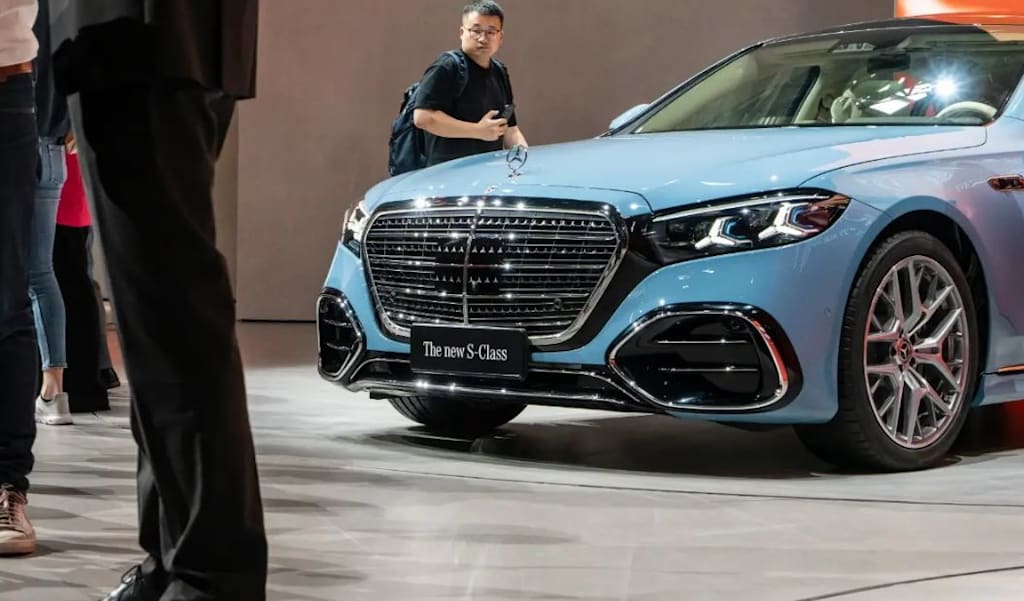
Mercedes-Benz Group AG has become the latest German automotive giant to sound the alarm on its financial outlook, sharply cutting its profit guidance for the year. The luxury carmaker announced on Tuesday that it now expects an adjusted return on sales in its core cars division of between 2% and 3%, a significant downgrade from its previous projection of up to 5%. This revision places Mercedes squarely alongside peers Volkswagen AG and BMW AG, all of whom are grappling with the same daunting reality: the rapid erosion of their once-unshakable dominance in the Chinese market.
The immediate catalyst for the downgrade is a confluence of weakening demand in China and rising operational costs. Mercedes cited an "increasingly tough environment" in its largest single market, where local competitors are aggressively capturing market share with advanced electric vehicles (EVs) at competitive price points. Compounding this revenue pressure are higher expenses in the fourth quarter, particularly driven by escalating material costs and the heavy investment required to transition its fleet toward electrification. Consequently, the company now expects group earnings before interest and tax (EBIT) to remain roughly flat compared to the previous year, abandoning its earlier forecast for a significant increase.
Market Reaction and Strategic Scrutiny
Investors reacted swiftly to the news, sending Mercedes shares down as much as 5.4%, the steepest drop in just over a month. The stock’s performance this year has been bleak, having fallen by more than a third, reflecting deepening anxiety about the company’s ability to navigate the dual challenges of decarbonization and geopolitical fragmentation.
The downgrade has intensified scrutiny of CEO Ola Källenius’s long-standing strategy of prioritizing high-margin, ultra-luxury vehicles over volume sales. Known internally as "top-end luxury," this approach was designed to insulate the brand from the price wars plaguing the mass market. However, the current downturn suggests that even the premium segment is not immune to the broader economic slowdown in China and the shifting preferences of affluent Chinese consumers, who are increasingly turning to domestic brands like Nio, Li Auto, and BYD for their technological sophistication and status appeal.
China: From Profit Engine to Strategic Headache
For decades, China served as the dependable profit engine for German automakers, offering high margins and robust growth. Today, it has transformed into one of their most significant strategic headaches. The market is no longer just a destination for exports; it is a hyper-competitive battleground where local manufacturers have achieved parity, and often superiority, in battery technology, software integration, and supply chain efficiency.
Falling earnings in China leave German automakers with less financial room to maneuver just as they need capital most. They are facing enormous expenditure requirements to reposition their businesses for an electric future, including building new battery plants, developing proprietary software stacks, and restructuring legacy manufacturing facilities. The inability to generate surplus cash from China threatens to slow this transition, potentially leaving them lagging behind both American innovators like Tesla and agile Chinese rivals.
The Cost of Transition
Beyond the China-specific issues, Mercedes is also burdened by a German cost base that was engineered for an era of higher production volumes and stable energy prices. With global demand softening and the European market facing its own regulatory and economic pressures, the company must now undertake painful restructuring efforts to align its fixed costs with lower expected output. This includes potential workforce adjustments and the closure or repurposing of inefficient plants.
The path forward for Mercedes-Benz is narrow and fraught with risk. It must simultaneously defend its brand prestige in a market that is becoming increasingly nationalistic, finance a heavy product rollout of new EV models, and streamline its operations in Europe. The cut in profit guidance is not just a numerical adjustment; it is an acknowledgment that the old rules of the automotive industry no longer apply. In the new era of software-defined, electric mobility, heritage and badge value are no longer enough to guarantee profitability. As the year ends, Mercedes faces the urgent task of proving that its luxury strategy can survive not just in the showrooms of Stuttgart, but in the fiercely competitive digital highways of Shanghai.
About the Creator
Mark Lim
Hi I am mark an automotive student and a car, tech and food enthusiast ! Im gonna try and post daily & hope you enjoy what I write and do share my page with people you know. I would gladly appreciate it! Cheers
Enjoyed the story? Support the Creator.
Subscribe for free to receive all their stories in your feed.
Comments
There are no comments for this story
Be the first to respond and start the conversation.