
The Car That Made Even Frank Sinatra Wait in Line
There are luxury cars, and then there is the 1973 Rolls-Royce Corniche

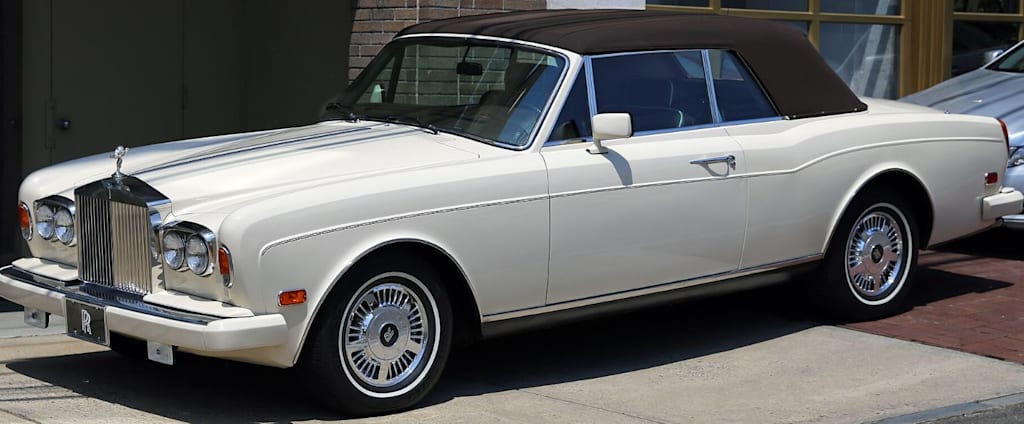
There are luxury cars, and then there is the 1973 Rolls-Royce Corniche, a machine so thoroughly desirable when it arrived that David Bowie, Michael Caine, Elton John, and Dean Martin all put their names on two-year waiting lists just for the privilege of eventually owning one. Paul McCartney, Frank Sinatra, and Tom Jones didn't wait. They bought theirs immediately. That tells you almost everything you need to know about what the Corniche meant in its moment.
The name itself carries weight. Corniche is a French word for a coastal road carved along the face of a cliff, most famously the Grande Corniche above Monaco, winding above the Mediterranean with the kind of drama that only geography and engineering together can produce. Rolls-Royce first used the name on a 1939 prototype that survived 15,000 miles of endurance testing across continental Europe before being destroyed by a bomb at a dock in Dieppe, awaiting shipment home. The production version didn't arrive for another three decades, but Rolls-Royce held onto the name, knowing they would eventually build something worthy of it.
What It Actually Was
The Corniche was not built from scratch. It grew out of the two-door variants of the Rolls-Royce Silver Shadow, the saloon and the drophead coupé that had been produced since the mid-1960s by coachbuilder Mulliner Park Ward in London. In March 1971, Rolls-Royce gave these cars a new name and a clearer identity, and the Corniche was born. It was available as either a hardtop coupé or an open-top convertible, both sharing the same essential character: long, low, unhurried, and built as if time itself were not a constraint.
Under the bonnet sat the same 6.75-litre V8 engine that Rolls-Royce had been refining for years, an aluminium block unit with a bore and stroke that prioritised smooth, effortless torque over outright performance figures. Rolls-Royce, famously, declined to publish horsepower numbers for decades, describing output simply as "adequate." A three-speed automatic transmission sourced from General Motors handled gear changes, and four-wheel disc brakes upgraded to ventilated discs for 1972 provided the stopping power. The suspension used a hydraulic self-levelling system that kept the car sitting correctly regardless of load, a piece of engineering refinement that made every journey feel equally composed.
The 1973 Corniche I sits in the early, purest expression of that formula. Twin SU carburettors fed the engine, but fuel injection would not arrive until 1977. The interior featured a three-spoke steering wheel with a wood rim and the first standard tachometer Rolls-Royce had ever fitted to one of its cars, a small acknowledgement that drivers might occasionally wish to know how hard the engine was working.
What Made It Different
Visually, the Corniche was distinguished from other Silver Shadows by details that rewarded attention rather than demanding it. Exclusive half wheel covers finished in stainless steel trim, fitted partly for brake cooling and partly for the look they gave the car. The proportions were right in a way that photographs capture but don't fully explain long enough to feel genuinely grand, low enough to look purposeful, with a roofline that, on the convertible, dropped away to reveal an interior that felt less like a car cabin and more like a very well-appointed drawing room that happened to be moving.
No other car of its era, by common consensus, communicated wealth quite as effectively as the Corniche. It appeared in films and television throughout its production run, Beverly Hills 90210, Dynasty, Dirty Rotten Scoundrels, not because it was hired for effect, but because it was simply the obvious choice whenever a story required a car that announced its owner's position without any further explanation.
Jeremy Clarkson, never one to leave a provocation unused, once dismissed James May's 1972 Corniche on Top Gear as "just a Ford Zephyr with a chrome nose." It is the kind of joke that only works because the car it is aimed at is secure enough not to need defending.
The Bigger Story
The Corniche was built from 1971 through to the late 1980s in its original form, with the coupé variant discontinued in 1981 and the convertible continuing through successive generations Corniche II, III, IV until 1995. In total, more than 6,800 Corniche models were produced across the entire run, a figure that sounds large until you consider that a comparable volume of certain modern cars is produced in a single day.
Each one was hand-built at Mulliner Park Ward in London, then later at Crewe, at a pace that reflected the fact that the point was never quantity. The point was that whoever eventually took delivery after however long they had waited would receive something that no amount of money spent elsewhere could quite replicate.
In 1973, that something cost considerably less than it would today. A well-preserved example now changes hands for multiples of its original price, which is perhaps the most straightforward measure of what it meant then, and what it still means now.
About the Creator
Mark Lim
Hi I am mark an automotive student and a car, tech and food enthusiast ! Im gonna try and post daily & hope you enjoy what I write and do share my page with people you know. I would gladly appreciate it! Cheers
Enjoyed the story? Support the Creator.
Subscribe for free to receive all their stories in your feed.
Comments
There are no comments for this story
Be the first to respond and start the conversation.