
The Brake Pedal That Broke at 1,612 Newtons
Three new Zunjie V800s failed the same emergency test. The rules still don't require that strength.
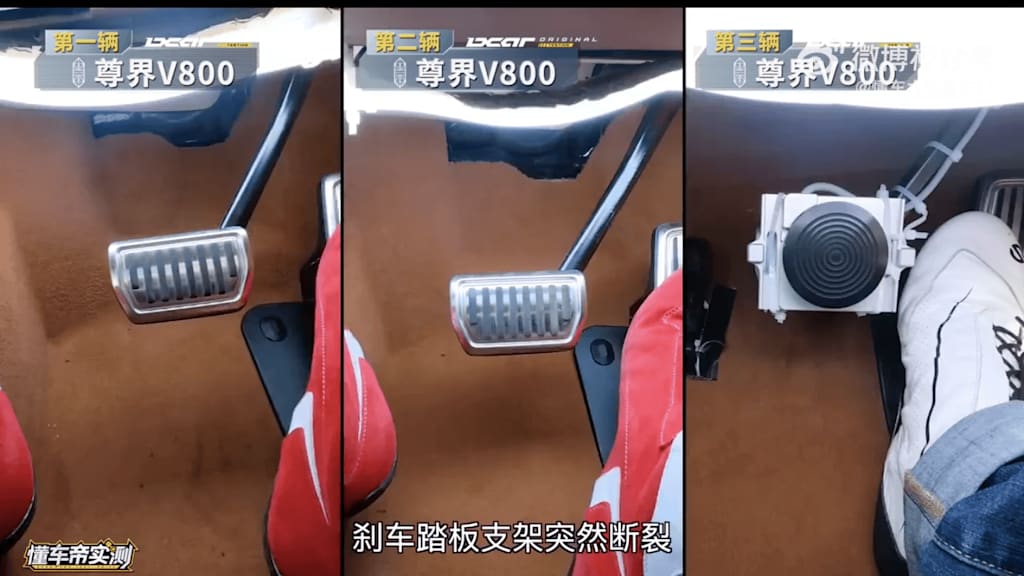
I. 1,612 Newtons
On October 8, 2026, Dongchedi released a test video.
Three Zunjie V800s performed emergency braking from 100 km/h to 0 on a closed course. The first car's pedal bracket broke on the third braking event. The second broke on the fourth. A third car, bought to verify the problem, broke on its second full-force brake application. The pedal force sensor recorded 1,612 N at the moment of fracture in the third car.
The other eight models in the same test each completed six full-force braking events with average pedal force above 1,600 N. None of their pedals or brackets failed.
After the pedal bracket broke, the vehicle's foot-brake function failed. Testing showed stopping distance extended from about 38 meters under normal conditions to about 140 meters. The Zunjie V800 owner's manual notes that P-gear emergency braking is mainly for deceleration and cannot fully replace conventional braking.
Three new cars from different batches showed similar fracture locations and fracture-surface shapes. Teardown footage showed the fracture was in the pedal bracket pivot area. The material was marked PP+GF40, or 40% glass-fiber reinforced polypropylene. The testers noted that the Zunjie V800's brake pedal center is about 130 mm from the bracket pivot, farther than in the three comparison models, but the pivot area has only a single vertical plate support. Other models using the same material and same supplier have two to three reinforcing vertical plates in that position. The stress-concentration area of the fractured bracket showed weld lines. Wall thickness and reinforcing rib design were relatively weak.
That afternoon, JAC Motors hit the daily limit down, with market value shrinking by about 6.2 billion yuan. It fell again the next day, losing nearly 11.8 billion yuan over two trading days.
II. Three Numbers
The incident moved from a product controversy to a question about the standards system. The structural strength of automotive brake pedals in China has standards, but they are not mandatory.
The current standard system has three layers.
The mandatory national standard GB 7258-2017, Technical Conditions for Motor Vehicle Operation Safety, sets the upper limit of pedal force. For passenger cars, pedal force at maximum braking effectiveness must not exceed 500 N. This number governs whether a person can press the brake normally without excessive effort. It has nothing to do with whether the pedal will break.
The mandatory national standard GB 21670-2025, Technical Requirements and Test Methods for Passenger Car Braking Systems, takes effect on January 1, 2026. It requires passenger car brake pedal assemblies to withstand a 2,000 N static load for 5 seconds without failure. But the standard does not give a quantified load threshold, material restriction, or test method for the brake pedal and its bracket. It also does not give specific design requirements. It only states that the part must be a component not prone to failure and that the material should be metal or a material with performance equivalent to metal.
The recommended industry standard QC/T 788-2018, Performance Requirements and Bench Test Methods for Automobile Pedal Devices, requires a longitudinal force of 1,500 ± 20 N on the brake pedal. The force is held for 5 seconds, released, and repeated five times. After the test there must be no cracks or damage, and permanent deformation must not exceed 5 mm. A recommended standard has no mandatory enforcement.
The three numbers mean this: 500 N is the force a person can normally exert. 1,500 N and 2,000 N are forces the component should withstand. The core standard for brake pedal fracture strength, QC/T 788, is recommended. Of the two mandatory national standards, one only governs the upper limit of pedal force. The other only makes a general requirement without a quantifiable fracture-strength threshold.
In the development of QC/T 788-2018, an early revision draft used a more demanding scheme of 2,000 ± 50 N held for 30 seconds. When formally issued, this requirement was lowered to 1,500 N.
Global mainstream automakers' standards are usually far above this recommended value. Porsche's MSB platform requires a brake pedal fracture load of 3,000 N, tested at minus 35°C, room temperature, and 80°C. GM's 2007 GMW15396 engineering specification requires 2,700 N for 10 seconds.
III. Show Your Pedals
On the evening of October 8, Lu Fang, chairman of Voyah Automobile, posted two photos of a brake pedal on his personal Weibo. The caption was nine characters: "Multi-layer high-strength steel main beam!"
On October 9, Lin Zhibin, deputy general manager of GAC Honda, posted using the Accord as an example. He said its brake pedal is made of high-rigidity steel. After testing, it can withstand more than 3,000 N of pressure while maintaining structural integrity and not breaking. He added that this value came from an actual test, not a theoretical calculation on a PPT.
Zheng Yu, assistant to the general manager of BYD Yangwang, announced that the pedal assemblies of the Yangwang U8, U8L, and U7 are all metal and follow a corporate standard of 2,500 N. He wrote that safety is the greatest luxury. Wan Liangyu, CEO of M-Hero Automobile, said all its products use high-strength materials for brake pedals, with load-bearing capacity far exceeding the national standard.
On October 9, CATARC sent a survey questionnaire on brake pedal assembly materials to major automakers. The survey focuses on the use of non-metallic materials in pedal assemblies. Changan Automobile confirmed receiving the questionnaire that day. An industry insider said the questionnaire is preparatory work. It will most likely push forward revision of the industry standard, such as QC/T 788-2018.
The survey focuses on non-metallic materials. Industry insiders noted that the industry standard's quantitative test indicators, 1,500 N static load and 500,000 cycles of durability, have traditionally been based on metal characteristics such as high yield strength and elastic mechanical behavior. Current regulations have a standard blank for non-metallic brake pedal assemblies. CATARC's urgent survey is seen as a signal of industry-standard revision.
MIIT, together with the Ministry of Public Security, the Ministry of Ecology and Environment, and the State Administration for Market Regulation, issued a draft notice on strengthening the management of innovative design and R&D testing and validation of automotive products. The draft requires newly declared products to complete complete reliability and durability testing. Reliability validation test mileage must be no less than 30,000 km. The environmental adaptability validation period must be no less than one year, including two winters and one summer. The document also sets a red line for innovative design access. Physical controls and prominent markings must be retained for safety-related controls such as emergency escape and emergency braking.
IV. Two Recalls
In 2020, Ford recalled 38,005 2020 Mustang automatic-transmission vehicles worldwide. During production, the brake pedal bracket material was changed from nylon to polypropylene. Engineering specifications and design validation procedures did not consider sufficient design margin. The change reduced the peak braking-force load strength of the brake pedal bracket. Under emergency braking, the bracket could break in the pivot area and cause loss of braking capability.
Ford replaced the improved brake pedal bracket assembly free of charge and switched production back to nylon. In China, Ford recalled 2,627 imported Mustangs at the same time. At the start of the recall, Ford reported that it was not aware of any accidents or injuries caused by the defect.
In 2014, a Porsche 911 GT3 had two engine fire incidents, one on a track and one on a street. A total of 785 vehicles were affected, a fire rate of about 0.26%.
Porsche advised all owners to stop driving and have their vehicles transported to Porsche centers by tow truck. Engineers could not find a clear cause. They even began to suspect driver error. Porsche's senior management asked one question: "Can you guarantee it will not catch fire again?" After about three weeks of item-by-item screening, the cause was identified as a connecting-rod bolt. The solution was to replace the entire engine in all 785 vehicles, not repair it. Media estimated the recall cost at about 20 million euros.
In both recalls, Ford did not say the bracket strength met the industry standard at the time. Porsche did not say a 0.26% fire rate was a small-probability event.
V. After the Material Change
The Ford Mustang problem lay in engineering specifications and design validation procedures that did not consider sufficient design margin. Changing the material from nylon to polypropylene was not necessarily wrong by itself. The failure was not reassessing structural strength after the material change.
Zunjie V800's official statement said the braking system completed the full process of development and validation in accordance with requirements higher than national standards and higher than industry standards. QC/T 788's recommended static-load threshold is 1,500 N. The fracture occurred at 1,612 N, which is 7% above the recommended standard. Under emergency braking, the pedal force applied by a driver can easily exceed that value. In the same test, other models completed six braking events above 1,600 N without damage.
Zunjie said the brake pedal bracket base upgrade plan is expected to be confirmed by the end of October and launched in November. Owners of delivered vehicles can voluntarily apply for a free upgrade.
CATARC's survey questionnaire has been sent, and revision of QC/T 788 will most likely be pushed forward. Raising the recommended standard from 1,500 N to 2,000 N or even higher may not prevent similar incidents. A standard sets a floor. It does not set a ceiling. When an automaker's engineering culture is to meet the standard, it will hover near the standard line. When an automaker's engineering culture is to eliminate uncertainty, it will replace all engines for a 0.26% probability.
Mandatory national standards lack a quantified threshold for brake pedal fracture strength. Recommended standards have no mandatory force. Corporate standards vary widely. Ford replaced the assembly. Porsche replaced the engine. Zunjie's first response was "not a recall."
Standards can be revised and raised. Ford and Porsche have given their answers. Chinese brands need to give their own.
About the Creator
Jin
Writer of reamstories
https://reamstories.com/jin
Enjoyed the story? Support the Creator.
Subscribe for free to receive all their stories in your feed. You could also become a paid subscriber, letting them know you appreciate their work.
Comments
There are no comments for this story
Be the first to respond and start the conversation.