
The Bolt vs The Leaf: Two Affordable EVs Fight It Out So You Don't Have To
In a world where the average new car now costs over $50,000, these two hatchbacks are doing something genuinely radical being affordable. But which one actually deserves your money?

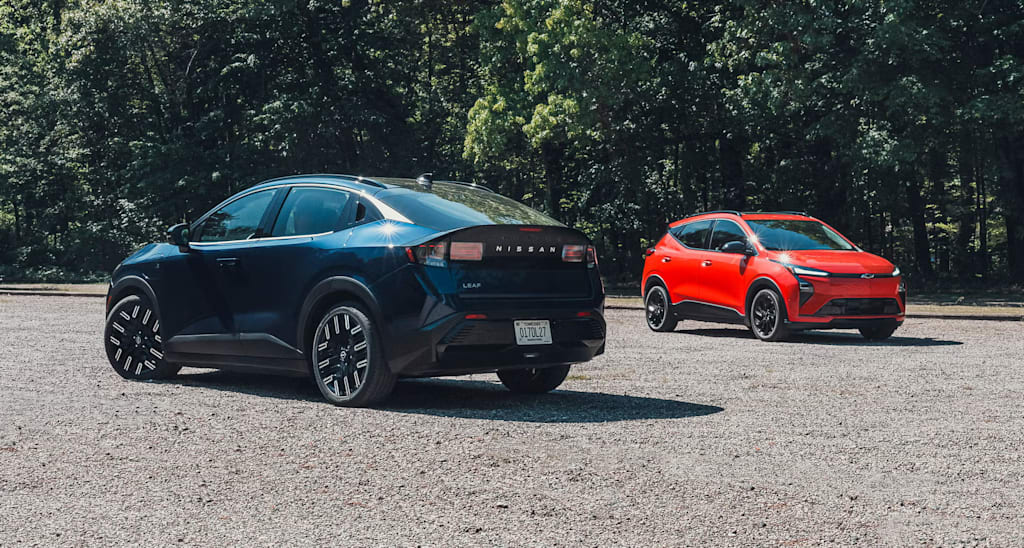
Something strange has happened to the car market. Electric vehicles were supposed to democratise transportation, cleaner, simpler, cheaper to run, and eventually cheaper to buy. Instead, the average new car transaction price is cresting $50,000, EV options below that threshold have quietly evaporated, and the idea of an honest, affordable electric hatchback has started to feel almost nostalgic.
Which makes the current moment genuinely interesting. Two affordable EVs, the returning 2027 Chevrolet Bolt and the freshly updated 2026 Nissan Leaf, are on sale simultaneously, both undercutting the market significantly, both making a case for electric transportation that doesn't require a second mortgage. They deserve serious attention and a serious comparison.
Car and Driver ran both cars back to back. Here's what actually matters.
What You're Actually Choosing Between
Both cars are front-wheel-drive, five-passenger hatchbacks priced in base form well under $40,000. The Bolt starts at $32,995. The Leaf Platinum+ starts at $40,535, which technically pushes it past the threshold in top spec, though lower trims bring it back down. Both are trying to solve the same problem: getting someone into a new electric vehicle without requiring them to spend like they're buying a luxury sedan.
The similarities largely end there.
Design and Interior: Two Very Different Philosophies
From the outside, the Leaf is the more visually ambitious of the two. Nissan's latest corporate design language gives it a sleek, premium appearance, with the slicked roofline, the taillights borrowed from the Z sports car, and a shape that genuinely doesn't look like it costs what it costs. The Bolt, by comparison, received a modest refresh rather than a reinvention. Chevy changed perhaps four things about its exterior appearance, though they did fix the brake lights previously in a questionable location, so progress is being made.
Inside, the gap is more nuanced. The Leaf's dashboard is genuinely impressive for the price: clean, unbroken surfaces made of materials that feel and look premium, a futuristic layout with haptic climate controls embedded into the trim, and excellent seats that are among the most comfortable in this class. It feels expensive. It does not feel like a sub-$40,000 car.
The Bolt is more honest about where its money went. The interior plastics are notably hard. Car and Driver's reviewers put them at a 10 on the Mohs hardness scale, which is a cutting way to say they feel exactly like budget GM plastics. But the practical layout is actually superior: more cubbies, better storage solutions, a centre console with a proper floor tray for bags and items, and physical buttons and dials for climate control rather than the Leaf's haptic system that works inconsistently.
Legroom comparison matters here: the Bolt offers 7.3 extra inches of rear legroom. For anyone who regularly carries adult passengers, that's a meaningful real-world advantage over the Leaf's more cramped back row.
Performance: Lighter Wins
Neither of these cars is trying to be a sports car, and neither pretends otherwise. They're efficiency machines, and they drive accordingly.
The Leaf has a larger battery, 75 kWh versus the Bolt's 65 kWh, and more torque: 261 lb-ft versus 169 lb-ft. That torque advantage is noticeable at low speeds, giving the Leaf a stronger initial punch off the line in town. But the Bolt weighs 574 pounds less than the Leaf, and physics eventually wins. By 60 mph, the Bolt has pulled ahead, reaching it in 6.7 seconds versus the Leaf's 6.9. The Bolt also stops shorter, 179 feet from 70 mph, against the Leaf's 184, and turns in a slightly higher quarter-mile speed.
On range, the Leaf's larger battery pays dividends. At a consistent 75 mph highway speed, the Leaf managed 250 miles. The Bolt managed 230. Both are limited to 150 kW DC fast charging, which is adequate but not remarkable by current standards.
The Driving Experience: Where It Gets Decisive
This is where the Bolt pulls away convincingly, and it comes down to feel.
Multiple Car and Driver editors drove both cars back to back. The Bolt won the driving experience assessment by a significant margin. It simply felt more composed, more confidence-inspiring, more like a car you'd actively enjoy driving rather than merely tolerate as transportation.
The Leaf's tyres gave up earlier in corners, with considerable noise along the way. The brake pedal outside of one-pedal driving mode felt too soft, with too much dead travel before deceleration began. Nissan also incorporated a self-moving brake pedal in its e-Step one-pedal mode, a feature that Mercedes tried on the EQS and largely abandoned because it felt strange. It still feels strange on the Leaf.
The Bolt's brake pedal inspired confidence across every situation. Its handling delivered what Car and Driver described as a "slow car fast" feeling, the particular pleasure of a lightweight, agile car that rewards commitment through corners. It's not exciting in absolute terms, but it's genuinely enjoyable in the way that affordable, well-sorted cars can be.
The Bolt RS also offers GM's Super Cruise as an option, hands-free highway driving that Car and Driver rates among the best available, now accessible in one of GM's most affordable vehicles. It requires $4,450 in options to unlock, but for highway commuters, it's a meaningful differentiator.
The Numbers That Matter
The Bolt starts at $32,995 and reaches $38,940 fully loaded as tested. The Leaf Platinum+ tested at $41,980. Both are remarkable value propositions in the current market. But the Bolt's lower entry point, combined with its superior driving dynamics and roomier rear seat, makes its value case considerably stronger.
The one genuine advantage the Leaf holds beyond its excellent seats is range. Twenty additional miles at highway speeds is real. For anyone whose daily reality includes longer highway runs without reliable fast charging access, that gap is worth considering.
The Bolt wins this comparison. It's more fun to drive, more practically laid out inside, cheaper to buy, and lighter on its feet in a way that makes it more satisfying daily. The Leaf is not a bad car; its interior quality is genuinely impressive, and its range advantage is real, but the driving experience gap is significant enough that the Bolt is the clearer recommendation for most buyers.
There's a caveat attached, and it's an important one. GM has a complicated history with the Bolt, including discontinuing a beloved product and then reversing course. Car and Driver notes that the Bolt RS has a "confoundingly limited life cycle," whatever that means for its long-term availability is worth investigating before you commit.
But if you want an honest, affordable, enjoyable electric hatchback right now, the Bolt is the answer. In a market that has largely abandoned the idea of affordable, it's doing something genuinely valuable.
Get it while it exists.
About the Creator
Mark Lim
Hi I am mark an automotive student and a car, tech and food enthusiast ! Im gonna try and post daily & hope you enjoy what I write and do share my page with people you know. I would gladly appreciate it! Cheers
Enjoyed the story? Support the Creator.
Subscribe for free to receive all their stories in your feed.
Comments
There are no comments for this story
Be the first to respond and start the conversation.