
The Big-Casino Rule for Car Reviews Is Only Half Right
A platform’s size can lower the odds of a paid smear. It cannot make a negative verdict self-verifying.
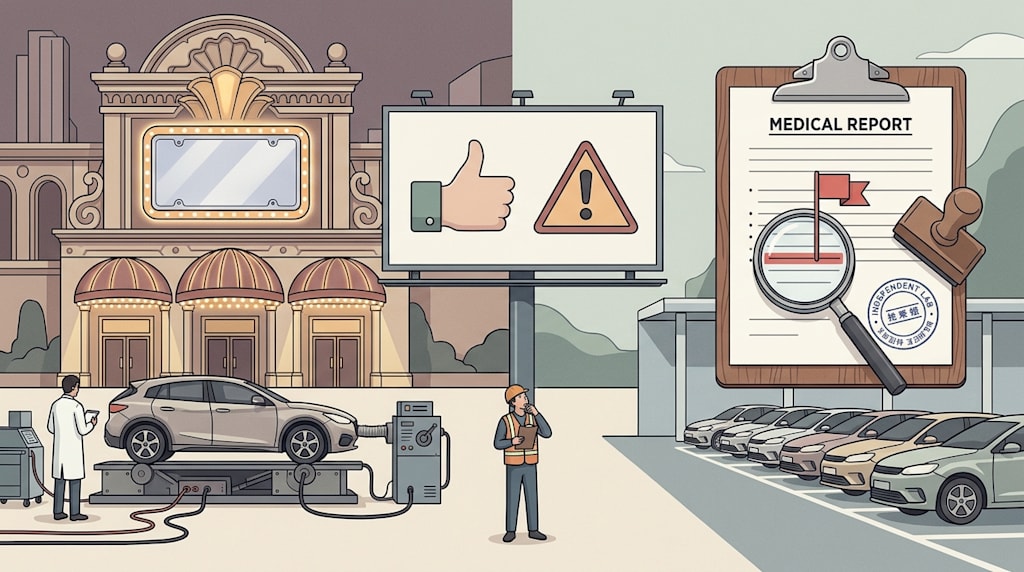
“If Dongchedi says a car is good, you do not have to buy it. If Dongchedi says a car has problems, you absolutely must not buy it.”
This line has become popular. It is sharper than the claim that any platform taking advertising must be selling smears. It rests on a serious business argument: bigger platforms have more to lose; in a repeated game, a long-term reputation is worth more than one payoff; big casinos do not cheat, private games do. The argument explains something real. It also skips a step. It treats “the platform has a reason to protect its reputation” as “the platform’s negative conclusions are credible by default.” A motive can be real while the method is unreliable. Not wanting to cheat does not mean every hand can survive review.
What the line gets right, and what it misses
The line is not pure emotion. A commercial testing platform is managing a trust asset. A small workshop can grab what it can and disappear because its name is worth little. A large platform’s name is worth something, so in theory it has more reason to protect it. In 2025 Dongchedi separated testing from commercial work, isolating the testing team from commercial projects in personnel, process, and finance. That shows it understands that testing independence is a core asset. The casino comparison works at the level of game theory: the more expensive the license, the higher the expected cost of cheating.
But big casinos do not refrain from cheating because they are big. They operate under license regulation, independent audits, appealable rules, and a legal structure that can be held accountable. Without those, a big casino can still have problems. Dongchedi has a legal team, a regular profit model, and the fear of destroying its own business. Those are constraints. What counts as regulation and audit in testing? Public standards, reproducible methods, traceable raw data, and conclusions that third parties can test. If those links stay opaque, then no matter how large the platform is, a negative conclusion is a weighty clue, not a confirmed risk.
The costly-signal argument depends on difficulty of faking, not on cost alone. The harder a signal is to fake, the more credible it is. Dongchedi publishing a smear would damage its own business, so its negative conclusions are credible. That inference needs two conditions at once. The platform must have a real reason to protect its long-term reputation. The negative conclusion must also survive testing. Dongchedi largely meets the first condition. The second condition is the hard one.
The Zunjie pedal case: a signal the public could not reproduce
The Zunjie pedal controversy is where the second condition breaks down.
Dongchedi reported that under consecutive emergency braking, the pedal brackets on three Zunjie V800 vehicles fractured at about 1,612 N. Zunjie commissioned a third-party report from the China Automotive Engineering Research Institute. That report found displacement qualified at the industry standard of 1,500 N. When the test was tightened to 3,000 N for five cycles, none of the 14 pedal assemblies showed cracks or damage. More than ten days into the controversy, among more than 22,000 delivered Zunjie vehicles, no real user or third party had reproduced a pedal fracture.
Those facts do not prove Dongchedi was smearing. Different test conditions, dynamic versus static loading, sample differences, and different operating conditions can all explain the result. They do show one thing: the negative conclusion was not independently reproduced in public. A negative conclusion that cannot be independently verified does not carry the same signal cost no matter who issues it. It can be explained by different test conditions. It can also be explained as an isolated observation under extreme conditions. From the outside, the public cannot tell which explanation is closer to the truth.
A costly signal is costly because faking it carries a price while verifying it is relatively easy. If the signal itself cannot be reviewed, it is no longer a costly signal in the strict sense. It is a clue with a brand attached. A clue has value. It is not a verdict.
Separating commerce from testing isolates process, not revenue
Some will say Dongchedi has already separated commerce from testing, so the conflict is gone. That progress matters. Economic Daily pointed to a deeper conflict: Dongchedi’s revenue structure. Advertising and marketing plus lead generation make up about 72% of its revenue, and brand advertising is sold directly to automakers. Separation isolates process. It does not isolate the platform’s overall dependence on automakers’ ad budgets.
This does not mean Dongchedi will publish smears. A platform can depend on advertising and still work hard to keep testing independent. But its negative conclusions lack the structural trust basis a neutral third party has. A casino can say it does not cheat. Gamblers cannot rely only on the casino’s self-declaration. Commercial testing works the same way. A legal team, a regular profit model, and the fear of losing business can lower the chance of intentional wrongdoing. They cannot replace outside review. A clean motive does not equal a reliable method. A reliable method does not equal a reproducible conclusion.
How to read a negative review: as a clue, not a verdict
“Treat positive reviews as advertising and negative reviews as a medical report” points in the right direction. One premise needs fixing. A medical report that cannot be reviewed should not become a diagnosis just because a large institution issued it. A red flag is a reason to get another test. It is not proof that you are sick.
A more robust rule has three layers.
First, check reproducibility. Has another independent test, a real-user sample, or a third-party report reproduced the problem? If not, downgrade the claim to a clue.
Second, check whether test conditions are public. Force values, cycle counts, sample sizes, and operating conditions can change the conclusion. When a platform says there is a problem, ask under what conditions.
Third, check for a structural conflict of interest. A conflict does not prove fakery. It does mean the conclusion needs stronger outside verification. A high share of ad revenue is not a crime. It is a variable that belongs in the trust discount.
Conclusion
The popular line says that if Dongchedi praises a car you can ignore it, and if it flags a problem you must walk away. Its flaw is that it turns a guess about motives into a judgment about evidence. It makes you think that a big enough platform, an expensive enough license, and a high enough cost of losing business will make negative conclusions credible by default. Motive can explain whether a platform wants to fake something. It cannot explain whether the platform tested something wrong. It cannot explain whether a specific conclusion survives review.
Treating “a big platform will not cheat for small money” as faith and treating “a big platform will always collect protection money” as faith are the same mistake in different clothes. Both replace evidence checks with motive guesses.
“Big casinos do not cheat” may be true. A medical report from a big casino still needs indicators, review, and a second hospital that can reproduce the result. Trust does not come from enshrining the license. Trust comes from being open to verification and surviving it. Next time you see a red flag, ask one question. Can a second hospital reproduce this indicator?
About the Creator
Jin
Writer of reamstories
https://reamstories.com/jin
Enjoyed the story? Support the Creator.
Subscribe for free to receive all their stories in your feed. You could also become a paid subscriber, letting them know you appreciate their work.
Comments
There are no comments for this story
Be the first to respond and start the conversation.