
The 503 km/h Run Happened. The Record Is Narrower Than the Headline.
Yangwang’s U9 Xtreme passed 500 km/h on a closed Abu Dhabi road. The Guinness category, the tire rating, and the missing two-way average change what that number means.
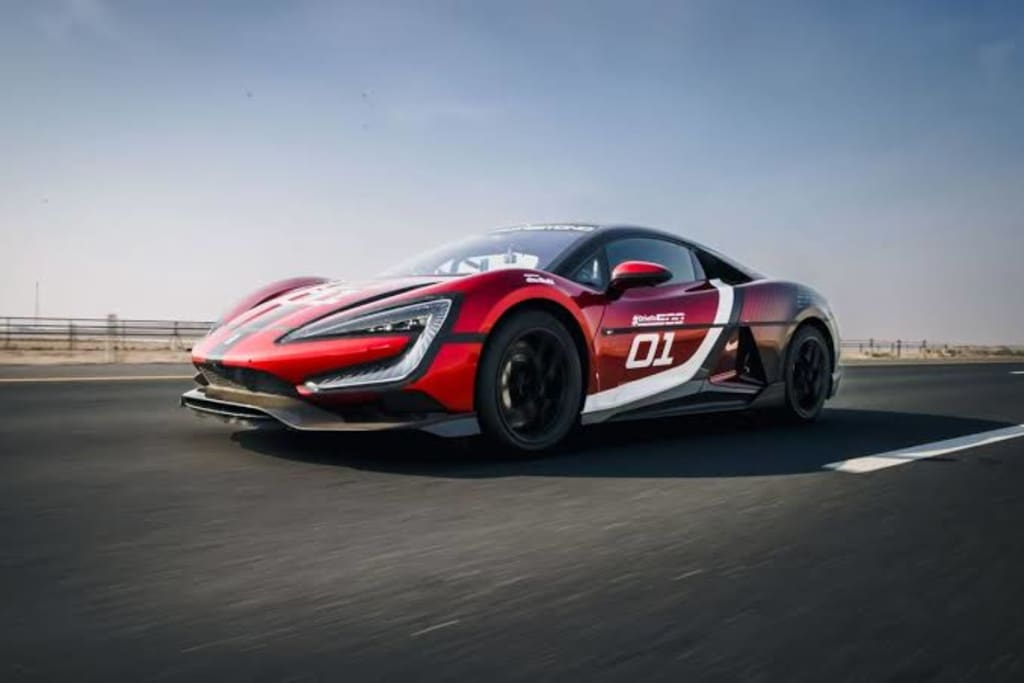
The Yangwang U9 Xtreme ran 503.17 km/h in Abu Dhabi. The setting needs correction first. It did not happen on an open road with traffic. Local authorities closed a 10 km section of the E11, including a 7 km straight. The car was prepared, the surface was inspected, and the run was organized as a record attempt. The conditions still differed from a purpose-built high-speed oval. There was no banking. The surface had ordinary road variation. Heat, dust, and crosswind were present.
The category needs correction second. Guinness awarded the run as the highest speed by a production car in a single-direction run, plus a parallel electric-car category. The phrase to hold onto is single-direction. The 503.17 km/h figure is one pass in one direction. It is not a two-way average.
That distinction changes the comparison. The traditional production-car top-speed record uses two runs in opposite directions on the same road within a set window, usually one hour. The final number is the average. The rule reduces help from wind, gradient, or surface conditions. In that frame, the cited reference is the SSC Tuatara’s 455.3 km/h average in 2021: 450.1 km/h one way, 460.4 km/h the other, within an hour at the Kennedy Space Center. The Koenigsegg Agera RS held a two-way average record at 447.19 km/h. Bugatti’s Chiron Super Sport 300+ ran 490.484 km/h in 2019 with TUV verification and independent observers. Guinness did not accept it under the traditional fastest-production-car wording because it was a single-direction run. Bugatti said the Ehra-Lessien surface had directional characteristics and a reverse high-speed run carried risk.
So the 503.17 km/h figure has a specific place. It is the fastest single-direction run in this production-car category. It moves past the earlier 496.22 km/h U9 run. It is fair to say the U9 Xtreme is the first production car to pass 500 km/h in a single-direction run under this Guinness category. It is not fair to drop the qualifier and call it the fastest production car outright. On the two-way average ruler, 455.3 km/h remains a separate reference. Yangwang has not published a two-way average for this run. The FIA verification in the announcement does not change the category wording Guinness used.
The word production needs the same reading. Yangwang says the U9 Xtreme is a limited model, 30 units worldwide, priced above RMB 20 million, with customer configuration and production scheduling under way. That is more than a one-off prototype. A buyer can order it in a defined limited series.
The record car was not the standard U9. Top Gear described it as a heavily modified version of the standard 1,252 bhp U9. The record car’s combined output is quoted at 3,019 hp, with four motors and a 1,200 V platform. Autoblog/Yahoo noted the car ran on custom semi-slick tires developed with Giti. The same report said it was unclear whether customer cars would receive those tires. That tire point matters. At 500 km/h, the tire is one of the tightest limits in the system.
Hagerty’s account of why Bugatti’s 304.77 mph Chiron run was not accepted under the traditional Guinness production-car record is useful. The car was a pre-production vehicle with a roll cage and different seats, and customers could not buy the same specification. Yangwang’s 30-unit limit is closer to the buyable end. The gap between the record car and the customer car still needs answers on tires, chassis settings, safety equipment, and aero configuration. Without those answers, production car is a category label with a visible seam.
The engineering side still deserves attention. The E11 section had no banking. The team’s first day produced a best run of about 490 km/h. Overnight, the rear wing angle was changed to add rear-axle downforce. The suspension software’s rebound damping was revised for the road surface. Tire pressures were reset. On the second day, the second run produced 503.17 km/h. The car did not arrive and simply run the number. It was tuned against a road that was not a test oval.
The powertrain question is not peak horsepower. It is whether the battery and motors can deliver enough power for a 500 km/h pass without falling into thermal protection. The U9 Xtreme’s 30C track-oriented blade battery is quoted as holding about 2,400 hp at 20% state of charge. A 500 km/h run lasts less than two minutes. The heat load and discharge rate in that window are outside any civilian use. Doing it in Abu Dhabi heat is a thermal-management test.
The tire is the component with the least margin. The GitiSport e.GTR 2 PRO semi-slick was described as able to withstand 500 km/h, with aramid-fiber reinforcement to control centrifugal growth. The car ran 503.17 km/h. That is a small overrun past the stated 500 km/h boundary, and it worked. It also shows how little margin exists at that end. The record was not set with a tire certified to 503 km/h and a comfortable reserve. It was set by running slightly past the tire’s quoted 500 km/h capability without failure. That is an engineering result. It also shows that the tire, not the horsepower figure, is the binding constraint.
One more detail belongs here. Shortly before this run, a U9 Xtreme crashed at about 280 mph, roughly 450 km/h, during high-speed testing. The driver was not seriously injured. The car was heavily damaged. A 500 km/h pass is not a routine event that follows from a power figure. It depends on power delivery, heat management, aero stability, suspension behavior, tire integrity, and road surface all holding at the same time.
Read with its category attached, the 503.17 km/h run is a documented result: a closed public road, a single-direction production-car record, a car that needed overnight setup changes after a 490 km/h first day, and a tire taken slightly past its quoted 500 km/h limit. Read without the category, it becomes a larger claim than the paperwork supports. The two-way average benchmark remains 455.3 km/h. The customer-car tire question remains open. The record car remains a heavily modified limited-build machine.
For now, the number belongs next to its qualifiers: single-direction, production car, closed public road, 500 km/h-rated tires, 30 units. Remove one of them, and the sentence changes.
About the Creator
Jin
Writer of reamstories
https://reamstories.com/jin
Enjoyed the story? Support the Creator.
Subscribe for free to receive all their stories in your feed. You could also become a paid subscriber, letting them know you appreciate their work.
Comments
There are no comments for this story
Be the first to respond and start the conversation.