
The $3.8 Billion Fight Over a Dashboard Knob
Tesla, BMW, and Rivian removed AM radio. Congress wants it back. In a blackout, it is the only signal that survives.
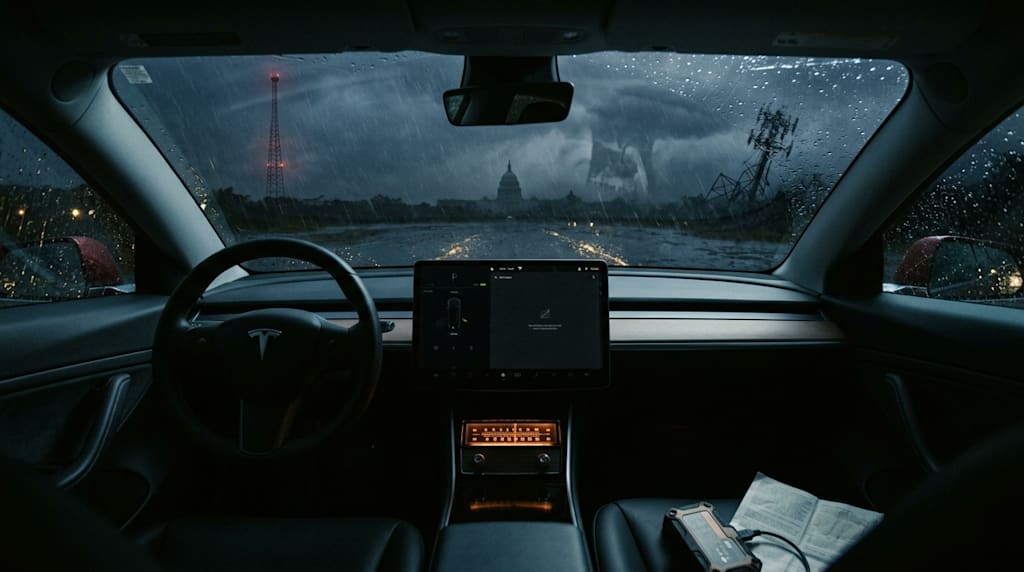
The Lifeline on the Steering Wheel: A Legislative Battle Over AM Radio
1. Asheville at Three in the Morning
At three in the morning on September 27, 2024, in Asheville, North Carolina, Tropical Storm Helene tore open the city’s communications lifeline.
Cell signals dropped to zero. The internet went down. Fiber-optic cables were severed by mudslides, and nearly 200 base stations went out of service because of power and cable outages. Dozens of villages lost contact with the outside world.
But WWNC’s AM frequency was still on the air.
The transmitter site’s backup diesel generator hummed. The announcer’s voice cut through the rain into every car whose dashboard lights were still glowing. Some people parked on overpasses, turned the radio volume to maximum, and cracked a window. Rain poured in. No one cared. The broadcast said: Do not approach tunnel entrances. The broadcast said: The underground garage of the city hospital is flooded.
During those 72 hours, WWNC’s instantaneous listening peak was 19 times its usual level.
Not 19 percent. Nineteen times.
Asheville was not an isolated case. On the night of July 20, 2021, when Zhengzhou Metro Line 5 was flooded, in a taxi parked on an overpass, the radio became the only channel through which many people heard the words “Do not approach tunnel entrances.” The local emergency broadcasting center later reviewed the incident: the instantaneous listening peak on the AM channel was 19 times the usual level.
Two different years, two different disasters, two different countries, the same number.
This is no coincidence. AM radio’s physical properties determine its role in extreme scenarios. Medium-wave signals can travel over a thousand kilometers. Transmitter sites have backup generators that can keep broadcasting for days. The system does not rely on cellular networks or a power supply. A few batteries and a radio are enough to keep it working.
On September 15, 2026, the U.S. House of Representatives passed the AM Radio for Every Vehicle Act by voice vote. The bill requires all new passenger cars, trucks, and SUVs manufactured, sold, or imported in the United States to be equipped with AM radio at the factory. It prohibits automakers from charging consumers an extra fee for it. The Senate version has 61 cosponsors, crossing the 60-vote threshold needed to overcome a filibuster. Senate Commerce Committee Chairman Cruz has clearly stated his support.
The bill is backed by a coalition of 125 organizations. The National Emergency Management Association. The American Farm Bureau Federation. AARP. The International Association of Fire Chiefs. SAG-AFTRA. The National Association of Black Owned Broadcasters.
From firefighters to farmers, from seniors’ advocacy groups to actors’ unions. Interest groups that usually talk past one another have come together on AM radio.
On the other side stand almost all mainstream automakers.
2. A Missing Knob on Tesla’s Dashboard
The base versions of Tesla’s Model 3 and Model Y have no AM receiver. Rivian’s new R2 SUV eliminated both FM and AM receivers. Some new BMW and Volvo models have also removed AM functionality.
Ford had planned to follow suit on the Mustang Mach-E and F-150 Lightning but reversed the decision after policy pressure.
Automakers’ first reason is technical. Electric vehicles’ motors, inverters, and high-voltage cables generate broadband electromagnetic noise during operation, and the frequencies fall exactly within the AM broadcast band. Conventional gasoline vehicles also produce electromagnetic interference, but the interference from an EV’s high-voltage electrical system is more pronounced. It causes obvious static and hissing on AM broadcasts and, in severe cases, completely drowns out the programming.
Solutions exist. Adding electromagnetic shielding to high-voltage cables costs about $35 to $50 per vehicle. Adding filtering equipment costs another $15 to $20. That adds up to $50 to $70 in manufacturing cost per EV. A 2023 industry study by the Center for Automotive Research estimated that the industry would need to spend about $3.8 billion to solve the interference problem.
A 2025 study published in IEEE proposed a tunable notch filter design that targets the 540 to 700 kHz range, where interference in the AM band is most pronounced. It can achieve attenuation of up to 60 decibels. Compared with low-pass filters, it has the advantages of lower cost and a more compact size. But such solutions still need time to move from the lab to mass production.
The Congressional Budget Office did not adopt the industry data. It considered the conclusion of a “$70 cost increase” unreasonable and likely exaggerated.
Automakers’ firm removal of AM radios may stem from more than technical difficulty. Business logic also plays a role. John Bozzella, president of the Alliance for Automotive Innovation, which represents automakers, said bluntly: “Unlike airbags and seat belts, AM radio does not contribute to motor vehicle safety.”
In automakers’ view, streaming media, satellite radio, and smartphone alerts already provide sufficient channels for obtaining information. Mandating a technology that many consumers rarely use is unreasonable.
3. A Cross-Partisan Coalition
In the United States, political polarization has deepened. Few issues can put Ted Cruz and Ed Markey in the same camp.
The Senate version of the AM radio bill was jointly introduced by Cruz and Democratic Senator Markey. The House Energy and Commerce Committee has included the bill in a bipartisan surface transportation authorization package. In the second quarter of 2026, automakers and “Big Tech” interest groups outspent broadcasters on lobbying. Toyota North America alone reported more than $2 million in quarterly lobbying activity. Tesla disclosed $670,000.
Broadcasters spent less on lobbying than automakers. They redefined the issue’s framing.
The National Association of Broadcasters repackaged AM radio from a “technological nostalgia” issue into a “public safety infrastructure” issue. This framing shift was key to the bill’s bipartisan support. When the coalition of supporters expanded from broadcasters to firefighters, emergency managers, and farmers, opposing the bill became politically difficult.
Curtis LeGeyt, president and CEO of the National Association of Broadcasters, said: “No matter how our technology continues to evolve, one fact has never changed: if there is no cellular network and no electricity, broadcast radio is your lifeline.”
During a July 2026 event on Capitol Hill, the National Association of Broadcasters explicitly mentioned that the bill “has President Trump’s support.” Broadcasters from 31 states, together with AARP, the International Association of Fire Chiefs, and local emergency managers, went to Capitol Hill to deliver a simple message to lawmakers: it is time to pass the AM radio bill.
4. Of 72 PEP Stations, 62 Are AM
AM radio’s role in the U.S. emergency communications system is institutional design.
In 2006, FEMA established the Integrated Public Alert and Warning System under Executive Order 13407. It integrated the Emergency Alert System and other public alert systems. The Emergency Alert System uses a hierarchical distribution structure. Alerts are first transmitted to 72 “Primary Entry Point” stations nationwide. Those stations then relay them to smaller stations.
Of those 72 PEP stations, 62 are AM radio stations. That is 86 percent.
These PEP stations have direct connections to FEMA. They are equipped with backup communications equipment and generators. They have independent emergency studios. They are designed to withstand natural disasters and terrorist attacks. AM stations play a dual role in emergency alerts. They are the initial access point for designated presidential and non-presidential emergency alerts in the EAS broadcast distribution system. They are also one of multiple communications paths for non-presidential emergency alerts.
The AMBER Alert system also relies on AM radio. In 1996, broadcasters in the Dallas-Fort Worth area partnered with local police to create this child abduction alert system. It later expanded into a national program. AMBER Alerts are disseminated to the public through radio, television, and electronic highway signs. They are an important part of the Emergency Alert System.
The United States is vast and sparsely populated in places. Network signals are not good everywhere. About 4,500 AM stations currently operate nationwide. Their signal coverage far exceeds other broadcast formats. For farmers, long-haul truck drivers, and residents of remote areas, AM radio is daily life.
5. Parallel Moves on Both Sides of the Atlantic
In April 2025, China formally initiated a mandatory national standard for Vehicle-Mounted Wireless Broadcast Receiving Systems. The Ministry of Industry and Information Technology and the National Radio and Television Administration jointly promoted it. The Electronics and Electromagnetic Compatibility Subcommittee of the National Technical Committee of Auto Standardization is responsible for implementation.
The standard explicitly defines vehicle-mounted wireless broadcasting as “an important device for the public to quickly and effectively receive authoritative emergency information in sudden emergencies.” It is scheduled to be released in February 2027 and become mandatory in February 2029. Its technical content covers functional, performance, automotive environmental reliability, and electromagnetic compatibility requirements and test methods for terminals and antennas.
The regulatory paths of the two countries are highly similar. This is no coincidence.
After the 2013 magnitude-7.0 Lushan earthquake in Sichuan, China established a small radio broadcasting network in the disaster area. It broadcast emergency information to the affected region via AM frequencies and loudspeakers. It later used that network as the basis for launching a national emergency broadcasting system. During the 2024 super typhoon in Hainan, signals in large areas were completely cut off, yet the AM broadcast system could still transmit voice information.
In extreme disaster scenarios, cellular networks collapse and power is cut. AM radio, because of its signal propagation characteristics and infrastructure resilience, remains the broadest-reaching and most reliable means of information transmission. That judgment does not change across national borders.
6. Who Pays the $3.8 Billion Bill?
Once the bill takes effect, its impact will extend beyond the United States.
Automakers already selling in the United States, whether domestic brands or imported models, will need electromagnetic compatibility modifications. Chinese brands planning to enter the U.S. market will need to include hardware adaptation for AM radio and electromagnetic compatibility testing in engineering budgets. If the industry’s total cost is spread across about 15 million new vehicles a year, the per-vehicle cost increase is about $25 to $30. With testing and certification fees, it is even higher.
The bill also stipulates that automakers may not pass this cost on to consumers. That means automakers will have to absorb this expense themselves, on top of existing cost pressures such as tariffs, exchange rates, and logistics.
The automakers’ opposition is not without merit. Unlike airbags and seat belts, AM radio does not directly contribute to motor vehicle safety. Using legislation to force the retention of a technology naturally displaced by digital streaming does not make sense in business logic.
But supporters’ logic is equally clear. In extreme disaster scenarios, cellular networks collapse and power is cut. AM radio is the only means of information transmission that can cover vast areas, keep working for days, and depend on no external infrastructure. A few batteries can keep an AM radio running for days. No new technology has yet overturned that simple fact.
Satellite communications solutions such as Starlink may in the future be able to take on part of the emergency communications function. But currently very few vehicles come pre-installed with Starlink receivers. Household Starlink use still requires power. Power outages are precisely the most common situation in disasters.
7. That Knob on the Dashboard
The bill has crossed the 60-cosponsor threshold in the Senate to overcome a filibuster. Senate Commerce Committee Chairman Cruz has clearly expressed support. The House Energy and Commerce Committee has included the bill in a bipartisan surface transportation authorization package. The odds of it becoming law are relatively high.
This means that in the future, new cars sold in the U.S. market will once again have an AM knob on the dashboard. For brands such as Tesla and Rivian, which sell themselves on minimalist interiors, this knob is a reminder: at every stage of technological evolution, some bottom lines should not be casually crossed in the name of business efficiency.
While AI calculates the optimal route, AM radio guards the most basic bottom line: if people are still alive, they must be able to hear a voice.
The voice at 3 a.m. in Asheville, the voice on the overpass in Zhengzhou, the voice in the Lushan disaster area. They come from the same technology, the same frequency band, the same logic.
A few batteries. One radio. One knob.
That is all.
About the Creator
Jin
Writer of reamstories
https://reamstories.com/jin
Enjoyed the story? Support the Creator.
Subscribe for free to receive all their stories in your feed. You could also become a paid subscriber, letting them know you appreciate their work.
Comments
There are no comments for this story
Be the first to respond and start the conversation.