
The 1963 Chevy Impala Z11: The First Factory 10-Second Car
How a lightweight, street-legal missile from Chevrolet rewrote the drag racing record books and why GM tried to bury it.

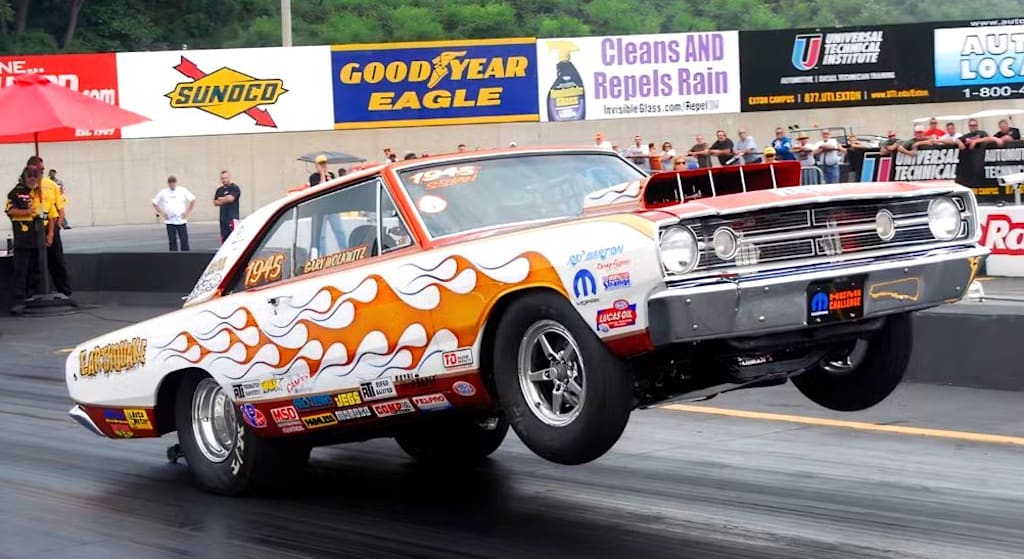
For as long as performance cars have existed, enthusiasts have been obsessed with making them faster. The factory floor rarely prioritized outright speed—that was left to backyard mechanics who wrung every last horsepower from otherwise ordinary machines. This grassroots hunger gave rise to organized racing, because there's really no point in building a faster car if you can't use it to humble the competition. Many of these cars still wore an Oldsmobile or Plymouth badge, but they were stripped of everything that didn't contribute to speed. The moonshiners wanted to see who had the fastest revenue-evading set of wheels, and that eventually became NASCAR. The SoCal hot-rodders settled their disputes on the dry lake beds of the Los Angeles area, which led to the formation of the National Hot Rod Association (NHRA) and professional drag racing. In the early years, race cars were basically cobbled together by drivers or teams, but in the early 1960s, Detroit started offering awesome track-ready cars straight from the factory. Even better, these ungodly powerful cars were technically street legal, and one very special Chevrolet managed to rewrite the record books.
Factory Drag Car Frenzy
Drag racing really started to gain popularity in the early 1960s, but it was still largely a hobby in which drivers were on their own with their cars. Some automakers provided support through high-performance parts or technical advice, but nobody was handing out whole cars that were ready to rock a quarter-mile. That all changed in 1963, when it seemed like everyone was building factory drag cars. Pontiac had the "Swiss Cheese" Catalina Super Duty, followed by the Ford Fairlane Thunderbolt and Mercury Comet A/FX, all of which were posting ETs in the low 12s and high 11s. Mopar started out with the Hemi-powered Coronet A990, but then realized the 426 cubic-inch V8 could do more damage in a compact body and unleashed the '68 Hemi Dart. With few exceptions, all of these extraordinary cars were sold through dealers and, amazingly, were street legal.
The factory drag car phenomenon was a response to the growing demand from enthusiasts who wanted to go racing without having to build their own cars from scratch. Automakers recognized that there was money to be made by catering to this crowd, and they began producing limited runs of purpose-built drag cars that were faster and more capable than anything that had come before. These cars were often stripped of luxury features, fitted with high-performance engines, and equipped with racing transmissions and rear ends. They were the automotive equivalent of a scalpel: sharp, precise, and designed for one purpose only.
Qualified For Street Use
There's a lot of confusion over the term "street legal," with many people assuming it has something to do with how powerful a car is. The reality is that a car needs to meet basic requirements: bumpers, working headlights, tail lights, and turn signals, items that are often deleted in race cars to shed weight. It also needs a VIN, something purpose-built race cars often lack. Every state has different requirements to register a vehicle, but horns, brakes, and mirrors are usually part of the checklist. Most factory drag cars of the 1960s had everything needed for street use, with perhaps the exception of their exhausts or lack thereof, but it's easy enough to bolt a muffler onto a Ford Fairlane 500 R-Code if you wanted to use one as a daily driver.
The fact that these cars were street legal added to their mystique. You could buy a car from a dealership, drive it to the drag strip, run a quarter-mile in the low 12s, and then drive it home. It was the ultimate combination of performance and practicality, and it captured the imagination of a generation of car enthusiasts. Of course, driving a race car on public roads came with its own set of challenges. These cars were loud, rough-riding, and often temperamental, but for those who owned them, the trade-off was worth it.
Voluntary Racing Ban
The Automobile Manufacturers Association (AMA) was a trade group created to promote the common interests of carmakers, but in practice it operated more like an overbearing homeowners' association. In the late 1950s, they convinced all American automakers to agree to withdraw from supporting motorsports and to refrain from building super-powerful passenger cars. While the Big Three signed on to this arrangement, they largely looked the other way as their divisions formed racing teams and cranked out fearsome street machines. In 1963, however, GM decided to formally comply with the AMA's racing ban, but not before the ultimate Chevy could make some history on the drag strip.
The AMA ban was a product of its time. Concerns about safety, liability, and the public image of the automotive industry led the trade group to push for a voluntary cessation of racing activities. The automakers, eager to avoid government regulation, agreed to the ban but they didn't always follow it. Behind the scenes, divisions continued to develop high-performance parts and support racing teams through unofficial channels. The ban was more of a gentleman's agreement than a legally enforceable rule, and it was frequently ignored.
Third-Gen Chevrolet Impala
The Chevy Impala was introduced in 1958 and was produced all the way until 2020, serving roles that ranged from full-size luxury cruiser to compact family sedan. It is one of the all-time best-selling Chevy nameplates and an iconic American car, but its greatest era was the short-lived 1961–1964 third generation. This was the first Impala to shed the dated '50s styling cues in favor of a long, sleek body that was dripping with cool, with acres of real estate on the hood and decklid. The third generation also introduced the SS performance trim, which transformed the Impala from a smooth cruiser into a street bruiser backed by serious big-block V-8 power.
The third-gen Impala's design was a masterpiece of automotive styling. Its clean lines, elegant proportions, and understated chrome accents gave it a timeless appeal that still turns heads today. The SS package added a touch of aggression, with bucket seats, a floor-mounted shifter, and special badging that announced its performance intentions. Under the hood, the Impala SS was available with a range of V-8 engines, from the small-block 327 to the mighty 409, which would become legendary in its own right.
Low-Rider Legend
Nobody could have guessed at the time, but the third-gen Impala which was at the forefront of American performance, would eventually become the slow-rollin' low rider's car of choice. There are plenty of classics that have gotten the hydraulic hop treatment, but nothing beats a '61 to '64 Impala cruising down the avenue. The reason low rider culture was so drawn to the third-gen Impala is straightforward: Chevy built them in enormous numbers, and they have traditionally been affordable, leaving plenty of budget for customization. Later on, hip-hop artists gravitated toward the third-gen Impala low rider—specifically the '64 — and the best explanation anyone has offered is that it's remarkably easy to rhyme with "six-four" or "six-foe."
The third-gen Impala's transformation from performance icon to low rider legend is one of the great ironies of automotive culture. The same car that was once the king of the drag strip became the king of the boulevard, embodying a different kind of cool. It's a testament to the versatility of the design and the enduring appeal of the Impala nameplate.
The Fabulously Ferocious 409
Long before War's 1975 hit "Low Rider" celebrated the chill cruising culture, the Beach Boys touted the Impala's street cred with their 1962 song "409." Released as the B-side to "Surfin' Safari", the tune was a shout-out to the Chevy 409ci V-8, which was the standard engine for the 1962 Impala SS. Producing 409 horsepower, the Chevy big-block was one of the most powerful engines ever fitted to a passenger car up to that point but the Beach Boys should have held off a year, because the engine was about to get even wilder. A 1963 dual-quad variant of the 409 pumped out 425 horsepower and 425 pound-feet of torque, making for one of the few 13-second full-sized cars of the Golden Age.
The 409 engine became a cultural phenomenon in its own right. The Beach Boys' song immortalized it in the popular imagination, and the engine's reputation for raw power and brutal acceleration made it a favorite among drag racers and street racers alike. It was the kind of engine that demanded respect, and it earned it.
The Heavyweight 1963 Chevrolet Impala Z11 Lightweight
Also in '63, Chevy built a factory drag car that made the Impala SS 409 look like it was standing still. The car, known as the Impala Z11, was perhaps the result of Chevy knowing that GM was about to shut down high-performance development across its divisions, a last great hurrah before the corporate hammer came down. The Z11 was a lightweight race car designed for the drag strip and NASCAR, but it was completely street legal, if not exactly a practical daily driver. Unlike most factory drag cars that stripped out nearly everything unrelated to speed, the Z11 shipped with a full interior and, curiously, bench front seats.
The Z11 went on a diet courtesy of aluminum fenders, body panels, and bumpers, shaving roughly 400 pounds off a standard Impala's curb weight. That unconventional sheet metal is also why it wasn't the world's greatest grocery-getter it dented easily, and some drivers even painted warnings on the exterior telling people to keep their hands off. Completing the Z11 package was a 427 cubic-inch dual-quad V8 conservatively rated at 430 horsepower and 575 pound-feet of torque. It represented the greatest power-to-weight ratio of any production car up to that point. Approximately 50 Z11s were built, and perhaps a dozen still exist, making it a true Chevy Holy Grail.
The Z11 was a car built with a single purpose: to dominate the drag strip. Everything else was secondary. The lightweight body, the powerful engine, the racing suspension all of it was designed to get the car down the quarter-mile as quickly as possible. And it succeeded. The Z11 was one of the fastest cars of its era, and it earned a place in the pantheon of automotive legends.
First Factory 10-Second Car
There's a misconception that the Z11's 427 was a Corvette engine, but the C2 wouldn't receive a big-block of that displacement until 1966. The Z11's engine was a 409 cubic-inch V8 that had been stroked out to 427 cubic inches. It also featured a high-rise aluminum intake manifold, dual Carter AFB carbs, and a 13.5:1 compression ratio making it the most potent engine of its day. Fast drag car passes in '63 were of the 12- and 11-second variety, but the Z11 pushed into the 10s. Though no official timed test runs or drag strip receipts exist for the '63 Impala Z11, the car is widely reported to have covered a quarter-mile in 10.8 seconds, and there's no compelling reason to doubt it. With that, the Impala Z11 became the first factory car to break into the 10s a milestone that deserves its own place in motorsport history.
The achievement was remarkable not just for its speed but for the context in which it occurred. In 1963, a 10-second quarter-mile was the stuff of legend. It was a time when most production cars were struggling to break into the 15s, and even the fastest factory cars were in the 12s. The Z11's performance was a testament to the ingenuity of Chevrolet's engineers and the determination of the company to go out with a bang.
Street Use is Heavily Discouraged
While the '63 Impala Z11 was technically street legal, just because you can do something doesn't always mean you should. Chevy never intended these rocket cars to be used on public roads, but they built them so they could be, and they were ordered mostly through dealerships, so there's a near certainty that at least a few of them raised some hell locally. Most of the Z11s that have appeared at auction are known race cars and presented as such, but the black example pictured above looks as though it may have been someone's pink-slip collector back in the day. The Mecum Kissimmee 2017 listing notes several drivers who owned this car, but the complete absence of sponsorship graphics on the exterior suggests it wasn't always a dedicated track monster. That car sold for $340,000—a relative bargain, given that clean Z11s are considered half-million-dollar cars.
The Z11 was a car that demanded respect. Its immense power and lightweight construction made it a handful to drive, and only the most skilled drivers could extract its full potential. But for those who could, it was an experience like no other.
Impala Z11 Had GM Rethinking Street Performance
GM was actually less than pleased with the Chevy Impala Z11 as well as the '63 Pontiac Catalina Super Duty drag car. They didn't like the idea of cars that powerful and were undoubtedly worried about the liability of selling such machines to the general public, where inexperienced drivers could easily hurt themselves or others. In one of the stranger moments in automotive history, GM sent cease-and-desist letters to both Chevrolet and Pontiac, demanding they halt production of their factory drag cars immediately. Rumor has it that Pontiac still had a few "Swiss Cheese" cars in the pipeline and finished them even after GM's order came down.
GM's reaction to the Z11 was a reflection of the times. The company was worried about its public image and the potential for lawsuits if someone were to be injured in one of these cars. It was also concerned about the impact of the AMA ban and the possibility of government regulation. In the end, the decision to shut down the high-performance programs was a calculated move to protect the company's interests.
Involuntary Big Engine Ban
GM had agreed to step back from motorsports under AMA pressure, but was well aware that its divisions were neck-deep in racing. In 1963, GM decided to enforce this legally non-binding agreement and put a stop to any racing support or development. Part of this corporate edict included banning its divisions from fitting engines displacing more than 400 cubic inches in intermediate-sized or smaller cars. Muscle car mania exploded the following year, and a full-blown horsepower war broke out, but Buick, Chevy, Olds, and Pontiac were all handcuffed by GM's big-engine ban. That arbitrary restriction effectively handed the Golden Age of muscle to Mopar, whose 426 Hemis and 440 Six-Pack cars were nearly unbeatable, all thanks to a self-imposed GM rule.
The big-engine ban was a turning point in automotive history. It prevented GM from competing in the muscle car wars of the late 1960s and early 1970s, allowing Mopar and Ford to dominate the performance scene. It was a decision that GM would come to regret, as it ceded market share to its rivals and lost its reputation as a performance leader. The ban was finally lifted in the early 1970s, but by then, the damage had been done.
The Legacy of the Z11
The 1963 Chevrolet Impala Z11 remains one of the most significant cars in American automotive history. It was the first factory car to break into the 10-second quarter-mile, a milestone that redefined what was possible in drag racing. It was also one of the last cars of its kind, built at a time when the industry was about to pull back from the pursuit of performance.
Today, the Z11 is a sought-after collector car, with values reaching into the hundreds of thousands of dollars. Its legacy lives on in the world of muscle cars and drag racing, where it is remembered as a true pioneer. And while GM may have tried to bury it, the Z11's place in history is secure.
About the Creator
Mark Lim
Hi I am mark an automotive student and a car, tech and food enthusiast ! Im gonna try and post daily & hope you enjoy what I write and do share my page with people you know. I would gladly appreciate it! Cheers
Enjoyed the story? Support the Creator.
Subscribe for free to receive all their stories in your feed.
Comments
There are no comments for this story
Be the first to respond and start the conversation.