
The 1.7x Repair Bill: Why Electric Cars Are Cheap to Drive and Expensive to Crash
A single broken clip can total a car. Here is why EV repairs cost so much, how insurance and resale turn fuel savings into a trap, and how to calculate your real cost.
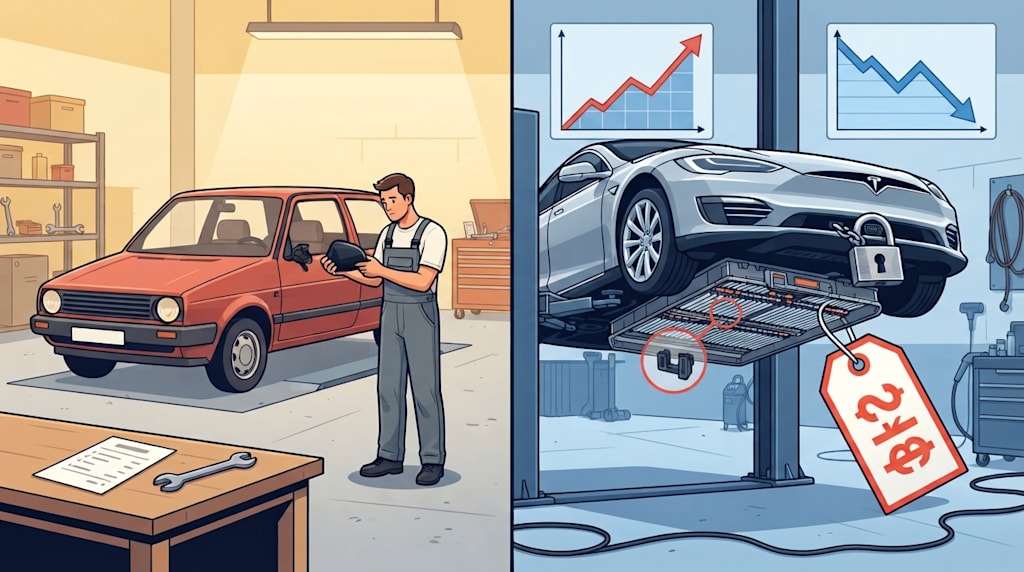
A driver backs into a pillar. The side mirror cracks. In a gasoline car, a body shop orders a replacement shell, maybe a motor, and returns the car in a day or two. In an electric car, the mirror is a module. It handles power adjustment, folding, heating, and blind-spot monitoring. The shop says the whole unit must be replaced. The part has to be shipped from another city. The bill: 5,700 yuan. The wait: nearly a week.
Now consider the battery pack. A new owner scrapes the underside. One plastic clip on the battery housing breaks. The clip is molded into the pack. The manufacturer says it cannot be repaired separately. The whole pack must be replaced. Quote: 130,000 yuan. The car cost about half that. The insurer refuses to pay for the pack alone. The car is totaled. The owner loses the window tint and other add-ons, nearly 10,000 yuan. A clip. A whole car.
These cases are not rare. They follow from how electric cars are built and how they are serviced.
J.D. Power’s 2026 China New Energy Vehicle After-Sales Service Satisfaction Study puts the average repair cost for an EV accident at 1.7 times that of a gasoline car. The China Automotive Maintenance and Repair Association gives a range of 1.6 to 2.3 times. After a serious crash, some EVs cost almost as much to repair as to replace.
EVs are expensive to fix. They are also increasingly impossible to fix in the way gasoline cars are fixed.
Integration by design, replacement by default
For the past decade, EV makers have raced to integrate parts. The goal is lower manufacturing cost, faster assembly, stronger structures. The methods are now familiar.
Gigacasting, popularized by Tesla, turns dozens or even hundreds of welded parts into a single large casting.
Cell-to-pack batteries remove modules and stack cells directly into the pack, often bonded with structural adhesive.
Multi-in-one electric drive units combine the motor, gearbox, inverter, onboard charger, DC-DC converter, power distribution unit, vehicle controller, and battery management system into one assembly.
These designs save the manufacturer money. They also remove the possibility of local repair.
In a traditional gasoline car, a damaged fender can be cut, welded, or replaced. A battery module can be opened, a single cell swapped. In many new EVs, there is no module to swap. The cells are glued together. The pack lid may be bonded to the cells. A single bad cell means a new pack. A broken clip means a new pack. A cracked mirror means a new module.
The numbers show the result. According to CIRI, the average zero-ratio for a pure electric vehicle’s power battery, meaning the cost of the battery as a share of the car’s price, is about 44% to 50%. Replacing the battery alone costs nearly half the car. For a 150,000-yuan EV, that is 66,000 to 75,000 yuan. For some models, it is more.
The manufacturer saves on the line. The owner pays at the shop.
The service bay is locked
If the only problem were design, a competitive aftermarket could still offer cheaper repairs. But the aftermarket is locked out.
EV makers use three tools to keep repairs inside their own network.
Encrypted three-electric systems. The battery, motor, and electronic control units run encrypted software. Independent shops may get a part, but they cannot match it, calibrate it, or flash the firmware.
Warranty conditions. Most brands offer a lifetime warranty on the three-electric system, but only if every service and repair is done at an authorized dealer. One outside repair voids the warranty.
Diagnostic protocols. The data needed to diagnose and repair is not published. Without it, a third-party shop is guessing.
The result is a closed loop. China has about 400,000 auto repair shops. Only 2% have full capability to repair the three-electric system. Independent shops handle just 8% of EV repairs. More than 90% of repair work goes through brand-authorized channels. The number of EV repair businesses is only 20,000 to 30,000. The share with full three-electric capability is 2% to 3%. The industry lacks more than 800,000 qualified service technicians. High-end technicians who can read three-electric data and fix faults are scarce.
J.D. Power found a painful contrast. When an accident happens, owners who call the brand’s 400 hotline first give the highest satisfaction score: 744. But the net promoter score for that same channel is -10.5. The hotline answers politely. It does not solve the problem. It cannot speed up the damage assessment, deliver the part, or finish the repair. The owner hangs up and still waits.
Even though automakers now proactively contact 49.2% of owners after an accident, 42.2% of owners still call their insurance company first. In the moment that matters most, the brand is not the first call.
The industry is also cutting service to cut costs. J.D. Power’s data shows that 88% of accidents are small: under 10,000 yuan. These are scratches, dents, cracked bumpers. They are the moments when a brand could build loyalty. Instead, owners complain about slow assessments, long part waits, and endless communication. In the first half of 2026, the average after-sales service capability score across EV brands was 78.33, down 1.41 points from the second half of 2025. Service quality is sliding.
What the car costs
“EVs save money” is not wrong. It is incomplete. The sticker price and the electricity bill are only two lines in the ledger. Three other lines matter just as much: insurance, repair risk, and depreciation.
Electricity: cheap, but only with a home charger
With a home charger and off-peak rates, an EV can cost about 5 yuan per 100 kilometers. A gasoline car costs about 60 yuan per 100 kilometers. Over 15,000 kilometers a year, that is 750 yuan versus 9,000 yuan. The EV saves more than 8,000 yuan a year.
Without a home charger, public fast charging can push the cost to 25 yuan per 100 kilometers. The gap shrinks. The home charger is the first dividing line.
Insurance: the hidden bill
At the same price point, a pure EV’s annual premium is typically 20% to 30% higher than a gasoline car’s. The difference can be several hundred to more than a thousand yuan a year. Over six years, that is close to 10,000 yuan.
In 2025, China’s EV insurance market lost 56 billion yuan. The loss ratio for 143 vehicle series exceeded 100%. Insurers are losing money because claims are too expensive. The root cause is repair cost. When one accident costs more to fix, insurers raise premiums and tighten underwriting. The repair bill does not disappear. It comes back through insurance and resale value.
Depreciation: the gap is narrowing, but the absolute loss remains
The three-year residual value for gasoline cars fell from 67.6% in 2023 to 46.07%. For pure EVs, it is 44.5%. The gap is now about 1.27 percentage points. But in absolute terms, a three-year-old EV is worth less than half its original price.
Take a 150,000-yuan car. After six years, a gasoline model might sell for 60,000 yuan. An EV might sell for 30,000 to 45,000 yuan. The difference is 15,000 to 30,000 yuan.
A rough six-year calculation
Fuel: gasoline about 54,000 yuan; EV about 4,500 yuan. Savings: about 49,500 yuan.
Maintenance: gasoline about 10,000 yuan; EV about 3,000 yuan. Savings: about 7,000 yuan.
Insurance: EV pays 1,000 to 2,000 yuan more per year. Extra cost: 6,000 to 12,000 yuan.
Resale: EV sells for about 20,000 yuan less.
Net result with a home charger and high mileage: the EV may still save 20,000 to 30,000 yuan over six years.
Net result without a home charger, with low mileage, or with a short ownership period: the savings can disappear. One accident can raise the next year’s premium enough to wipe out a year of fuel savings. Two accidents can lead to a refused policy.
The question is not whether EVs are cheaper. The question is whether you have a home charger, how many kilometers you drive a year, how long you will keep the car, and whether you can absorb a premium spike and a lower resale value after one accident.
The rules are changing, slowly
The policy response has begun. In June 2026, the Ministry of Commerce and nine other departments issued a notice on boosting the auto aftermarket. It tells automakers and battery makers to open repair technology authorization. It also pushes “repair instead of replace.” It bars brands from voiding warranties simply because an owner chose an independent repair shop.
Some companies are moving. CATL’s Ningjia Service has raised its repairable model coverage to 76.8%. With repair-instead-of-replace, many battery packs no longer need full replacement. The cost can drop by more than 70%. Battery-swap insurance models are being tested. If they launch, commercial premiums for consumers could fall by 15% to 30%.
CIRI’s 21st zero-ratio study shows progress. The NEV “repair burden 100 index” fell to 23.81, down 13.92% from the previous period. That is one of the largest drops in years. The unit price of power batteries fell to 1,359.44 yuan per kilowatt-hour, down 179.39 yuan. Cheaper batteries directly lower repair and claim costs.
But the overall zero-ratio is still high. The NEV “zero-ratio 100 index” is 311.42%. The total price of all parts is still more than three times the car’s price. And the pressure is shifting from batteries to smart hardware. Front headlights have an average zero-ratio of 2.50%. Exterior lights average 9.74%. For some models, a single headlight costs 7.82% of the car’s price. Lidar, cameras, and integrated bumpers are becoming the new pain points.
The structural conflict remains: cheap to buy, expensive to crash.
What to do with this
An EV can be a good purchase. It is a different purchase. The calculation depends on your life, not the brochure.
If you have a fixed home charger, drive more than 15,000 kilometers a year, plan to keep the car for six years or more, and rarely take long highway trips, an EV can save thousands. The fuel and maintenance savings can outweigh the insurance and depreciation penalties.
If you have no home charger, drive less than 10,000 kilometers a year, plan to sell in three to five years, or cannot handle a premium jump after one accident, think carefully. The fuel savings may be smaller than the insurance and resale losses. A single crash can turn the ledger red.
A practical test: add the price difference between the EV and a comparable gasoline car, the estimated six-year insurance difference, and the estimated six-year resale difference. Divide that by the estimated six-year fuel savings. That gives you a payback period. If the payback period is longer than the years you plan to keep the car, the EV is not saving you money.
The electric car saves fuel. It does not always save money. The difference is written in the repair bill, the insurance premium, and the resale price. Read those lines before you sign.
About the Creator
Jin
Writer of reamstories
https://reamstories.com/jin
Enjoyed the story? Support the Creator.
Subscribe for free to receive all their stories in your feed. You could also become a paid subscriber, letting them know you appreciate their work.
Comments
There are no comments for this story
Be the first to respond and start the conversation.