
Tesla's Roadster Flip Uses Two Separate Tricks
Underbody suction holds the car to the C-ramp. Cold-gas thrusters roll it in the air. The gas budget explains why the maneuver lasts seconds.
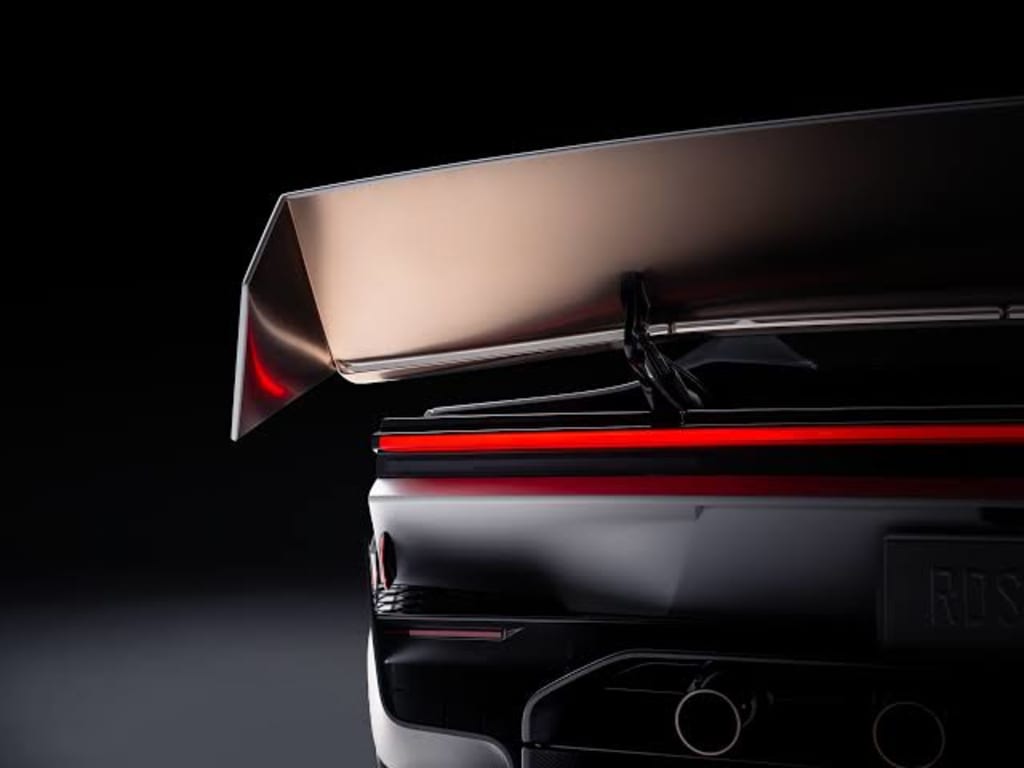
Two clips released the same day show different maneuvers. In the official C-shaped ramp clip, the car runs up a large curved wall, reaches a near-inverted attitude near the top, leaves the surface, rotates roughly half a turn in the air, and lands on four wheels after a burst of white gas from the underbody. In the five-car jump clip posted by Elon Musk, the car launches forward and upward, clears a row of vehicles including a Semi, rolls nearly a full turn sideways, and fires downward jets before touchdown.
The two maneuvers use different mechanisms in different phases. On the ramp, the car holds itself against the wall with an underbody low-pressure system. In the air, it controls attitude with high-pressure cold-gas thrusters. The C-shaped ramp supplies pitch. It does not supply roll. The roll in both clips has to come from the car itself.
On the C-shaped wall: pressure differential, not speed
A conventional sports car generates downforce with wings, a diffuser, and bodywork that depend on airspeed. That approach fades at low speed, and it does not explain a car holding a near-inverted attitude on a curved wall.
According to Tesla's Roadster page and the demonstration footage, the new Roadster uses a multi-mode fan system with an underbody seal. The fan draws air out of the volume between the floor and the surface, lowering pressure under the car. Normal atmospheric pressure remains above the car. The difference multiplied by the floor area produces a force pressing the car toward the wall.
This force does not depend on vehicle speed. A standard atmosphere is about 100 kPa, roughly 10 tonnes per square metre. If the underbody pressure is only 20 percent below ambient, a floor area of two to three square metres still yields several tonnes of downforce. The seal limits how quickly outside air can rush back in. The fan keeps removing air. The car can be held against the surface at low speed or at a standstill.
In the C-shaped ramp clip, the car's body pitches backward as the wall curves overhead. The ramp geometry produces that pitch. The ramp does not produce left-right roll. Once the car leaves the wall, the underbody low-pressure region is exposed to open air and collapses. The suction phase ends.
In the air: cold-gas thrusters and torque
The midair rotation comes from a carbon-fiber-wrapped pressure vessel, or COPV, and a set of cold-gas nozzles around the body. A valve opens. High-pressure gas exits at speed. The car receives a reaction force in the opposite direction.
Where that force points relative to the centre of mass determines the motion. If underbody nozzles fire straight down and their combined thrust passes through the centre of mass, the car rises or decelerates without being tipped. If a nozzle is offset from the centre of mass, the thrust has a moment arm and produces a torque.
A single offset nozzle both rotates the car and pushes it sideways. To produce roll without a large sideways push, nozzles on opposite sides can fire in opposite directions. For example, the left side fires downward to push the left body upward, while the right side fires upward to push the right body downward. If the forces are equal, the vertical components cancel and the remaining effect is a pure torque, a force couple that rolls the body.
This is close to the reaction-control logic used on the Harrier. NASA's study of the YAV-8B describes how, at low speed or in hover, the aircraft bleeds high-pressure air from the engine compressor to small nozzles at the nose, tail, and wingtips. The long moment arms allow pitch and roll control when the wing surfaces have little airflow. The Roadster has no jet engine to bleed, so it carries stored high-pressure gas and vents it directly. The valve response is fast, and the exhaust is cold, which suits rapid switching within a few seconds.
The C-shaped ramp can pitch the car backward. It cannot roll the car left or right. The midair roll in both clips is produced by offset thrust and paired nozzles.
Starting the roll and stopping it
Once the car is rotating, it has angular momentum. It will not stop with the wheels down just because it has reached that attitude. It will keep rolling unless a reverse torque removes the angular momentum. The thrusters that start the roll must be followed by thrusters that arrest it.
Spin-up uses gas. Spin-stop uses gas. In the five-car jump, the airborne phase lasts only a few seconds. A full roll in about one second means peak rotation rates of hundreds of degrees per second. In tens of milliseconds the body turns through a visible angle. Tesla's Roadster page states that the cold-gas thrusters use all-electric actuators with sub-second response for rapid attitude corrections. That response time matters because the sequence of launch, spin-up, spin-stop, and landing cushion has narrow windows.
After the body is upright and the rotation is arrested, the car is still falling. Both clips show a downward jet and dust just before wheel contact. The jet provides upward thrust to reduce descent speed before touchdown. It also makes the final control input visible.
The landing cushion needs a large thrust. A simplified example: treat the car as a point mass, ignore air drag and the mass of expelled gas, and let it fall from rest at 20 m. The first 15 m are free fall. The last 5 m use constant downward jet thrust until the car stops at the ground. The required upward thrust is about four times the car's weight. One part cancels gravity, and three parts remove the downward speed accumulated over the first 15 m. If the jet starts closer to the ground, the stopping distance is shorter and the required thrust is higher.
The gas budget: a short controlled hop, not cruise
Reported figures from the demonstration car put the tank at about 600 litres, holding about 250 kg of compressed air, with 10 nozzles and more than 80 kN of total thrust. Tesla has not published the orientation of each nozzle or how much of that 80 kN can be directed vertically.
A rough check: if all 250 kg is usable and the cold-gas specific impulse is about 60 seconds, total impulse is around 150 kN·s. At a constant 80 kN, continuous full-thrust firing lasts less than two seconds. The car can coast between burns, and launch, roll, and landing do not require full thrust throughout. That calculated time is not the airborne time. But launch, spin-up, spin-stop, and landing cushion draw from the same tank. The system must reserve enough gas for the final deceleration.
Cold gas gives fast valve response and no hot exhaust. Its specific impulse is low. The tank supports short jumps, not sustained hover or cruise. After the gas is spent, the tank must be recharged.
Version boundaries
Tesla's published three-version configuration and the Roadster site separate the hardware. The dual-seat Performance version has active aerodynamics and underbody suction. The dual-seat Thrust version adds rear cold-gas thrusters. Only the single-seat Rocket version, available by invitation, has the body-perimeter cold-gas nozzles for upward acceleration and rotation. The Roadster site places a note under the Rocket version: "Not approved for public road use."
The note limits the system to demonstration use. The perimeter cold-gas system is not a standard road feature across the line. The clips show low-altitude attitude control, not a road function.
The videos show external motion only. Tesla has not released full telemetry. Two data points would clarify the system's margin. First, how much pressure remains in the tank at wheel contact. That number would show how much gas the sequence consumes and how much reserve remains. Second, how the 10 nozzles are arranged and how thrust is split between launch and roll torque. That layout would show how many control degrees of freedom the car has during the few seconds between leaving the ramp and touching down.
About the Creator
Jin
Writer of reamstories
https://reamstories.com/jin
Enjoyed the story? Support the Creator.
Subscribe for free to receive all their stories in your feed. You could also become a paid subscriber, letting them know you appreciate their work.
Comments
There are no comments for this story
Be the first to respond and start the conversation.