
Tesla’s Profit Got Cut in Half. Musk Is Still Betting on Tomorrow.
The car business is making more money. The company is making less. That gap explains why Wall Street and Musk keep talking past each other.
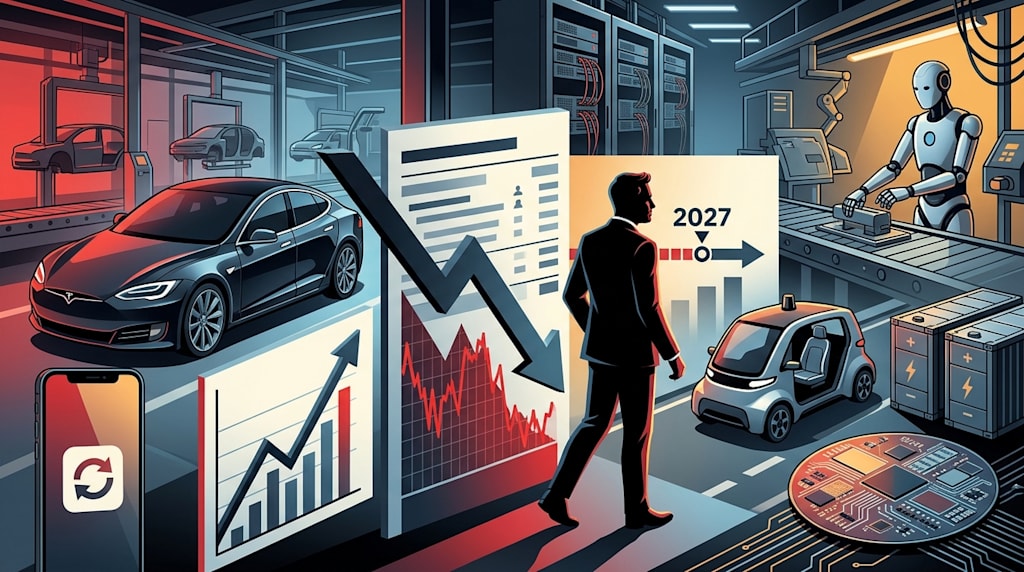
Tesla’s latest earnings report puts the Musk contradiction back on the table.
The car business is healing. Gross margin is up, the order backlog is the highest in four years, and FSD paid users grew by 700,000 in a year. The company’s operating profit fell 56%. Operating margin dropped to 2.6%. More than $68 billion in market value vanished overnight, roughly the market cap of General Motors.
Read the income statement and the market’s frown makes sense. Listen to Musk on the earnings call and the company sounds like it is making a new bet: Cybercab is running in Robotaxi service, Optimus has started production, Terafab could cost tens of billions, and FSD is still “far ahead,” including in China.
The money from today’s car sales is being spent on tomorrow’s AI, robots, and chips. Wall Street prices Tesla like an automaker. Musk values it like an AI platform. That gap runs through the entire report.
1. Auto gross margin is recovering, but expenses are eating the profit
The car business is not as weak as the market imagined.
Tesla delivered 486,500 vehicles in Q3, up about 1.3% from Q2. Deliveries were still down 2.1% from a year earlier, but above the roughly 460,000 analysts expected. Model 3 and Model Y delivered 478,200 vehicles combined, more than 98% of the total. With Model S and Model X fading out, those two models carry the volume.
Orders look better. Tesla said its backlog of undelivered passenger vehicles at the end of Q3 hit the highest level in nearly four years. Deliveries in Canada, Australia, Japan, and several other markets reached records. Musk said demand now exceeds production capacity and the company is working to raise factory output. The Shanghai plant sold 95,366 vehicles wholesale in September, its highest single month this year, with exports up 58% from a year earlier.
That demand helped automotive profitability. Q3 revenue was $28.046 billion, roughly flat year over year. Automotive revenue was $20.56 billion, down 3%, and still more than 70% of the total. Gross profit was $5.494 billion, up 9%. Consolidated gross margin was 19.6%, up 1.6 percentage points. Automotive gross margin recovered to 18.5%. Excluding regulatory credits, it was 18.1%, above 16.3% in Q2 and 15.4% a year earlier.
The CFO credited a richer Asia-Pacific delivery mix, better sales mix, and higher-margin FSD subscriptions.
Then the contradiction appears. Gross profit grew. Operating profit and net income fell.
Q3 operating profit was $718 million, down 56%. Operating margin narrowed from 5.8% to 2.6%. Net income attributable to common shareholders was $787 million, down 43%. Non-GAAP adjusted net income was $1.697 billion, down 4%.
Expenses explain the gap. Operating expenses reached $4.776 billion, up 39%. R&D hit $2.761 billion, up about 69%. Selling, general, and administrative expenses rose 29%. Gross profit rose by $440 million. Operating expenses rose by $1.346 billion.
AI, superintelligence, other R&D projects, share-based compensation, and selling costs consumed the auto margin gain. Tesla still makes money selling cars. Musk keeps spending it on the next war.
2. FSD users are growing. China entry still has no date.
FSD came up more than any other topic on the call.
Global active FSD paid users reached 1.74 million in Q3, up 67% year over year and up 260,000 from Q2. Over a year, Tesla added about 700,000 paid users, nearly 2,000 a day. Subscriptions are spreading. More than half of global FSD paid users now pay monthly. In North America, more than 75% of Q3 deliveries came with an FSD subscription, up nearly 20 percentage points from the prior quarter.
FSD is turning from a one-time purchase into recurring software revenue. Analysts estimate FSD annual recurring revenue may be near $1 billion. The CFO endorsed the direction. A car delivery can keep producing software revenue for years. The car is the entry point.
Tesla stayed confident on the call. It said its “lead in this technology is something other Chinese OEMs currently do not have.” It also said it is pushing for broader FSD approval in China.
The timetable for full China entry: none.
Neither the call nor the report gave a date. Tesla said it is seeking broader approval and plans to add start-point and end-point handling in FSD V15, then parking, destination recognition, and other navigation tasks. Tesla’s VP of AI said the company is building its own AI map and navigation system with voice interaction, personal preference learning, and fleet data.
China is not empty land waiting for FSD. Chinese automakers are pushing urban NOA and other advanced driver assistance into lower price bands. Software now sells cars. Even with broader approval, Tesla faces a harder question: when advanced driver assistance becomes common, why should a buyer keep paying separately for FSD?
A technology lead is one asset. Converting it into recurring revenue is another. FSD’s China test is simple: can Tesla keep charging for software while competitors bundle it into the car?
3. Robotaxi and Optimus have dates. Neither has a payoff yet.
Robotaxi is moving faster than supervised FSD.
By the end of Q3, Tesla’s Robotaxi service had logged nearly 2 million unsupervised miles, about 3.22 million kilometers, roughly eight times the prior quarter. Musk said the fleet in Austin grew about tenfold in a month after Cybercab started operating in early September. Tesla plans more cities and longer operating hours. The CFO gave a cost target: about 30 cents per paid mile.
Tesla also plans to push FSD V15 software to eligible private vehicles. Its latest target is to let the first private cars join the Robotaxi fleet around Q2 2027. An ordinary Model Y still needs geofencing, vehicle management, and regulatory approval. Robotaxi is an operations, regulation, and cost problem as much as a software problem.
Optimus has a longer road.
Tesla started early Optimus production at Fremont in Q3. The first robots meeting mass-production quality standards came off the line. Space once used for Model S and Model X is moving to robots. A production start is not a delivery ramp. Musk said most equipment for a million-unit line is installed, but reaching about 20,000 robots a week will take at least another year, likely longer.
Hardware is one constraint. Robot hands are hard. The larger constraint is real-world task data. Tesla’s car fleet feeds FSD road data. Robots have no comparable base. Musk plans to build 10,000 to 20,000 Optimus units for an internal Optimus Academy, where robots practice tasks and collect data. Tesla plans to put its AI5 chip into Optimus around April 2027. Early use will be industrial: repetitive, high-risk, long-duration work. Home use comes later. External deliveries are targeted for around the end of 2027.
Robotaxi has milestones. Optimus has a line. Neither has a large commercial payoff. Both sit in the valuation as options, not in this quarter’s income.
4. Energy storage and chips: Musk keeps pushing upstream
Energy storage is closer to reality than robots.
Q3 storage deployments reached 13.7 GWh, up about 10% and the second-highest quarter on record. Storage revenue fell 16% to $2.881 billion, partly on tariff-related customer refunds. Storage gross margin rose from 20.4% to 33.1%, helped by tariff rebates and lower warranty accruals after battery-cell cost adjustments.
Musk said Megapack capacity for 2027 is almost fully booked. AI data centers are adding power demand. Tesla has started production at its Texas Megafactory, with planned annual capacity of 50 GWh.
Chips are the more aggressive bet. Tesla is building a research fab in Austin, with equipment commissioning planned for the first half of 2027 and first test chips targeted for midyear. Terafab points to 2028. Musk said it will need tens of billions in capital equipment and could eventually exceed $100 billion.
This logic is familiar. It helped Tesla push EVs from niche to mainstream. The new bet is larger and messier. AI, robots, chips, and storage follow different industrial clocks. A tweet or a launch event cannot shorten them.
5. Tesla may struggle to repeat its own success
The strategic choice matters more than the profit cut.
In the short term, the car business has support: deliveries beat expectations, the backlog is the highest in four years, gross margin is recovering, and FSD subscriptions are growing. In the medium term, FSD and Robotaxi offer software revenue. In the long term, Optimus, AI5, Terafab, storage, and AI infrastructure are Musk’s second growth curves.
The risks are just as clear. Operating expenses are rising fast, and operating margin is 2.6%. FSD has no full China timetable and faces Chinese competitors who bundle advanced driver assistance. Robotaxi still needs regulatory and cost proof. Optimus needs time and real-world data. Terafab is a tens-of-billions capital bet.
The market sold the stock because it sees the income statement. Musk keeps spending because he sees a platform company ten years out. That mismatch will not close this quarter.
Musk still believes a large enough upfront investment buys a larger market. Tesla’s hardest act to copy may be its own past. In EVs, one car helped create an industry. In AI and robots, Tesla faces a more crowded field, more regulation, and more expensive capital.
Will FSD be “far ahead” in China? No one can put a date on it. Musk has again chosen to spend today’s profit on tomorrow’s answer. This earnings report is the bill for the middle of that bet.
About the Creator
Jin
Writer of reamstories
https://reamstories.com/jin
Enjoyed the story? Support the Creator.
Subscribe for free to receive all their stories in your feed. You could also become a paid subscriber, letting them know you appreciate their work.
Comments
There are no comments for this story
Be the first to respond and start the conversation.