
Tesla Built a Flying Car. The Road Still Says No.
The new Roadster can barrel-roll in midair and hit 60 mph in under a second. It just can't legally take you anywhere.
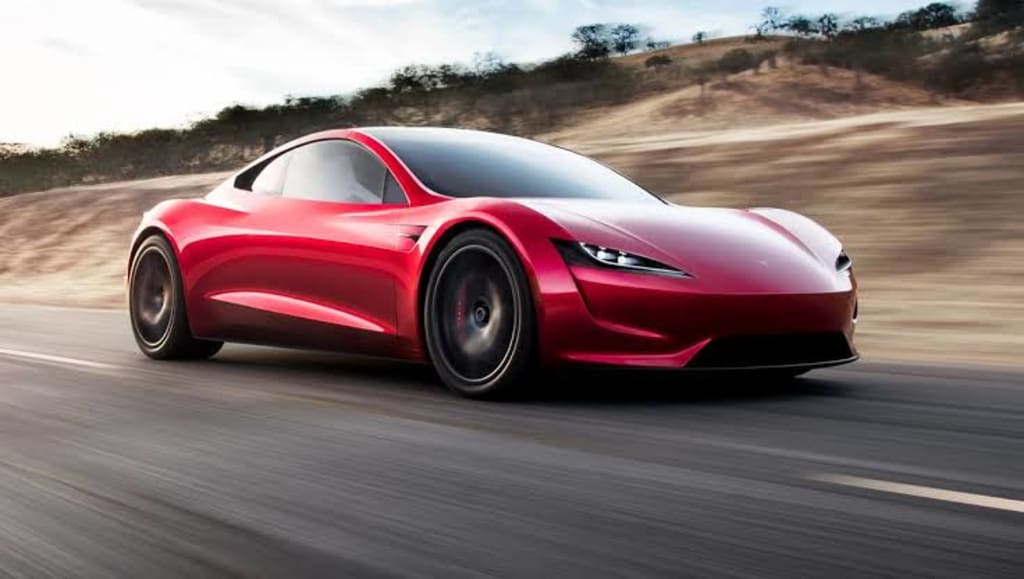
October 15, 2026, McGregor, Texas. At a SpaceX rocket test site, a silver-gray Roadster shot up a giant curved ramp. Underbody fans pinned it to the vertical steel. The car drove upside down for dozens of meters, left the ramp, completed a barrel roll in midair, and landed on four wheels. From hundreds of meters away, the audience saw a driverless sports car move through fog and red laser light in a way that looked edited.
Musk walked onstage and said, "It worked."
The timer stopped at 0.81 seconds. That is the car's 0 to 96 km/h time. Average acceleration: about 3.4 g. Tires on asphalt alone can barely break one second. The Roadster used supersonic air from rear cold-gas thrusters to shave off 0.2 seconds. It also pushed the zero-to-sixty race, a contest more than half a century old, to an endpoint that borders on ridiculous.
Fans, Air Tanks, and Rocket Attitude Control
To see why this car can fly, look at the two systems underneath it.
First: a multi-mode fan suction system. Ground-effect fans in the chassis pull air out from between the car and the road. That creates a pressure difference and directed downforce equal to twice the car's weight. At the event, the system let the Roadster roll and steer on a vertical slope with almost no normal gravity holding it. In corners, it broke the roughly 1.26 g grip limit of conventional tires and pushed lateral acceleration past 2 g. Tesla says it "seems to violate the laws of physics." More accurately: it adds an actively controlled mechanical dimension beyond what tires can do.
Second: the SpaceX cold-gas thruster system, internally called A71. Two carbon-fiber-wrapped high-pressure vessels sit inside the body. Total volume: 600 liters. They store about 250 kilograms of compressed air and feed about 10 nozzles controlled by all-electric actuators. High-pressure gas leaves the nozzles at supersonic speed and produces more than 80 kilonewtons of thrust. No ignition. No exhaust flame. No fuel combustion. Lars Moravy, vice president of engineering, says the carbon-fiber pressure vessels fill almost all usable space inside the car. The tanks refill through the onboard system. No special propellant is needed.
The idea is not new. SpaceX's rocket attitude control units use cold-gas thrusters. On a rocket, they make fine adjustments in vacuum. On the Roadster, they make a two-ton sports car barrel-roll in midair. Same engineering logic, different scale: high-pressure gas creates control in a dimension where traditional mechanical systems cannot reach.
In the demonstration, after the Roadster left the inverted ramp, four hidden nozzles fired high-pressure gas in milliseconds, adjusted its attitude in midair, and then it landed. The demonstration car was remotely controlled. No one was inside. The thrusters are loud enough that the audience had to stand hundreds of meters away. At this stage, the flight capability is a controlled engineering demonstration, not real driving.
What Can Fly Can't Go on the Road. What Can Go on the Road Can't Fly.
The Roadster comes in three versions. Performance: road-legal, active aerodynamics, multi-mode suction, 0 to 96 km/h in under 1.6 seconds. Thrust: rear cold-gas thrusters, under 0.9 seconds, built for the track. Rocket: about 10 thrusters around the body, forward and upward acceleration, lateral rotation, 0 to 96 km/h in under 0.59 seconds, single-seat, invitation only.
What decides this car's fate is not how high it can fly. It is how many places it can fly.
Tesla's product page says the Rocket version has not been approved for public roads. Versions with the thruster system will most likely be illegal on public roads. They are allowed only for demonstrations on closed tracks and test sites. Musk admitted: "I'm not sure it will be legal in every jurisdiction." Reuters reported that it remains unclear whether the car's flight function can be legally used on public roads. The FAA generally treats vehicles that leave the ground as aircraft. Flying vehicles over about 250 pounds must go through FAA approval. Dedicated frameworks exist for eVTOL vehicles, but the Roadster's flight profile (brief lift-off, midair attitude adjustment, non-continuous flight) does not fit any existing regulatory category.
That creates a structural contradiction. The version that can fly cannot legally go on the road. The version that can legally go on the road cannot fly. The Rocket version's flight capability is a technology demonstration inside a closed site, not everyday transportation. Cold-gas thrusters depend on compressed-air tanks. Once the high-pressure gas is spent, it is over. They can sustain only short bursts of lift. Continuous flight is impossible. It is closer to a catapult launch than flight.
This limitation sets the Roadster's market ceiling. A car that cannot show its core difference on public roads has a flight capability that is unusable in most situations. Collectors who pay for a technological spectacle may not care. Anyone expecting a usable supercar gets a constrained engineering prototype first and a car second.
Two Billion Dollars in Revenue, and a Company That Doesn't Make Its Money From It
After the event, independent research firm Battle Road Research estimated that if the Roadster sells 7,000 units in its first year, at an average price of $280,000, it would bring Tesla nearly $2 billion in annualized revenue and raise expected 2027 revenue by about 2%.
That number is not bad. $2 billion in annualized revenue is a tiny share for a company selling a million vehicles a year. But the Roadster's profit margin is different. As a supercar priced between $200,000 and $250,000, with deposits for some versions as high as $250,000, its per-unit gross margin far exceeds the Model 3 or Model Y. This is the profit logic of traditional high-end combustion sports cars: tiny absolute sales, huge margins, and a positive spillover on brand premium.
Two factors discount the estimate.
The first is time. Production is planned for 2028. Nine years have passed since reservations opened in 2017. The car was originally scheduled for 2020. Since then, the timeline has slipped at least six times. Even if production starts on schedule in 2028, it will be eight years later than planned. Tesla's reservation agreement says: "The vehicle is still in development, no delivery time can be promised, and a reservation does not constitute a formal purchase order."
The second factor is more fundamental. In Tesla's current strategy, the Roadster is a technology demonstration platform, not a profit engine. Tesla's strategic focus has shifted. Model S and Model X are discontinued. The freed factory space is being reworked for the Optimus humanoid robot. Musk confirmed at the event that, in the long run, the new Roadster will be the last manually driven car Tesla produces.
That positioning explains the problem. In a company pushing autonomous driving and robotics, a sports car that needs a human driver has strategic value not in sales or profit, but as a technology validation platform. Cold-gas thruster engineering can feed back into SpaceX's rocket attitude control systems. Active control of ground effect through fan suction may influence future industrial equipment. Battery and electronic-control management under extreme acceleration can flow into other product lines. The Roadster matters because it shows what new possibilities appear when Tesla and SpaceX engineering is pushed to its limits.
The Patience for Delays, and a Narrative About Cars
In November 2017, the second-generation Roadster first appeared at the Tesla Semi electric truck event. It promised delivery in 2020, 0 to 96 km/h in 1.9 seconds, 620 miles of range, a starting price of $200,000, and a $50,000 reservation deposit. Nine years later, some of those numbers have been met. Some have been blown past. One, the delivery date, has been pushed into a future that could still move again.
Over those nine years, the Roadster's delays became a story of their own. They drained market patience and turned the name Roadster, in public perception, from Tesla's first car into a symbol of waiting. The original 2008 Roadster used a modified Lotus Elise chassis. It was Tesla's first production car and proved electric cars could be fun to drive. When production ended in 2012, only 2,418 had been delivered. That car established Tesla's DNA. Eighteen years later, Musk positioned the second-generation Roadster as the last launch of a human-driven car. It completes a historical loop: a manually driven, flying car that doesn't need to be driven, closing an era.
The Roadster's significance may extend beyond itself. It proves that a car company's technological boundaries no longer have to be defined by tires, engines, and aerodynamic kits. When a car can actively control ground effect, fire high-pressure gas to adjust its attitude, and drive on a vertical surface, the assumptions behind grip and handling in traditional automotive engineering get shaken. This goes beyond incremental performance improvement. It disturbs the established model.
The cost of that disturbance is clear. The regulatory framework is not ready. Use cases are extremely limited. Production is still far off. The price will deter most people. A flying Roadster in 2026 is an engineering manifesto, not a product roadmap.
Its market prospects depend on the yardstick. If the yardstick is sales and profit, it will be a niche within a niche, with almost no impact on Tesla's financial performance. If the yardstick is control over the technological narrative, who defines the imaginative boundary of the next generation of cars, then the Roadster has already done its job. It turned an image that once existed only in Knight Rider into an engineering demonstration that can be analyzed frame by frame. What that demonstration becomes before 2028, no one can say.
About the Creator
Jin
Writer of reamstories
https://reamstories.com/jin
Enjoyed the story? Support the Creator.
Subscribe for free to receive all their stories in your feed. You could also become a paid subscriber, letting them know you appreciate their work.
Comments
There are no comments for this story
Be the first to respond and start the conversation.